

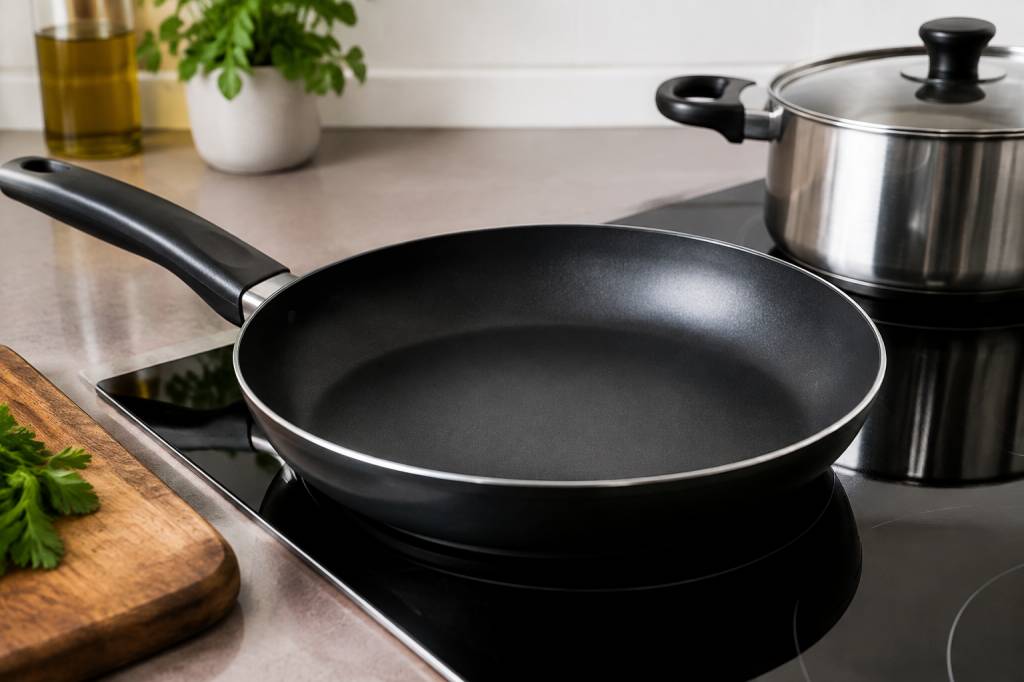
Non-stick cookware is a familiar feature in many kitchens. A quick wipe is often enough to clean a frying pan, and delicate foods such as eggs or fish are less likely to stick. But the smooth coating that makes these pans convenient has also raised an important question: does PTFE cookware contain PFAS, and could it affect human health or the environment?
The short answer is nuanced. PTFE is itself a type of PFAS, but the risks associated with a finished, properly used non-stick pan are not the same as those linked to contaminated drinking water, industrial emissions or exposure to certain smaller PFAS chemicals. Understanding that distinction is essential for making sensible choices without either dismissing legitimate concerns or treating every non-stick pan as an immediate health emergency.
What are PTFE and PFAS?
PFAS, or per- and polyfluoroalkyl substances, are a large family of thousands of manufactured chemicals. They are valued for their resistance to heat, water, oil and chemical reactions. These properties have made PFAS useful in products ranging from firefighting foams and waterproof textiles to food packaging and industrial coatings.
PTFE, short for polytetrafluoroethylene, is a fluoropolymer. It is best known by the brand name Teflon, although not every PTFE product is made under that brand. PTFE has a strong carbon-fluorine structure, which gives it a very low-friction surface and exceptional chemical stability.
That stability explains both its usefulness and its persistence. PTFE does not behave like smaller, mobile PFAS such as PFOA or PFOS. It is a large polymer, designed to remain relatively inert under normal conditions. However, it is still part of the broader PFAS family, and its manufacture has historically involved other fluorinated processing chemicals.
This is where much of the public confusion begins. Saying that a pan is “PFOA-free” does not necessarily mean that it is free from all PFAS. It generally means that PFOA is not intentionally used or present above a stated threshold. A product labelled “PFAS-free” makes a broader claim, but consumers should still check how the manufacturer defines and verifies that statement.
Is PTFE cookware made with PFOA?
PFOA, or perfluorooctanoic acid, was historically used as a processing aid in the production of some fluoropolymer coatings, including PTFE. PFOA has been associated with adverse health effects, including effects on the immune system, cholesterol levels and certain cancers. It is also highly persistent in the environment.
In the United States, major manufacturers phased out PFOA under the Environmental Protection Agency’s PFOA Stewardship Program, with the programme’s targets ending in 2015. In the UK and European Union, PFOA is subject to strict restrictions under chemicals legislation. Modern cookware sold through reputable supply chains should not contain PFOA as an intentionally added ingredient.
However, “PFOA-free” should not be interpreted as “free from all environmental or chemical concerns”. Other processing aids or fluorinated substances may have been used during manufacturing, depending on the product, the date of production and the jurisdiction. The most reliable approach is to seek clear, current information from the manufacturer rather than relying on a single marketing phrase.
Can PFAS leach from a non-stick pan?
Under normal cooking conditions, the PTFE coating on a sound, intact pan is generally considered stable and unlikely to release significant amounts of PFAS into food. PTFE is not water-soluble, and its polymer structure makes it very different from small PFAS molecules that can migrate through water and accumulate in the environment.
Research and regulatory assessments generally distinguish between the finished PTFE coating and the chemicals involved in manufacturing it. A properly made coating is tightly bonded to the cookware surface. This means that ordinary use at moderate temperatures is not expected to produce the same type of exposure associated with PFAS-contaminated drinking water.
That does not mean exposure is impossible in every circumstance. Manufacturing defects, degradation, contamination of raw materials or inappropriate use can alter the situation. In addition, the coating may release particles if it is severely damaged. Current evidence does not establish that swallowing occasional tiny flakes of PTFE coating causes systemic PFAS toxicity, but damaged cookware is still best replaced. There is little benefit in continuing to use a pan that is visibly peeling or losing its surface.
Why overheating matters
The main household concern with PTFE cookware is severe overheating. When an empty pan is left on a high heat setting, its temperature can rise rapidly. At sufficiently high temperatures, the coating begins to degrade and can release fumes. This is sometimes referred to as “Teflon flu”, or polymer fume fever.
Symptoms may include headache, chills, fever, chest tightness and body aches. They are usually temporary, but the experience can be unpleasant and potentially serious for people with respiratory conditions. Birds are particularly sensitive to fumes from overheated fluoropolymers. In some cases, fumes that may cause only mild symptoms in humans can be fatal to pet birds.
Temperature is more important than cooking time. PTFE coatings are commonly intended for use at temperatures well below the point at which significant thermal decomposition occurs. Many experts advise avoiding temperatures above approximately 260°C (500°F), while more substantial degradation can occur at higher temperatures, around 350–400°C and above. Exact thresholds vary according to the coating formulation and cookware design.
In practical terms, never preheat an empty non-stick pan on a high setting. Use low or medium heat, add food or oil before the pan becomes excessively hot, and follow the manufacturer’s instructions. If a pan begins to smoke, turn off the heat, open windows and doors if safe to do so, and leave the area until it has been ventilated. Do not pour water into a severely overheated pan, as this can create burns and damage the cookware.
Are scratches and peeling coatings dangerous?
A scratch does not automatically mean that a pan has become toxic. Small particles of PTFE are generally considered chemically inert if swallowed and are expected to pass through the digestive system. Even so, a scratched or peeling surface is no longer performing as intended and may deteriorate further with continued use.
Damaged cookware can also expose the underlying metal, increasing the risk of uneven heating, sticking or corrosion. If the pan is flaking, blistering or visibly worn, replacement is the sensible option. Avoid scraping the coating with knives or metal utensils, and do not use abrasive cleaning pads.
A practical care routine is straightforward:
- Use wooden, silicone or other utensils recommended by the manufacturer.
- Cook on low to medium heat rather than using maximum heat.
- Do not place an empty pan over a hot hob or under a grill.
- Allow the pan to cool before washing it.
- Clean with mild detergent and a soft sponge.
- Replace cookware when the coating is significantly damaged or peeling.
The environmental issue is larger than one frying pan
For consumers, the immediate question is often whether dinner cooked in a PTFE pan is safe. From an environmental perspective, the bigger concern is the full life cycle of fluorinated chemicals.
PFAS are often called “forever chemicals” because many do not break down easily in the environment. They can move through soil and water, persist for years or decades, and accumulate in organisms. Industrial facilities that manufacture or process fluoropolymers may release PFAS-related substances through air emissions, wastewater or waste disposal if controls are inadequate.
There is also an end-of-life problem. PTFE cookware is not usually accepted in household recycling systems because it combines a coating with a metal base and may require specialist treatment. Throwing it into a recycling bin can contaminate material streams, while sending it to landfill does not eliminate the underlying persistence issue.
Consumers cannot solve the entire PFAS pollution problem through cookware choices alone. Drinking water contamination is more strongly associated with industrial sites, airports, firefighting foam use, waste facilities and some manufacturing activities. Nevertheless, reducing unnecessary demand for persistent chemicals remains part of a wider prevention strategy.
Should you switch to PFAS-free cookware?
For people who want to avoid fluoropolymers altogether, alternatives are available. Stainless steel, cast iron, carbon steel, glass and enamelled cookware do not require a PTFE coating. Ceramic-coated pans are often marketed as PFAS-free, but the term “ceramic” can describe different materials and manufacturing processes. A clear statement from the manufacturer is preferable to vague claims such as “natural” or “non-toxic”.
Each material has advantages and limitations:
- Stainless steel: durable, versatile and resistant to high temperatures, although food may stick without sufficient oil and appropriate preheating.
- Cast iron: long-lasting and suitable for high heat, but heavy and requiring seasoning to maintain its surface.
- Carbon steel: lighter than cast iron and increasingly popular for frying, though it also needs seasoning and care.
- Glass and enamel: useful for particular cooking and baking applications, but vulnerable to thermal shock or impact.
- Ceramic-coated cookware: often free from PTFE, but its non-stick performance may decline over time, especially with high heat and abrasive cleaning.
Switching is not automatically more sustainable if it means replacing usable cookware frequently. The environmental cost of producing and transporting new pans should also be considered. A well-maintained pan that is safe and functional may have a lower overall footprint than several short-lived replacements.
How to read cookware labels more carefully
Marketing language can make chemical information difficult to interpret. “PFOA-free” addresses one specific substance. “PFOS-free” addresses another. Neither phrase confirms that the product contains no other PFAS. “PFAS-free” is broader, but consumers should look for supporting details, such as testing standards, the scope of the claim and whether it applies to the coating, the entire product or the manufacturing process.
If information is unclear, contact the manufacturer and ask specific questions:
- Does the coating contain PTFE or another fluoropolymer?
- Is the product free from intentionally added PFAS?
- Does the claim apply to the complete pan or only to the surface coating?
- What temperature limits and care instructions apply?
- How should the cookware be disposed of at the end of its useful life?
Reputable manufacturers should be able to answer these questions without relying solely on broad environmental slogans.
What the evidence means for everyday cooking
For most households, using an intact PTFE pan at low or medium temperatures, without overheating it, is unlikely to be a major source of PFAS exposure. The strongest practical precautions are simple: do not heat the pan empty, avoid high temperatures, ventilate the kitchen and replace severely damaged cookware.
People who are particularly concerned about persistent chemicals, who cook at very high temperatures, or who want to reduce their reliance on fluorinated materials may prefer stainless steel, cast iron or another PFAS-free option. The choice does not need to be dramatic. A gradual switch as old cookware wears out can reduce waste while still meeting household needs.
PFAS pollution is a complex environmental and public-health issue, and a non-stick frying pan is only one small part of it. The useful distinction is between the stable polymer in a finished product, the potentially hazardous chemicals used in some manufacturing processes, and the emissions created when coatings are seriously overheated. Understanding those differences helps consumers make informed decisions rather than reacting to labels alone.
Sources and further reading
- UK Health Security Agency, information on per- and polyfluoroalkyl substances and human health.
- UK Environment Agency, guidance on PFAS and environmental contamination.
- European Chemicals Agency, regulatory information on PFOA, PFOS and other PFAS.
- United States Environmental Protection Agency, PFAS and the PFOA Stewardship Program.
- Agency for Toxic Substances and Disease Registry, toxicological information on PFAS.