
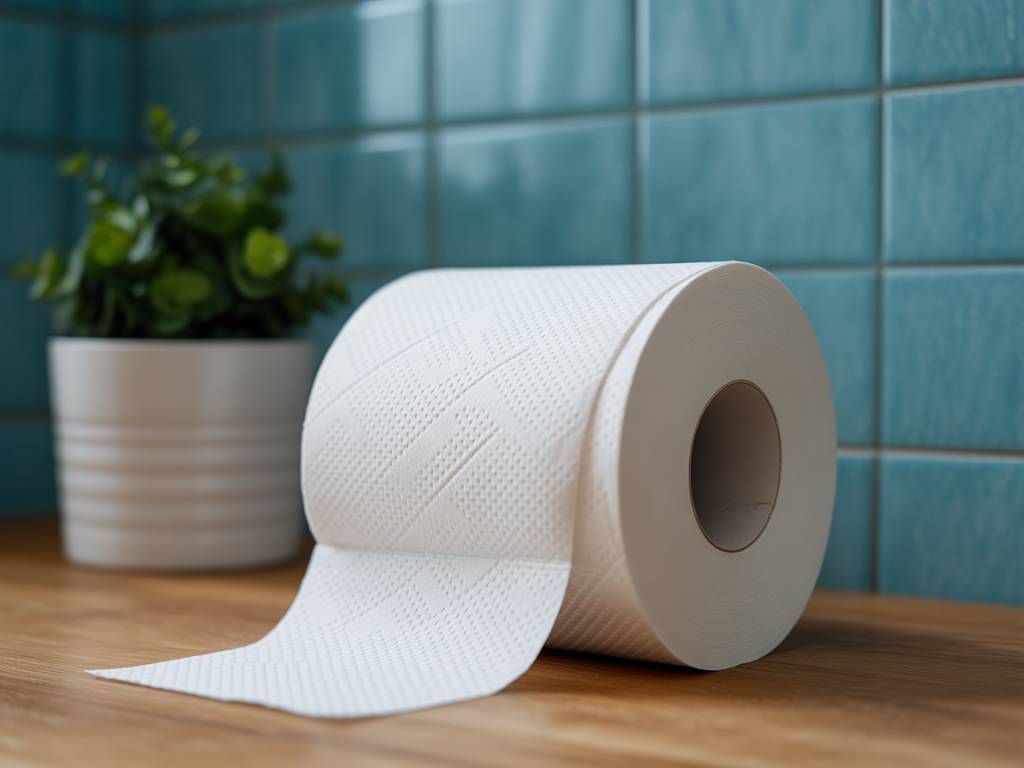
Most people grab toilet paper off the shelf without a second thought. Soft, strong, maybe recycled — done. But a growing body of research has uncovered something unsettling: many mainstream toilet paper brands contain detectable levels of PFAS, including some proudly labelled as « eco-friendly. » Now the shelves are filling up with « PFAS-free » alternatives. The question is whether those claims hold up — and how to tell a genuinely safer product from a greenwash.
Why PFAS end up in toilet paper at all
PFAS — per- and polyfluoroalkyl substances — are a family of over 10,000 synthetic chemicals engineered for one core property: they repel water, grease, and stains. That makes them useful in food packaging, non-stick cookware, waterproof textiles, and firefighting foam. It also makes them relevant to the paper industry.
There are three main routes by which PFAS find their way into toilet paper:
- Intentional use during manufacturing: Some paper mills use PFAS-based additives to improve « wet strength » — the ability of tissue to hold together briefly when damp — or to aid processing on high-speed machinery. Not every mill does this, but the practice exists.
- Contaminated recycled fibres: Recycled paper pulp is a blend of materials that previously lived as food packaging, thermal receipts, treated cardboard, and more. Many of those items contain PFAS. When mixed pulp is reprocessed into tissue, residues can carry through to the finished product.
- Background contamination in process water or equipment: Even mills that stopped using PFAS intentionally may have legacy contamination in machinery, coatings, or water supplies — particularly in regions where PFAS have historically been discharged into groundwater.
The result is that PFAS in toilet paper are rarely a deliberate ingredient — they’re more often an industrial side-effect that most brands never thought to test for, until recently.
What the science actually says about PFAS in toilet paper
Research on this specific topic is still relatively new, but the findings so far are difficult to ignore.
- PFAS are detectable across regions and brands: A landmark 2023 study published in Environmental Science & Technology Letters tested toilet paper samples from North America, Europe, Africa, and South America. Measurable levels of PFAS — including 6:2 fluorotelomer alcohol (6:2 FTOH), a common processing chemical — were found in the vast majority of samples tested.
- Toilet paper contributes to PFAS in wastewater: The same study estimated that toilet paper is a meaningful contributor to PFAS loads entering sewage systems. That matters because wastewater treatment does not fully remove PFAS — they pass through into rivers, and sewage sludge spread on farmland carries them into soil and, eventually, food crops.
- Recycled tissue is not automatically safer: Counterintuitively, some investigations found recycled toilet paper contained PFAS at levels comparable to — or higher than — virgin-fibre tissue. The PFAS-contaminated materials in the recycling stream appear to be the culprit.
- Concentrations are low but persistent: Levels detected are typically in the parts-per-billion or parts-per-trillion range. By weight, that is tiny. But PFAS don’t break down — they accumulate in the environment and in human tissue over time. « Low concentration » and « low concern » are not the same thing.
In terms of direct human exposure, toilet paper likely ranks below contaminated drinking water or food as a source of PFAS. But it does involve repeated, direct contact with sensitive skin and mucous membranes — and it feeds PFAS continuously into the water cycle.
Can toilet paper genuinely be PFAS free?
Here is where the marketing language gets slippery. From an analytical chemistry standpoint, declaring a product « 100% PFAS-free » is nearly impossible to prove — for several honest reasons.
- There are thousands of PFAS compounds: Standard commercial test panels cover a few dozen to a few hundred individual substances. A product could pass testing for the well-known legacy PFAS (like PFOS and PFOA) while still containing newer, less-studied variants.
- Laboratories have detection limits: Below a certain threshold — often in the low parts-per-trillion range — PFAS cannot be reliably detected. A « not detected » result means below the limit, not zero.
- Background contamination is everywhere: After decades of global PFAS use, ultra-trace residues can enter via dust, raw materials, ambient water, or shared supply chains. Complete absence is essentially unverifiable.
In practice, a « PFAS-free » label on toilet paper typically signals one or more of the following:
- The manufacturer does not intentionally add PFAS at any stage of production.
- The product has been tested against a defined panel of PFAS, with each substance reported as « not detected » above agreed thresholds.
- The product has achieved a third-party certification that explicitly restricts PFAS — with published test methods and limits.
That’s not nothing. It means the brand has actively worked to remove PFAS from its formulations and can demonstrate low levels for at least the most studied compounds. Just approach absolute-zero claims with healthy scepticism.
How to spot safer PFAS free toilet paper brands
Because PFAS are not listed as ingredients, you need to read beyond the front label. Here’s what genuinely safer brands tend to have in common — and what should prompt caution.
Positive signals worth looking for
- Specific, honest language around PFAS: Phrases like « no intentionally added PFAS » or « no added PFAS » are more credible than a generic « chemical-free » claim. They acknowledge real-world trace contamination while confirming the brand has actively removed PFAS from its formulations. Look for an explanation of how they verify this — ideally via third-party testing.
- Third-party certifications that explicitly cover PFAS: Not all eco-labels address PFAS — many were developed before the issue gained attention. When evaluating a certification, check the certifier’s own website to confirm their specific PFAS policy, test requirements, and detection limits. Certifications that require regular supply-chain documentation and updated testing carry more weight than one-off assessments.
- Transparent manufacturing details: Brands serious about chemical safety tend to disclose whether their paper uses virgin pulp, recycled fibre, or a mix; their bleaching method (TCF — totally chlorine-free — is considered the cleaner option); and a clear statement that no PFAS-based chemistries are used in their supply chain.
- Published test results with dates: Some forward-thinking brands now share PFAS test summaries directly on their websites. Look for the date of testing (ideally within the past one to two years), a list or reference to which PFAS compounds were screened, and the limit of detection used. Outdated or undated certificates are far less reassuring.
- No unnecessary additives: Fragrances, lotions, and dyes all extend a product’s chemical profile. Their absence simplifies the picture and is generally a good sign that a brand is taking a minimalist approach to formulation.
Red flags that suggest a claim may not hold up
- Vague « natural » or « chemical-free » language with no supporting data: Water is a chemical. Every material is made of chemicals. Brands using this language without specifics are likely relying on feel-good marketing rather than verified testing.
- No disclosure of test methods or certification bodies: If a brand claims PFAS-free status but won’t say who tested, what panel was used, or when, there is no way to evaluate the claim.
- Heavy reliance on « recycled content » as a safety proxy: As discussed above, recycled fibres are not inherently lower in PFAS. Recycled content is worth choosing for sustainability reasons — but don’t assume it means PFAS-safe.
- Certifications that predate PFAS awareness: Some older eco-labels simply don’t address PFAS because they were designed before the issue was on the radar. Holding a vintage certification doesn’t tell you much about PFAS status today.
Practical steps you can take right now
Navigating PFAS-free toilet paper claims doesn’t have to be a full-time research project. A few focused habits help enormously.
- Search the brand’s website for PFAS before buying. Use your browser’s search or type « site:[brandname.com] PFAS » in Google. If the topic doesn’t appear anywhere, that’s telling.
- Email the brand directly and ask. Companies that have done the work tend to answer quickly and specifically. Vague or deflecting responses are a signal.
- Prioritise virgin-pulp tissue from brands with explicit PFAS policies if avoiding PFAS is your main priority — at least until recycled-fibre supply chains are cleaner.
- Check independent testing databases. Organisations such as the Environmental Working Group (EWG) in the US, or CHEM Trust in the UK, periodically publish assessments of consumer products including tissue paper. These can shortcut a lot of individual brand research.
- Reduce overall PFAS exposure from all sources. Toilet paper is one small piece of a much larger picture. Filtering your drinking water for PFAS, avoiding PFAS-treated non-stick cookware, and choosing PFAS-free food packaging where possible will have a far larger impact on your total exposure than toilet paper alone.
The honest answer to « does PFAS-free toilet paper really exist? » is: some brands come meaningfully close, with verified low levels and transparent supply chains. Absolute zero is probably unverifiable with current science. But choosing a brand that actively tests, discloses results, and avoids intentional PFAS use is a genuinely better choice — both for your household and for the waterways downstream.