

For people worried about “forever chemicals,” a PFAS blood test can seem like the most direct way to find out whether exposure has occurred. The test can detect certain per- and polyfluoroalkyl substances in serum and estimate how much is circulating in the body. But what does a result actually tell you—and what can it not tell you?
PFAS blood testing is useful, but it is not a simple pass-or-fail health check. A result may confirm exposure without identifying its source, predicting illness or showing whether a person will develop a specific condition. Understanding the science behind the test is essential before spending money on testing or interpreting a result.
What are PFAS?
PFAS are a large family of synthetic chemicals used since the 1940s in products designed to resist water, oil, grease, stains and heat. The group includes thousands of substances, although only a small number are routinely measured in human blood.
Historically, perfluorooctanoic acid, or PFOA, and perfluorooctanesulfonic acid, or PFOS, were widely used in industrial applications and consumer products. Their manufacture and use have been restricted in many countries, but they remain in the environment because they break down extremely slowly.
Other PFAS, including shorter-chain alternatives and newer replacement chemicals, are still used in some applications. The phrase “forever chemicals” is therefore more than a memorable headline: it reflects the exceptional environmental persistence of many PFAS compounds.
Why do PFAS appear in blood?
People can encounter PFAS through contaminated drinking water, food, indoor dust, consumer products and certain workplaces. Exposure may also occur through food packaging, stain-resistant textiles, treated carpets, firefighting foams and some personal-care products.
Once absorbed, several PFAS bind to proteins in the blood rather than being stored primarily in body fat. They can circulate through the body and are gradually eliminated, mainly through urine and, to a lesser extent, other routes.
Some PFAS remain in the human body for years. PFOS and PFOA are generally associated with longer biological half-lives than many newer compounds. A half-life is the time required for the amount of a chemical in the body to fall by half. It does not mean that the substance disappears completely after one half-life.
This persistence explains why a person may still have detectable PFAS in their blood long after an exposure source has been removed. It also means that a blood test may reflect cumulative exposure over time rather than contact that occurred only recently.
What does a PFAS blood test measure?
A laboratory typically analyses a serum sample for a panel of individual PFAS. Commonly measured compounds include:
- PFOS
- PFOA
- Perfluorohexanesulfonic acid, or PFHxS
- Perfluorononanoic acid, or PFNA
- Perfluoroheptanoic acid, or PFHpA
- Perfluorodecanoic acid, or PFDA
- Perfluorobutanesulfonic acid, or PFBS
The exact panel depends on the laboratory, country and analytical method. A test that measures four compounds cannot rule out exposure to other PFAS. This is an important limitation: “negative” does not necessarily mean that no PFAS are present in the body.
Results are usually reported in nanograms per millilitre, written as ng/mL, or in micrograms per litre, written as µg/L. These units are numerically equivalent: 1 ng/mL equals 1 µg/L.
Testing is generally performed using highly sensitive techniques such as liquid chromatography coupled with tandem mass spectrometry. Reputable laboratories should explain which compounds they measure, their detection limits and the quality-control procedures used.
How is the sample collected?
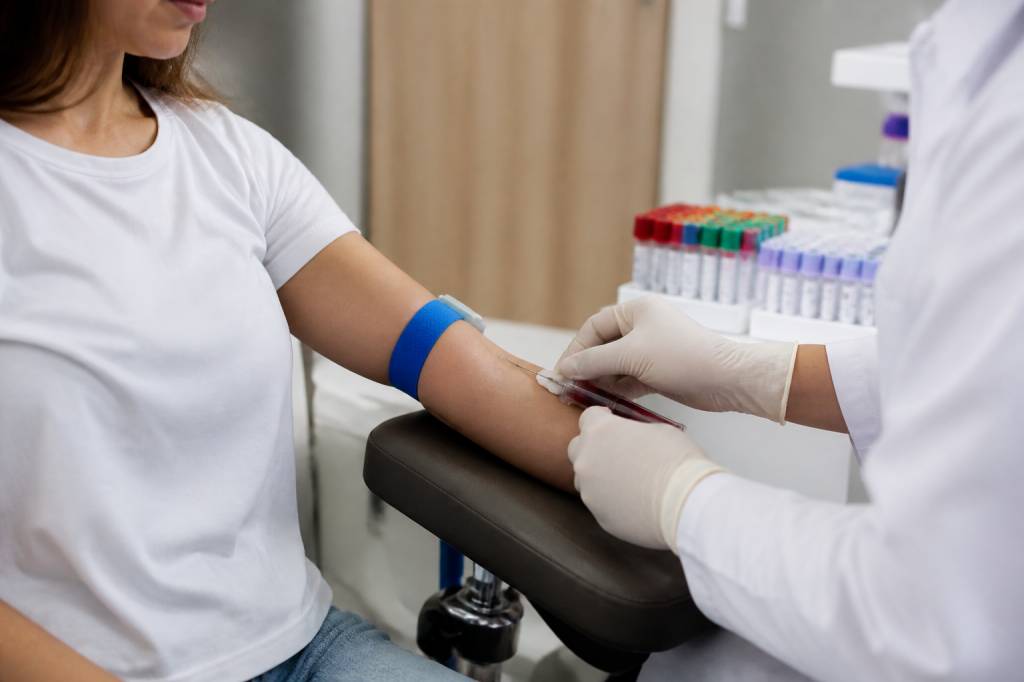
PFAS testing usually requires a blood sample collected by a healthcare professional or an accredited laboratory. Some services offer home collection kits, but the quality and interpretation of these tests can vary considerably.
Before testing, ask the provider:
- Which PFAS compounds are included in the panel?
- Is the laboratory accredited under a recognised quality standard?
- What are the reporting and detection limits?
- Are results reviewed by a clinician or toxicologist?
- How will the laboratory protect the sample from contamination?
There is generally no need to fast unless another blood test is being performed at the same time. However, patients should follow the laboratory’s instructions and provide information about occupational exposure, drinking water, diet and relevant medical history.
How should PFAS blood test results be interpreted?
PFAS results are not interpreted in the same way as a cholesterol or blood glucose result. For most PFAS, there is no universally accepted clinical threshold that separates a “safe” level from a “dangerous” level for an individual patient.
Laboratories may compare results with population data, such as national biomonitoring surveys. In the United States, the Centers for Disease Control and Prevention’s National Health and Nutrition Examination Survey has measured several PFAS in the general population. These data help show whether a result is relatively low or high compared with other people, but they do not provide a personal diagnosis.
A result above the population average means that exposure has been higher than that of many other participants. It does not prove that PFAS caused a particular symptom or disease. Similarly, a result below the population average does not guarantee that there is no health risk.
Interpretation should consider the specific chemical, concentration, age, pregnancy status, exposure history and overall health. Timing also matters. If an exposure source has recently been removed, levels may decline slowly, particularly for PFOS and PFOA.
What health effects are associated with PFAS?
Scientific research has linked exposure to certain PFAS with a range of health outcomes. The strength of evidence varies by chemical, exposure level, age and study design. Much of the evidence comes from epidemiological studies, which identify associations in populations but cannot always prove that PFAS directly caused an individual outcome.
Areas of concern identified by public-health agencies and scientific reviews include:
- Changes in cholesterol levels
- Reduced antibody response to some vaccines
- Effects on liver enzymes and liver function
- Pregnancy-related effects, including reduced birth weight in some studies
- Changes in fertility or reproductive health
- Possible effects on thyroid function
- Possible increased risk of certain cancers, particularly for some well-studied PFAS
The International Agency for Research on Cancer classified PFOA as carcinogenic to humans and PFOS as possibly carcinogenic to humans in 2023. These classifications describe the evidence that a chemical can cause cancer; they do not calculate an individual person’s probability of developing cancer from a particular blood concentration.
Health risk also depends on more than a blood result. Duration of exposure, multiple chemical exposures, genetics, lifestyle and existing medical conditions can all influence health. PFAS should be taken seriously, but a test result should not be treated as a forecast of someone’s future.
Can a blood test identify where exposure came from?
No. A blood test can show that PFAS are present, but it cannot identify whether they came from drinking water, food packaging, dust, consumer products or workplace contact.
Consider a household located near a former industrial site. If several residents have elevated PFOS, contaminated groundwater might be one possible explanation. But investigators would need environmental sampling, exposure questionnaires and information about local sources to establish a likely connection.
Exposure patterns can also be complicated. A person may drink filtered water at home but consume food prepared with contaminated water elsewhere. A worker may have occupational exposure that is not shared by other family members. Blood testing is therefore one piece of evidence, not a chemical detective with a tiny laboratory coat.
Who may consider testing?
People with known or suspected exposure may wish to discuss testing with a healthcare professional or occupational-health specialist. This can include residents in areas with documented drinking-water contamination, workers who handle PFAS-containing materials, and individuals involved in firefighting or the use of aqueous film-forming foam.
Testing may also be considered as part of a research study or public-health investigation. In these settings, results are often combined with environmental measurements and long-term health monitoring, providing more useful information than a standalone commercial test.
For the general population, routine PFAS blood testing is not currently recommended as a universal screening tool by many public-health authorities. The test does not usually change medical treatment, and there is no established therapy that removes PFAS from the body quickly or reliably.
What should you do after receiving an elevated result?
First, avoid panic. An elevated result indicates exposure, not immediate poisoning or a diagnosis. Arrange an appointment with a clinician familiar with environmental or occupational medicine, particularly if the level is substantially higher than population reference values or if there is a known contamination source.
Useful next steps may include:
- Reviewing the full laboratory report and the compounds tested
- Checking local drinking-water quality reports and regulatory notices
- Discussing occupational exposure and protective equipment
- Identifying possible household sources, such as contaminated private wells
- Following standard screening advice for blood pressure, cholesterol and other health measures
- Contacting the relevant environmental or public-health authority if contamination is suspected
Repeat testing is not always necessary. Because many PFAS have long half-lives, a second test taken shortly after the first may show little change. Testing is most useful when it answers a clear question—for example, whether levels decline after a documented exposure source has been removed.
Can filtration reduce PFAS exposure?
Where drinking water is a likely source, certified treatment can reduce exposure. Activated carbon and reverse osmosis systems are among the technologies used for PFAS removal, although performance depends on the specific compound, filter design, water chemistry and maintenance.
Not every water filter labelled “purifying” or “chemical-free” has been independently tested for PFAS. Consumers should look for certification against an appropriate standard, such as NSF/ANSI 53 or NSF/ANSI 58 where applicable, and check the manufacturer’s performance claims for the individual PFAS of concern.
Filter replacement is essential. A carbon filter that is overdue for replacement may become less effective, and poor maintenance can create other water-quality problems. Private well owners should arrange testing through an accredited laboratory if contamination is suspected; boiling water does not remove PFAS.
What PFAS blood testing cannot tell you
A blood test cannot determine the exact date of exposure, identify a single source, establish that PFAS caused a symptom or calculate an individual’s lifetime cancer risk. It also cannot confirm that a person’s drinking water is safe today, because blood concentrations may reflect past exposure.
The most valuable response to an elevated result is usually source reduction, not repeated testing alone. Finding and controlling contaminated water, improving workplace protections and supporting effective regulation can reduce future exposure more meaningfully than watching a number on a laboratory report.
PFAS blood testing can provide important information, especially in communities and workplaces affected by contamination. Used with careful laboratory methods, environmental data and professional medical advice, it helps turn an invisible exposure into measurable evidence. But the result should be viewed as one part of a broader public-health picture—an indicator of exposure, not a verdict on a person’s health.
Reliable sources for further information
- Centers for Disease Control and Prevention (CDC), National Health and Nutrition Examination Survey biomonitoring data
- Agency for Toxic Substances and Disease Registry (ATSDR), toxicological information on PFAS
- United States Environmental Protection Agency (EPA), PFAS drinking-water regulations and health assessments
- World Health Organization (WHO), guidance and reviews concerning PFAS in drinking water
- International Agency for Research on Cancer (IARC), evaluations of PFOA and PFOS