

Why pH Matters in Water Quality
When people assess drinking water, attention often goes straight to visible problems: cloudiness, unusual colour, sediment or an unpleasant smell. Yet one of the most important indicators of water chemistry is invisible. It is measured on a scale from 0 to 14 and known as pH.
pH describes how acidic or alkaline water is. Although the scale looks simple, pH can influence corrosion, taste, the performance of treatment systems and the behaviour of contaminants. For households, water companies and industrial sites, understanding pH is an essential part of responsible water management.
But what does “basic” mean in this context? Is alkaline water automatically healthier? Can a higher pH remove PFAS? The short answer to the last question is no. pH is important, but it is only one part of a much larger water-quality picture.
What Does Basic or Alkaline Water Mean?
The terms basic and alkaline are generally used to describe water with a pH above 7. Water with a pH below 7 is acidic, while water at pH 7 is considered neutral under standard conditions.
The pH scale is logarithmic. This means that a change of one pH unit represents a tenfold change in hydrogen ion concentration. Water with a pH of 6 is not simply “a little more acidic” than water with a pH of 7; it is approximately ten times more acidic. Similarly, water at pH 9 is around one hundred times more alkaline than water at pH 7.
In natural water, pH is influenced by geology, rainfall, soil, plant activity, dissolved minerals and carbon dioxide. Rainwater can absorb carbon dioxide from the atmosphere and form weak carbonic acid. As water moves through rocks, it may dissolve minerals such as calcium carbonate, increasing alkalinity and raising pH.
That is why two water supplies in the same country can have noticeably different chemistry. A groundwater source passing through limestone may be relatively alkaline and hard, while water flowing through areas with granite or peat may be softer and more acidic.
What Is a Typical Drinking-Water pH?
Most drinking water is maintained within a mildly acidic to mildly alkaline range. In the UK, water quality guidance commonly identifies an operational pH range of approximately 6.5 to 9.5 for public water supplies, although the precise requirements and monitoring arrangements depend on the applicable regulations and treatment context.
This range is not intended to suggest that pH alone determines whether water is safe to drink. A sample can have an acceptable pH while containing bacteria, nitrate, lead, PFAS or other contaminants. Conversely, water outside the preferred range may create corrosion or taste problems without necessarily containing a toxic substance.
Water companies monitor pH because it affects the wider treatment process. It helps operators control disinfection, manage mineral balance and reduce the risk of pipes releasing metals. In a household, however, a pH reading should be treated as an indicator rather than a complete health assessment.
Why Very Acidic or Very Alkaline Water Can Be a Problem
Water with a low pH can be corrosive, particularly when it has low alkalinity. Corrosive water may gradually damage plumbing and increase the release of metals such as copper, iron, zinc or lead from older pipes, fittings and solder. A blue-green stain around a tap is often associated with copper corrosion, although staining alone cannot identify the cause with certainty.
Acidic water may also have a metallic or sour taste. In private wells, low pH can be linked to local geology, organic matter or changes in groundwater conditions. Testing is important because adjusting pH without understanding the source can mask a more significant water-quality issue.
Highly alkaline water is less commonly associated with household corrosion, but it can affect taste, leave mineral deposits and interfere with some treatment processes. Extremely high or low pH can irritate the skin, eyes and digestive system, although ordinary variations within the normal drinking-water range are not usually a direct health concern.
The greater practical concern is often what pH does to other substances in the water. Chemistry is interactive. pH can influence whether metals remain dissolved, whether minerals precipitate and how effectively certain treatment chemicals work.
pH, Alkalinity and Hardness: Related but Different
One frequent source of confusion is the assumption that pH, alkalinity and hardness are interchangeable. They are not.
- pH measures the activity of hydrogen ions and indicates whether water is acidic or alkaline.
- Alkalinity describes the water’s ability to neutralise acids. It is mainly associated with bicarbonate, carbonate and hydroxide ions.
- Hardness is primarily determined by dissolved calcium and magnesium.
Water can have a relatively high pH but low alkalinity, meaning its chemistry may still change quickly when acid is added. Another sample may have a near-neutral pH but substantial alkalinity, giving it greater resistance to sudden pH changes.
This distinction matters when selecting treatment equipment. A simple pH test cannot tell you whether a water supply is hard, corrosive or well buffered. For a private well or a treatment system experiencing scale, odour or corrosion, a broader laboratory analysis is usually more useful than relying on a single test strip.
How pH Affects Filtration and Treatment
pH does not work like a filter cartridge. It does not physically remove particles, bacteria or PFAS from water. Instead, it can affect how efficiently other treatment technologies operate.
Some examples include:
- Coagulation and flocculation: Water treatment chemicals work best within specific pH ranges. If the pH is poorly controlled, particles may not bind together effectively and can remain suspended.
- Activated carbon: Carbon is widely used to reduce taste, odour and many organic contaminants. Its performance can be influenced by water chemistry, although the suitability of a carbon filter depends on the specific contaminant and contact time.
- Ion exchange: The charge and form of dissolved substances can change with pH. This may affect competition between contaminants and the treatment medium.
- Membrane filtration: Reverse osmosis and nanofiltration systems can be sensitive to scaling and fouling. Correct pH management may help protect the membrane, but it does not replace proper pre-treatment and maintenance.
- Disinfection: The effectiveness of chlorine-based disinfectants depends partly on pH. As pH rises, the balance between different chlorine species changes, potentially reducing the proportion of the most powerful disinfecting form.
For this reason, professional treatment systems are designed around the complete water analysis. Installing a filter solely because the water has a high or low pH is rarely a reliable solution.
Does Basic Water Remove PFAS?
No. Increasing the pH of water does not make PFAS disappear.
Per- and polyfluoroalkyl substances, or PFAS, are a large group of highly persistent chemicals used in products and industrial applications including firefighting foams, stain-resistant textiles, non-stick materials and some food-contact treatments. Their carbon-fluorine bonds are exceptionally stable, which is one reason they can remain in the environment for years or decades.
PFAS contamination must be assessed through targeted laboratory testing. pH readings, taste and appearance cannot confirm whether PFAS are present. Water containing PFAS may look, smell and taste completely normal.
Some treatment technologies can reduce particular PFAS, especially granular activated carbon, anion exchange resins, reverse osmosis and certain high-pressure membrane systems. However, performance varies according to the PFAS compounds involved, their concentrations, competing organic matter, flow rate, filter age and system design.
A key point for households is that a product marketed as an “alkaline water filter” should not automatically be considered a PFAS treatment system. Alkaline cartridges often add minerals such as calcium or magnesium after filtration. Unless the manufacturer provides independent test data for specific PFAS compounds and defined operating conditions, the product should not be relied upon for PFAS removal.
How Water Filtration Can Change pH
Filtration systems may alter pH depending on the media they contain. Reverse osmosis, for example, removes many dissolved minerals and can produce water with a lower mineral content. After treatment, the water may have a different pH and a reduced buffering capacity.
Some systems include remineralisation stages that add calcium or magnesium to improve taste and stabilise the treated water. Water softeners exchange calcium and magnesium for sodium or potassium, changing the water’s mineral profile but not necessarily removing all contaminants of concern.
Activated carbon generally has a limited direct effect on pH, although the overall result depends on the source water and the design of the cartridge. Acid-neutralising filters, calcite media and chemical dosing systems are specifically used to raise pH when water is corrosive. These systems must be correctly sized and maintained because excessive treatment can create a new imbalance.
A filter’s label may list the contaminants it is designed to reduce, but consumers should also check certification, replacement intervals and operating limits. A device that works well in a laboratory may perform differently when exposed to high sediment levels, variable flow or neglected maintenance.
Testing Basic Water Safely
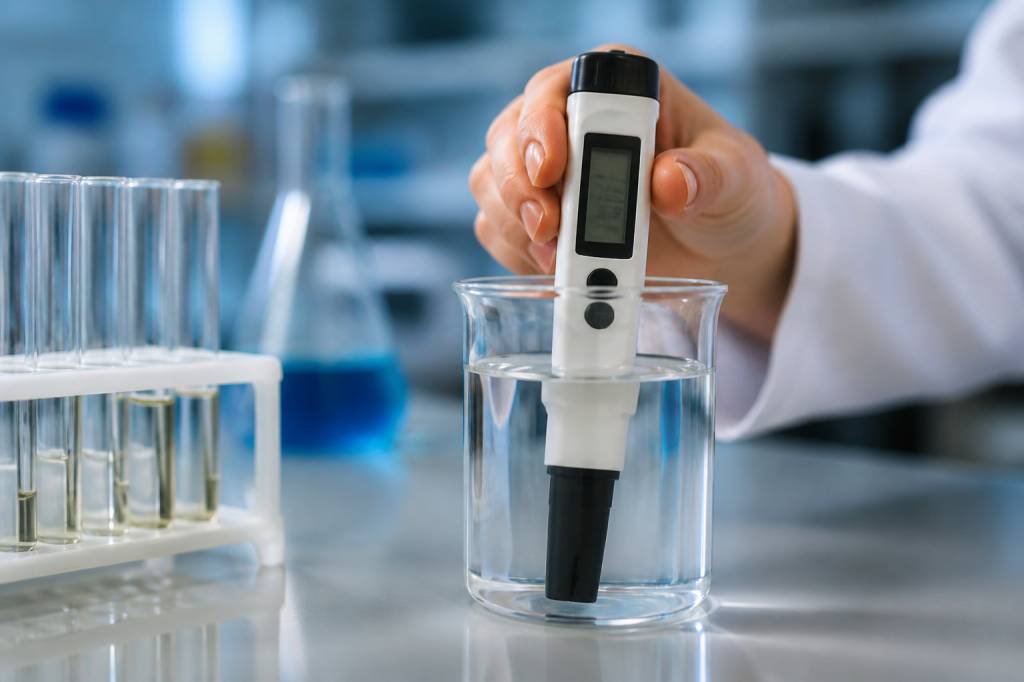
Home pH test strips and digital meters can provide a useful first indication, but they have limitations. Test strips may be difficult to read accurately, while meters require calibration, clean probes and appropriate storage. A single reading can also be misleading if the sample is contaminated by a dirty container or tested after prolonged exposure to air.
For a more dependable assessment:
- Use a clean sample container and follow the laboratory or meter instructions carefully.
- Test cold water from the tap rather than water that has been sitting in a kettle or storage tank.
- Take more than one reading if the result appears unusual.
- Consider laboratory testing for hardness, alkalinity, lead, copper, nitrate, bacteria and PFAS where there is a known or suspected risk.
- Retest after installing or servicing a treatment system.
Private well owners should be particularly cautious. Well chemistry can change after flooding, heavy rainfall, nearby construction, agricultural activity or changes in land use. Local public-health authorities and accredited laboratories can advise on appropriate sampling.
Choosing the Right Filtration Approach
The correct treatment depends on the contaminant and the intended use of the water. If low pH is causing corrosion, an acid-neutralising filter or controlled dosing system may be appropriate. If the problem is hardness, a water softener may help reduce scale. If PFAS are detected, the treatment system should be selected specifically for PFAS reduction and operated according to verified instructions.
There is no universal “best filter”. A point-of-use reverse osmosis system may be suitable for drinking and cooking water, while a whole-house carbon or ion-exchange system may be more appropriate for a broader contamination problem. Each option brings maintenance requirements, water wastage considerations and replacement costs.
Most importantly, treatment should begin with testing. Buying equipment before identifying the problem is an expensive way to guess at water chemistry—and water is not an ideal place for guesswork.
Reading Alkaline-Water Claims with Care
Alkaline water is often marketed with claims about improved hydration, detoxification or protection against disease. These claims frequently go beyond the available evidence. The human body regulates blood pH very tightly through the lungs and kidneys; drinking water does not meaningfully change the pH of the bloodstream in healthy people.
Some consumers enjoy the taste of mineral-rich water, and adequate hydration is important. But these benefits should not be confused with proven protection from PFAS or other chemical contaminants. A higher pH is not a safety certificate.
For environmental health, the more useful questions are practical ones: What is in the source water? Has it been tested? Which treatment technology targets the contaminant? Is the filter certified and maintained? Those questions offer far more protection than a marketing slogan built around the word “alkaline”.
A Small Number with a Larger Meaning
pH is one of the simplest measurements in water science, but its implications can be wide-ranging. It helps explain corrosion, mineral deposits, treatment performance and changes in water taste. It can also provide an early warning that a supply needs closer investigation.
At the same time, pH should never be used as a substitute for contaminant testing. Basic water is not automatically safer water, and adjusting pH will not remove PFAS. Reliable protection comes from understanding the source, testing for relevant hazards and matching the treatment technology to the problem.
When water quality decisions are based on evidence rather than assumptions, even a small reading on a test meter can become part of a much clearer picture—and a safer filtration strategy.