

Fresh fruit is an important part of a healthy diet, but many people still hesitate at the produce aisle: how much pesticide remains on an apple, strawberry or grape? Is rinsing enough? Would soaking fruit in vinegar make it safer?
These are reasonable questions. Pesticides help protect crops from insects, fungi and weeds, yet some residues can remain on the food we buy. The good news is that pesticide regulation, routine testing and simple washing practices can significantly reduce exposure. The less reassuring news is that no washing method removes every chemical, particularly compounds that have penetrated the skin or are naturally present inside the fruit.
Understanding the difference between pesticide hazard and real-world risk is the first step. So is knowing what washing can—and cannot—do.
What does “pesticide residue” mean?
A pesticide is a broad term for a substance used to control pests. It includes insecticides, fungicides, herbicides, rodenticides and plant growth regulators. Farmers may apply these products to crops before harvest, while some treatments are used after harvesting to prevent mould or extend shelf life.
A residue is the small amount of a pesticide, or its breakdown products, that remains on or in food after application. Residues may be found on the surface of fruit, trapped in waxes, or absorbed into the skin and flesh.
Authorities do not simply assume that any detectable residue is unsafe. Regulatory agencies establish a maximum residue level (MRL), sometimes called a maximum residue limit. This is the highest concentration legally permitted in a food when a pesticide has been used according to approved instructions.
MRLs are generally set well below levels expected to cause harm. Risk assessments take into account toxicology studies, dietary exposure, body weight and the fact that people eat a mixture of foods. In the UK, pesticide residues are monitored through the Health and Safety Executive’s Chemicals Regulation Division and the Expert Committee on Pesticide Residues in Food.
However, an MRL is not a guarantee that a fruit contains no pesticide. It is a regulatory threshold based on authorised use. Nor does it mean that every pesticide has the same health profile. Toxicity depends on the chemical, dose, duration of exposure and individual vulnerability.
Which fruits are most likely to carry residues?
Residues are more likely to be detected on fruit with edible skins, uneven surfaces or delicate structures that are difficult to wash thoroughly. Strawberries, grapes, peaches, nectarines, apples and cherries are commonly tested for multiple residues in monitoring programmes.
Soft fruit can be particularly challenging. Its porous surface and many crevices may hold soil, plant material and treatment residues. Berries are also easily damaged by vigorous scrubbing, which creates another route for microbes to enter.
Fruit with a thick, removable skin—such as bananas, oranges, melons and avocados—usually presents less dietary exposure from surface residues. That does not mean the outside is clean. Cutting through an unwashed melon or citrus fruit can transfer bacteria and residues from the skin to the edible portion.
It is also important not to treat lists such as the Environmental Working Group’s “Dirty Dozen” as a measure of danger. Such rankings can be useful prompts to wash produce, but they are not a formal assessment of health risk. A fruit with several detectable residues may still comply with safety standards, and residue detection does not automatically indicate harm.
What are the health concerns?
For most people, the main concern is long-term, low-level exposure to mixtures of chemicals rather than a single dramatic dose. Some pesticides can affect the nervous system, hormone signalling, reproduction or the developing body at sufficiently high exposure levels. Farm workers and people living close to treated fields may face higher exposure than consumers.
Children deserve particular attention because they eat more food relative to their body weight and their organs are still developing. Pregnant people, infants and individuals with certain health conditions may also be more sensitive to some contaminants.
At the same time, avoiding fruit altogether is not a sensible response. Fruit provides fibre, vitamins, minerals and beneficial plant compounds. The dietary benefits of eating a varied diet generally outweigh the risks associated with residues that comply with legal limits. The practical goal is exposure reduction, not fear-driven avoidance.
One further issue is the combined presence of many chemicals. Food monitoring frequently finds more than one residue on a sample, although each individual residue may be below its MRL. Scientists continue to study how mixtures behave and whether current risk assessment methods fully capture cumulative effects.
Can pesticides enter the fruit?
Yes. The location of a residue depends partly on the pesticide’s properties and how it is applied.
- Contact pesticides remain mainly on the plant’s surface. Washing and peeling can often reduce these residues.
- Systemic pesticides are absorbed and transported within the plant. Washing the outside may remove little of the chemical that has moved into the skin or flesh.
- Fungicides and wax-associated treatments may cling to the surface, especially when fruit has a natural or added wax coating.
- Post-harvest treatments can be applied during storage or packing, meaning that residues are not always linked to what happened in the field.
Washing remains worthwhile, but it should be viewed as a reduction method—not a chemical eraser.
The safest way to wash fruit
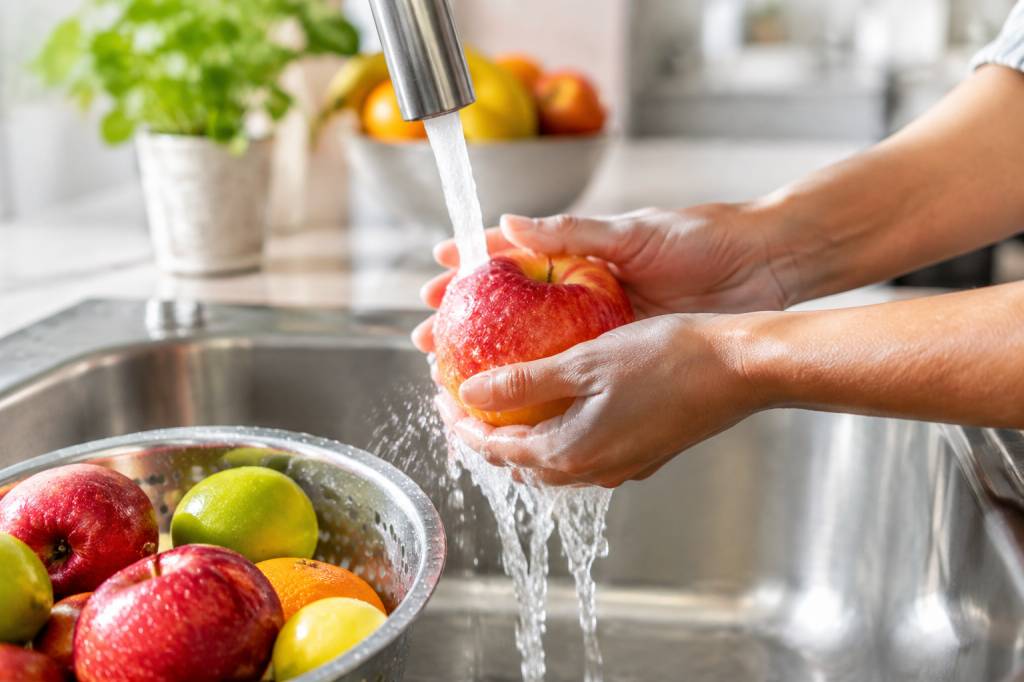
The most reliable household method is straightforward: wash fruit under cool or lukewarm running tap water before eating, cutting or peeling it. The Food Standards Agency and the US Food and Drug Administration both recommend this basic approach.
- Wash your hands with soap and water before handling produce.
- Remove damaged or bruised areas, where microorganisms may multiply more easily.
- Place fruit under running water and rub the surface gently with clean fingers.
- For firm fruit such as apples, pears, melons and citrus, use a clean produce brush. Do not use the same brush for raw meat or dirty kitchen surfaces.
- Rinse fruit before peeling it. Otherwise, a knife can transfer contaminants from the skin to the flesh.
- Dry produce with a clean paper towel or cloth where practical. Drying can remove additional surface material and reduces moisture that supports microbial growth.
- Refrigerate cut fruit promptly and keep it separate from raw meat, poultry and seafood.
Running water creates friction and carries away dirt, microbes and some surface residues. A short rinse is better than none, but a few seconds of gentle rubbing is more useful than simply placing fruit under the tap without touching it.
Are vinegar, salt and baking soda better?
Many online cleaning recipes promise a “chemical-free” fruit wash. The evidence is more limited than the marketing suggests.
Vinegar may reduce some bacteria because of its acidity, but it is not a universal disinfectant and does not reliably remove all pesticide residues. It can also leave an unpleasant taste and may damage delicate berries.
Salt water may help loosen some surface material, but there is no strong evidence that a household salt soak consistently removes a broad range of pesticides better than rinsing.
Baking soda has shown some ability to remove certain surface pesticides in laboratory or controlled washing studies. One frequently cited study published in the Journal of Agricultural and Food Chemistry found that a baking soda solution was more effective than tap water for removing two surface pesticides from apples. However, the researchers also noted that pesticides that had penetrated the skin were not completely removed. The study did not prove that baking soda is superior for every fruit or every pesticide.
If you choose to use baking soda, rinse the fruit thoroughly afterwards. Do not assume that a longer soak is automatically safer. Extended soaking can soften fruit, reduce quality and potentially spread contamination through shared water.
Why soap and commercial produce washes are not recommended
Fruit may look similar to a plate, but it is not designed to be washed with dish soap. Detergents can leave residues and may cause nausea, stomach irritation or diarrhoea if swallowed. Fruit and vegetable surfaces can also absorb cleaning products through pores or small cracks.
Commercial produce washes are not necessarily more effective than clean running water. Some are based on acids or surfactants, but independent evidence varies. Unless a product is specifically approved for food use and used exactly as directed, it is better left on the supermarket shelf.
Bleach, disinfectant, alcohol and household cleaning sprays should never be used on food. Washing produce should reduce risk, not replace one contaminant with another.
What about organic fruit?
Organic farming restricts which pesticides can be used, but “organic” does not mean pesticide-free. Organic growers may use naturally derived substances, minerals or approved synthetic products. These can still leave residues, and “natural” does not automatically mean harmless.
Organic and conventional fruit can both be nutritious choices. The most effective routine is to wash either type before eating. If buying organic fruit helps someone eat more produce or supports farming practices they value, it can be a reasonable personal choice—but it is not a substitute for hygiene.
The water quality question
Washing fruit is only as sensible as the water used to wash it. In the UK, public drinking water is subject to extensive quality controls, but private wells and poorly maintained plumbing may require additional attention. Water that is not safe to drink should not be used to rinse food.
This matters in discussions about PFAS, or per- and polyfluoroalkyl substances. PFAS can be present in contaminated groundwater and surface water, and they are extremely persistent. Standard household washing is not a dependable way to remove PFAS from fruit once the compounds are present in water or have entered the produce.
Activated carbon and reverse osmosis systems can reduce certain PFAS when properly selected, installed and maintained. Performance depends on the specific filter, flow rate, water chemistry and replacement schedule. A filter should never be chosen solely because its packaging says “purifies” or “removes chemicals”; look for independent certification and test data.
For households using private water supplies, regular testing is especially important. If PFAS contamination is suspected, contact the relevant local authority or water provider and follow official advice rather than relying on a homemade fruit-washing solution.
Reducing exposure beyond the kitchen sink
Washing is one useful step, but food safety also depends on how fruit is grown, transported and handled. Consumers can reduce unnecessary exposure by choosing a varied diet, eating seasonal produce where practical, trimming damaged areas and following storage guidance.
At a wider level, meaningful progress depends on stronger monitoring, safer pest-management strategies and reduced reliance on persistent chemicals. Integrated pest management—using crop rotation, biological controls, resistant plant varieties and targeted treatments—can reduce pesticide use while protecting yields.
Researchers are also developing coatings, sensors and filtration technologies that may improve residue detection and food safety. These innovations are valuable, but they should complement—not replace—careful regulation and transparent testing.
A practical routine for everyday fruit
For most households, the message is simple: wash your hands, rinse fruit under running water, rub or brush firm surfaces, dry it, and refrigerate cut produce. Peel when appropriate, but do not assume peeling removes every chemical or makes washing unnecessary.
There is no need to scrub strawberries until they surrender or soak apples in a complicated kitchen “detox” mixture. Clean water, gentle friction and sensible food hygiene remain the most evidence-based approach. The objective is not perfect removal—it is a realistic reduction in avoidable exposure while keeping fruit firmly on the menu.
Reliable sources for further reading
- UK Health and Safety Executive: Pesticide residues in food
- UK Food Standards Agency: Washing fruit and vegetables
- US Food and Drug Administration: Tips for cleaning fruits and vegetables
- Journal of Agricultural and Food Chemistry: Baking soda washing study
- US Environmental Protection Agency: PFAS information