

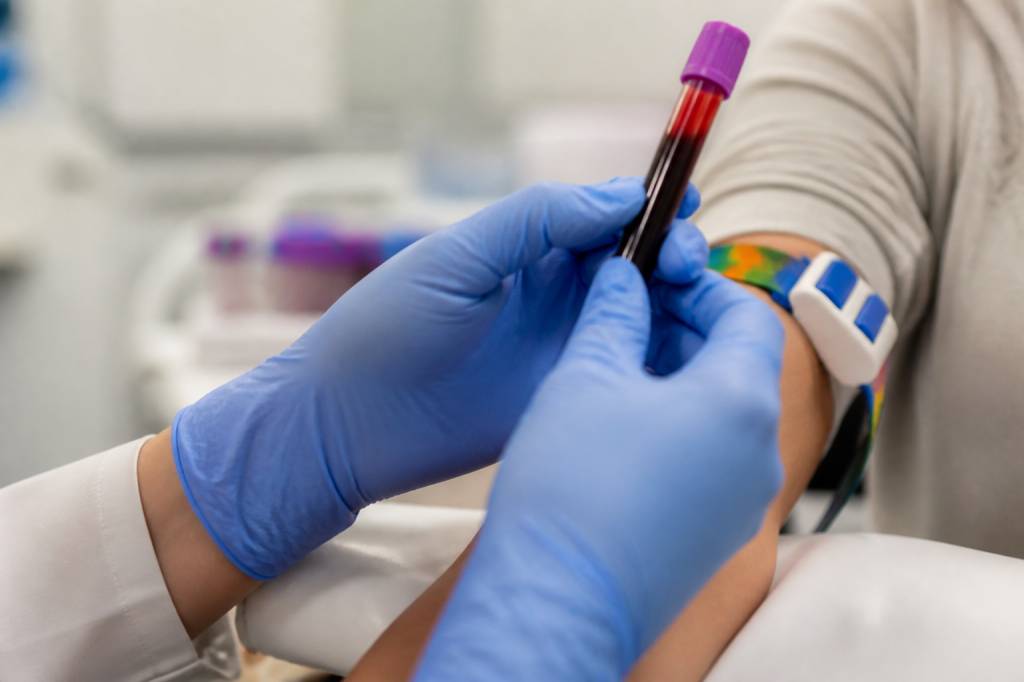
A blood test can reveal that PFAS have entered the body. It cannot, however, tell someone exactly where the chemicals came from, whether they will develop an illness, or how quickly their levels will fall. That distinction matters.
“Forever chemicals” is the informal name for per- and polyfluoroalkyl substances (PFAS), a large family of synthetic chemicals used in products designed to resist water, oil, stains and heat. Once absorbed, some PFAS can remain in the body for years. A blood test provides a snapshot of this internal exposure—but interpreting that snapshot requires context.
For people concerned about contaminated drinking water, food packaging, firefighting foam or occupational exposure, PFAS blood testing can be useful. It can confirm that exposure has occurred and may help identify higher-than-average levels within a community. But it is not a routine health screening test, and the result should be discussed with a qualified healthcare professional.
What a PFAS blood test actually measures
A laboratory blood test measures the concentration of specific PFAS in serum, the liquid component of blood. Depending on the laboratory, the panel may include several compounds, such as:
- Perfluorooctanoic acid (PFOA)
- Perfluorooctanesulfonic acid (PFOS)
- Perfluorohexanesulfonic acid (PFHxS)
- Perfluorononanoic acid (PFNA)
- Perfluorodecanoic acid (PFDA)
- Hexafluoropropylene oxide dimer acid (HFPO-DA), often associated with the trade name GenX
Results are usually reported in nanograms per millilitre (ng/mL), also written as micrograms per litre (µg/L). These units are numerically equivalent: 1 ng/mL equals 1 µg/L.
The test does not measure every PFAS in the blood. Thousands of PFAS have been identified, but analytical methods generally target a limited selection. Some newer or short-chain compounds may not be included in a standard panel. A “negative” result therefore means that the tested substances were below the laboratory’s reporting threshold—not that the person has never encountered any PFAS.
Why PFAS can remain in the bloodstream
PFAS behave differently from many other environmental chemicals. They are highly resistant to heat, water and chemical breakdown, which is useful in manufacturing but problematic once they enter the environment.
Several long-chain PFAS bind to proteins in the blood and accumulate in organs such as the liver and kidneys. The body eliminates them primarily through urine, but the process can be slow. Estimated biological half-lives vary by compound and by individual. In broad terms, PFOA, PFOS and PFHxS may remain in the human body for several years, although reported estimates differ between studies.
A half-life is the time needed for the amount of a substance in the body to decrease by half. It does not mean that the chemical disappears after one half-life. If a person has a PFOS level of 20 ng/mL and no further exposure occurs, the level might eventually fall to approximately 10 ng/mL after one half-life, then 5 ng/mL after another. This is an approximation, not a personal forecast.
Age, sex, pregnancy, kidney function, breastfeeding, diet and ongoing exposure can all influence blood concentrations. People may also absorb PFAS from several routes at the same time, making a single source difficult to identify.
How to read the numbers
One of the most important points is that PFAS blood results do not have a universally accepted “safe” or “unsafe” cut-off for individuals. A higher concentration generally indicates greater exposure, but the result does not predict whether a specific person will become ill.
Laboratories may provide a reference range based on values observed in a population. This is not the same as a health-based threshold. A reference range tells you how a result compares with other tested people; it does not establish that values below the range are harmless.
For perspective, population monitoring programmes have detected PFOA and PFOS in the blood of most people tested in the United States, although average concentrations have fallen substantially since some uses were phased out. The US Centers for Disease Control and Prevention’s National Health and Nutrition Examination Survey (NHANES) has tracked these trends for many years.
In the United Kingdom and Europe, exposure levels vary according to location, age group, diet and historical industrial activity. A result may be described as “elevated” compared with a local or national population, but that comparison still needs careful interpretation. The most useful question is often not “Is this number dangerous?” but “What exposure pattern might have produced it, and can that exposure be reduced?”
What a result can—and cannot—tell you
A PFAS blood test may help to:
- Confirm that a person has been exposed to one or more measurable PFAS.
- Compare exposure levels between individuals or communities.
- Support investigations near contaminated drinking-water supplies, industrial sites or airports.
- Provide a baseline for future monitoring if exposure is reduced.
It cannot reliably:
- Identify the exact source of exposure.
- Determine when exposure occurred.
- Predict whether someone will develop cancer, thyroid disease or another health condition.
- Show whether a particular symptom is caused by PFAS.
- Prove that a water supply, food product or household item is responsible.
This is where PFAS testing is sometimes misunderstood. A blood result is evidence of exposure, not a diagnosis. It should not be used to replace medical assessment, water testing or an investigation of environmental sources.
What health research says about PFAS exposure
Research has associated exposure to certain PFAS with several health effects. Evidence is strongest for associations involving higher cholesterol levels, reduced antibody response to some vaccines, changes in liver enzymes, pregnancy-related effects and reduced birth weight. Studies have also examined links with thyroid function, kidney and testicular cancer, and other outcomes.
Associations do not prove that PFAS caused an individual health problem. Many studies are observational, meaning researchers measure exposure and health outcomes without controlling every possible factor. People with higher PFAS levels may also differ in occupation, diet, income, location or exposure to other pollutants.
Even so, the evidence is significant enough that major scientific and public-health agencies continue to recommend reducing avoidable exposure. The International Agency for Research on Cancer has classified PFOA as carcinogenic to humans and PFOS as possibly carcinogenic to humans, based on its evaluation of the available evidence. Regulatory decisions increasingly reflect concern about the combined presence of multiple PFAS rather than focusing on one chemical at a time.
A blood test cannot translate these population-level findings into a personal risk percentage. That calculation is not currently possible. It is better viewed as one piece of evidence in a broader assessment.
Who might consider testing?
Routine PFAS blood testing is not recommended for everyone. Testing may be worth discussing with a healthcare professional when there is a known or suspected source of significant exposure, including:
- Long-term consumption of drinking water affected by PFAS contamination.
- Employment in industries that manufacture or use PFAS-containing materials.
- Work involving aqueous film-forming foam, particularly firefighting or emergency response.
- Residence near an industrial facility, airport, military base, landfill or training site where PFAS have been used.
- Participation in a public-health study or occupational monitoring programme.
People who are pregnant, breastfeeding, immunocompromised or managing kidney disease may wish to raise concerns with their clinician. This does not mean that testing will change medical treatment, but it can help guide a discussion about reducing exposure and monitoring general health.
For most people, the first practical step is not ordering a private blood test. It is finding out whether local drinking water has been tested and whether official environmental information is available.
Important limitations of private testing
Private PFAS blood tests are increasingly available, but quality and interpretation can vary. Before ordering a test, check whether the laboratory:
- Is accredited to an appropriate clinical or analytical standard.
- Uses a validated method such as liquid chromatography-tandem mass spectrometry.
- Clearly lists the PFAS included in the panel.
- Reports detection limits and quality-control information.
- Explains how results will be interpreted by a healthcare professional.
A broad-sounding package may still test only a small number of compounds. Conversely, a result containing many decimal places can create a false impression of precision if the health meaning of the number is uncertain.
Timing also matters. A test taken shortly after a single exposure may not capture the full picture, while an elevated result can reflect exposure that occurred months or years earlier. Repeating the test is not always useful unless there is a clear reason, such as a documented change in exposure or participation in a structured monitoring programme.
How exposure can be reduced
When a blood test indicates PFAS exposure, the sensible response is to investigate likely sources rather than panic. If contaminated drinking water is suspected, contact the local water supplier, environmental health department or relevant regulator. Home water testing can be useful, but samples should be collected and analysed by a competent laboratory using an appropriate method.
Certified treatment technologies can reduce certain PFAS in drinking water. Granular activated carbon, reverse osmosis and some ion-exchange systems may be effective, but performance depends on the specific chemicals, water chemistry, filter condition and maintenance schedule.
Consumers should look for independent certification and clear claims about PFAS reduction. A basic jug filter is not automatically suitable. Filters also have a finite capacity: once saturated, they may become less effective, which makes timely replacement essential.
Other sensible measures include:
- Following local advice during a confirmed water contamination event.
- Using alternative drinking and cooking water if authorities issue that guidance.
- Avoiding damaged or heavily worn stain-resistant products where practical.
- Reducing unnecessary use of grease-resistant food packaging.
- Following workplace safety procedures and using protective equipment correctly.
- Keeping household dust under control through regular cleaning and handwashing.
Boiling water does not remove PFAS. In fact, because water evaporates while the chemicals remain, boiling may slightly increase their concentration. It is an old-fashioned solution to a modern contaminant—and not the right tool for this job.
What to do after receiving a result
Ask the laboratory or clinician to explain which PFAS were detected, the units used, the reporting limits and how the values compare with relevant population data. Keep a record of the result, possible exposure sources, occupations, location history and any available water-quality reports.
Do not attempt to “detox” PFAS with unproven supplements, extreme diets or aggressive cleansing programmes. There is no medically established treatment that rapidly removes PFAS from the body. Phlebotomy, blood donation or plasma donation should not be undertaken as a PFAS treatment unless advised for an unrelated, legitimate medical reason.
The most effective long-term strategy is to stop or reduce continuing exposure. Over time, the body can eliminate some PFAS naturally, although the process may be slow. Healthcare professionals can address recognised risk factors—such as cholesterol, blood pressure, thyroid concerns or kidney health—using standard medical care.
Why better monitoring still matters
Individual blood tests can be informative, but population monitoring is even more valuable. When many people are tested using consistent methods, researchers can identify trends, compare communities and assess whether regulations are reducing exposure.
PFAS contamination rarely respects property boundaries. It can move through groundwater, rivers, wastewater systems, food chains and household dust. Blood testing therefore works best alongside environmental sampling, transparent public reporting and effective controls on industrial releases.
For anyone concerned about a result, the key message is straightforward: a PFAS blood test reveals exposure, not destiny. It can prompt better questions about drinking water, workplace conditions and consumer products—but it cannot provide a simple prediction about future health. Reliable interpretation, practical exposure reduction and evidence-based medical care are the most useful next steps.