

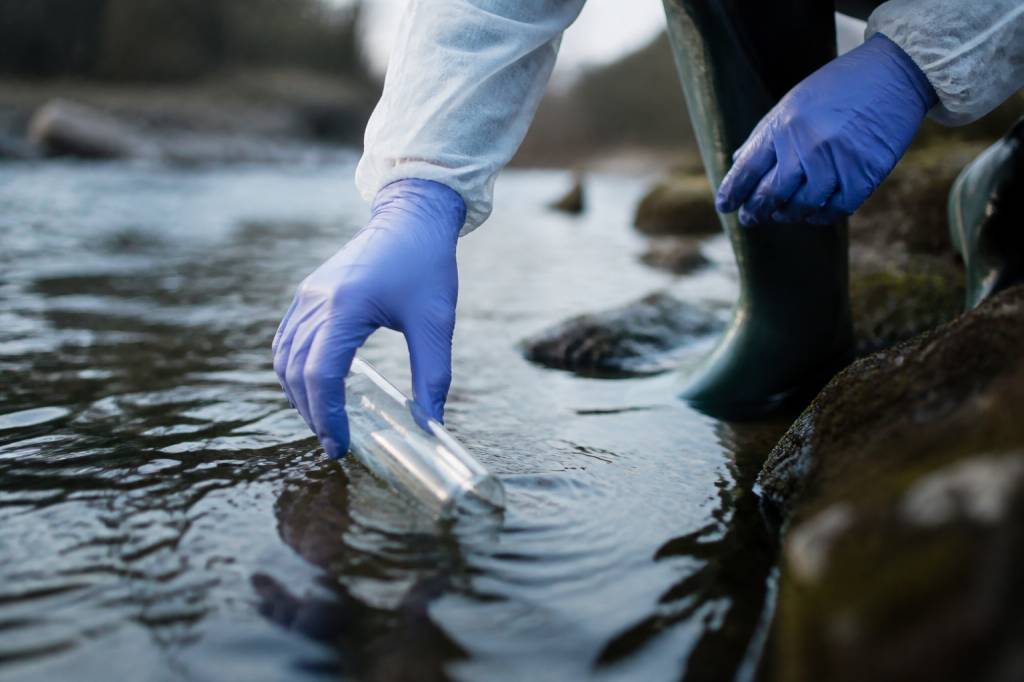
PFAS contamination in Scotland is no longer a distant or purely industrial concern. These highly persistent chemicals have been detected across the wider UK environment, including in areas affected by airports, fire-training sites, landfills, wastewater, manufacturing and the historic use of firefighting foams.
For most people, the immediate risk from Scottish tap water is expected to be low because public water supplies are treated and monitored. However, PFAS are often described as “forever chemicals” for a reason: they resist natural degradation, can move through soil and water, and may remain in the environment for decades. Their persistence makes prevention, monitoring and clean-up particularly important.
So what is known about PFAS in Scotland? Where are contamination concerns most likely to arise, what are the potential health effects, and how does Scottish regulation protect drinking water?
What are PFAS?
Per- and polyfluoroalkyl substances, commonly abbreviated to PFAS, are a large family of synthetic chemicals. Their carbon–fluorine bonds are exceptionally strong, giving PFAS properties such as resistance to heat, oil, water and chemical reactions.
These characteristics made PFAS useful in many products and industrial applications, including:
- Firefighting foams used at airports, military facilities and industrial sites
- Non-stick cookware and stain-resistant treatments
- Waterproof clothing, carpets and upholstery
- Food packaging and grease-resistant paper
- Industrial processes, electronics and surface coatings
PFOS and PFOA are among the best-known PFAS. Their production and use have been restricted or phased out in many countries, but older contamination can remain. Thousands of other PFAS exist, and replacing one compound with another does not automatically remove the environmental problem. Some short-chain alternatives may move more easily through water, while many newer substances have been studied far less extensively.
How PFAS enter Scottish water
PFAS can reach rivers, groundwater and drinking-water sources through several pathways. The most significant risks are generally localised rather than evenly distributed across Scotland.
Firefighting foam is one of the clearest examples. For decades, aqueous film-forming foams containing PFAS were used to extinguish fuel fires. Repeated training exercises could release foam onto surrounding land. Rain then carried PFAS into drainage systems, streams and groundwater. Airports and military sites are therefore important locations for investigation.
Scotland’s industrial history also matters. Manufacturing, textiles, metal finishing, waste management and other activities may have used PFAS-containing products. Landfill sites can receive consumer goods and industrial waste containing these chemicals. Leachate from landfill may transport PFAS into wastewater systems or nearby water bodies if it is not effectively captured and treated.
Wastewater treatment plants are not designed specifically to destroy PFAS. Conventional treatment may transfer PFAS from water into sludge rather than eliminate them. This means contamination can potentially move between wastewater, biosolids, soils and surface waters.
Urban runoff is another pathway. PFAS-containing materials gradually shed chemicals as they weather. Rainwater can wash residues from roads, buildings, industrial estates and treated surfaces into drainage networks.
A useful point is often missed: a polluted river does not automatically mean that nearby tap water is unsafe. Scottish public water supplies may draw from different catchments, use multiple treatment barriers and undergo routine quality checks. The source, concentration, treatment process and exposure route all matter.
Where are PFAS concerns most relevant in Scotland?
Potential hotspots include areas close to airports, former military bases, fire-training grounds, major industrial facilities, landfill sites and locations where contaminated land has been identified.
Scotland’s geography adds complexity. Many communities rely on upland catchments, lochs, rivers or groundwater. Private water supplies are particularly important in rural areas, where households may obtain water from springs, wells, boreholes or surface sources. These supplies can be more vulnerable to local contamination and may not receive the same centralised treatment as a public supply.
Private supply owners should not wait for concern to become a crisis. If a property is near a suspected source of PFAS, testing should be discussed with the local authority or an appropriately accredited laboratory. A general water test will not necessarily include PFAS; the laboratory must use a method designed to detect the relevant compounds at very low concentrations.
It is also important to distinguish evidence from speculation. The presence of a potential source does not prove that a drinking-water supply is contaminated. Equally, the absence of reported contamination does not prove that PFAS are absent. Sampling design, laboratory detection limits and the choice of PFAS included in the analysis all influence the result.
What does the science say about health risks?
People can be exposed to PFAS through food, indoor dust, consumer products and drinking water. Drinking water may become a more important exposure pathway when contamination levels are high or when a community relies on a polluted source over a long period.
Research has linked exposure to certain well-studied PFAS with several potential health effects. Evidence is strongest for associations involving:
- Reduced antibody response following some vaccinations
- Changes in cholesterol levels
- Small reductions in birth weight
- Effects on liver function and metabolism
- Pregnancy-related effects, including possible impacts on hypertensive disorders
- Kidney and testicular cancer for certain compounds, particularly PFOA, based on evaluations by international health agencies
These findings require careful interpretation. A statistical association in a population study does not mean that every exposed person will develop an illness. Risk depends on the specific PFAS, dose, duration, age, existing health conditions and combined exposure to other chemicals.
PFAS can also remain in the human body for years. The half-life varies considerably between compounds, but PFOS and PFOA are known to persist in blood for prolonged periods. This is one reason scientists and regulators focus on reducing exposure across the population, rather than considering only short-term peaks.
There is no reliable way to judge PFAS exposure by taste, smell or appearance. A clear glass of water can contain contaminants that are completely invisible. That is unsettling, but it is also why professional monitoring matters more than household guesswork.
How Scottish drinking water is regulated
Drinking-water regulation in Scotland is based on a precautionary, risk-based system. The Drinking Water Quality Regulator for Scotland, known as DWQR, independently monitors the performance of Scottish Water and reports on the quality of public drinking water.
Scottish Water is responsible for collecting, treating and supplying water through the public network. It operates treatment works and sampling programmes designed to identify chemical, microbiological and physical risks. Local authorities have important responsibilities for private water supplies, including regulatory oversight and risk assessment.
PFAS regulation is developing across the UK and internationally. Unlike a simple rule covering every PFAS compound, current frameworks often use a combination of limits or guideline values for specific substances, groups of substances and broader risk assessments. The exact legal requirement depends on the relevant Scottish regulations, the type of supply and the substance being assessed.
Several points are especially important:
- PFOS and PFOA have been subject to strict restrictions under international and UK chemicals legislation.
- Environmental standards may apply to surface waters or groundwater, while drinking-water requirements address water intended for human consumption.
- A numerical value for one PFAS should not be interpreted as a guarantee that all other PFAS are harmless.
- Regulatory limits can change as toxicological evidence and analytical methods improve.
Scotland also operates within broader UK and international commitments on persistent organic pollutants. The Stockholm Convention, for example, has driven global restrictions on PFOS, PFOA and related substances. The UK’s regulatory position is separate from the European Union’s, but scientific developments and EU drinking-water standards remain relevant reference points.
For the most current legal thresholds, residents and water professionals should consult DWQR, the Scottish Environment Protection Agency, Scottish Water and the Scottish Government rather than relying on an old internet table. PFAS policy is moving quickly, and yesterday’s guidance may not reflect today’s position.
Monitoring is essential, but testing has limits
PFAS analysis is technically demanding. Concentrations can be extremely low, samples can be contaminated during collection, and different laboratories may test for different lists of compounds. A result reported as “PFAS not detected” means that the chemicals included in the test were below the laboratory’s reporting limit. It does not mean that every PFAS is absent.
Modern laboratories may use liquid chromatography combined with tandem mass spectrometry to measure individual PFAS. However, targeted methods typically cover only a selection of the thousands of known substances. Non-targeted analysis can identify additional chemical signals, but it is more complex and does not always provide a definitive concentration for every compound.
Long-term monitoring should therefore consider more than a single sample. Seasonal changes, rainfall, groundwater movement and operational events can influence results. A robust investigation may include sampling at the suspected source, along the transport pathway, at the treatment works and at the point of use.
What can households do?
People connected to the public water network should follow advice from Scottish Water or their local authority. If a contamination incident is confirmed, official notices will specify whether to avoid drinking the water, use bottled water temporarily or take other measures.
For private supplies, practical steps include:
- Registering the supply with the relevant local authority where required
- Keeping records of the source, treatment equipment and previous test results
- Investigating nearby airports, fire-training sites, landfills and industrial activities
- Using a laboratory accredited for drinking-water and PFAS analysis
- Asking which compounds are tested, what detection limits apply and how samples are collected
- Maintaining treatment systems and replacing activated-carbon filters according to the manufacturer’s instructions
Activated carbon can reduce many PFAS, particularly longer-chain compounds, but performance depends on the carbon type, contact time, flow rate and level of contamination. Reverse osmosis can remove a broader range of PFAS when correctly designed and maintained. Neither technology is a licence to ignore the source: spent filters and concentrated reject water must be managed safely, and treatment systems require regular verification.
Boiling water is not an effective PFAS treatment. In fact, evaporation can leave the chemicals behind while reducing the volume of water. A kettle may be excellent for tea, but it is not a PFAS removal system.
The wider environmental challenge
PFAS contamination is difficult because it is not limited to one pipe or one polluted field. These chemicals can circulate between water, soil, sediment, air, wildlife and people. Clean-up can therefore be expensive and technically complex, especially where contamination has reached groundwater.
Scotland’s rivers, lochs and coastal environments support biodiversity, farming, fisheries and tourism. Even when concentrations are below levels expected to affect human drinking water, persistent chemicals may still be relevant for aquatic organisms and food webs. Monitoring must therefore look beyond the treatment works and consider the health of the catchment as a whole.
The most effective strategy remains prevention: phasing out unnecessary PFAS uses, controlling industrial discharges, managing firefighting foams carefully, improving waste treatment and applying the “polluter pays” principle where responsibility can be established.
A more precautionary approach to PFAS
Scotland has strong public water infrastructure and independent oversight, but PFAS present a challenge that conventional water-quality systems were not designed to solve alone. The chemicals are persistent, numerous and sometimes poorly understood. Regulation must keep pace with new scientific evidence, while monitoring programmes need to consider groups of PFAS rather than focusing only on a handful of historic substances.
For residents, the sensible response is neither complacency nor panic. Public-supply customers should use official information. Owners of private supplies should understand their local risks and test appropriately. Communities near suspected contamination sites should expect transparent communication, consistent sampling and clear explanations of uncertainty.
PFAS may be invisible, but the response does not have to be. Better data, tighter controls and effective treatment can reduce exposure while Scotland works towards a cleaner and more resilient water environment.
Useful sources:
- Drinking Water Quality Regulator for Scotland
- Scottish Water
- Scottish Environment Protection Agency
- Scottish Government
- World Health Organization: PFOS and PFOA in drinking-water
- Agency for Toxic Substances and Disease Registry: PFAS