

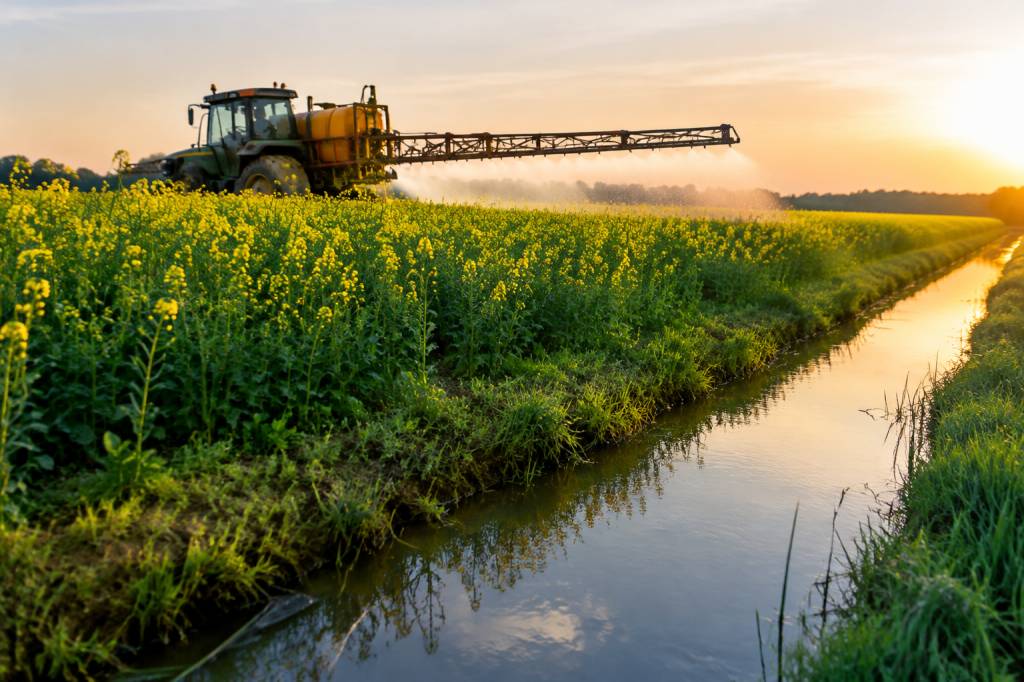
Neonicotinoids are widely used insecticides designed to protect crops from damaging pests. Their effects on bees have attracted considerable attention, but the story does not end in fields or gardens. These chemicals can also move into rivers, streams and groundwater, where they may affect aquatic life and complicate efforts to protect water quality.
What makes them a concern, how do they reach water, and what can be done to reduce the risks? The answers depend on the individual chemical, local conditions and how it is used. But one point is clear: a pesticide does not need to be highly visible to have a measurable environmental impact.
What are neonicotinoids?
Neonicotinoids are a group of insecticides that act on the nervous systems of insects. They include imidacloprid, clothianidin, thiamethoxam, acetamiprid and thiacloprid. The chemicals are used in agriculture and, depending on the country and product, may also be found in some horticultural or pest-control applications.
Many neonicotinoids are systemic: a plant can absorb the chemical and transport it through its tissues. This can help protect the crop, but it also means that the active ingredient is not necessarily confined to the place where it was applied. Some of it may remain in soil, move with water or leave a field in dust or plant material.
These substances are not PFAS. They are a different group of chemicals with different properties and sources. Yet the water-quality questions have familiar elements: where does a contaminant travel, how long does it persist, what organisms are exposed, and how effectively can it be monitored and managed?
How neonicotinoids get into water
Rainfall and irrigation are major pathways. Water moving over the surface of treated land can carry dissolved pesticide into nearby ditches, ponds and rivers. Water that soaks into the ground may transport some compounds down through soil towards groundwater. The amount reaching water varies with the chemical, soil type, rainfall, application method, drainage and distance to a water body.
Seed treatments are an important example. A coated seed is planted in the soil, where the growing plant can take up some of the insecticide. But not all of the coating necessarily ends up in the crop. During planting, small amounts can become airborne as dust; later, residues may remain in soil or be carried away in water. Field studies have detected neonicotinoids in streams and other surface waters, including in agricultural areas.
Urban sources can matter too. Runoff from gardens, parks and other treated areas may enter storm drains, which can discharge into local waters. A storm drain is not a miniature wastewater treatment plant: in many places, it conveys rainwater directly to a stream or river.
The timing of a detection can be as important as the concentration. A short-lived pulse after heavy rain may expose aquatic organisms during a sensitive stage of their life cycle. Regular, low-level inputs can create a different kind of pressure. Monitoring that samples only occasionally can miss both patterns.
Why aquatic life is vulnerable
Neonicotinoids are designed to affect insects, and many aquatic invertebrates are insects or closely related organisms. Mayflies, midges and other freshwater invertebrates can be exposed when contaminated water flows through their habitat. These animals are not minor parts of an ecosystem: they help break down organic matter and provide food for fish, birds and other wildlife.
Research has reported harmful effects on aquatic invertebrates at concentrations that may be lower than those causing immediate, obvious mortality. Depending on the species and exposure, effects can include impaired growth, reduced feeding, changes in behaviour or difficulties emerging as adults. Repeated exposure may also affect reproduction and the composition of communities over time.
That distinction matters. A river can look clear and still contain a chemical that affects sensitive organisms. And if one species declines, the effect may ripple through the food web. Fish that depend on aquatic insects for food, for example, may face reduced prey availability even if the pesticide does not directly kill the fish.
Risk is not identical for every neonicotinoid. Toxicity, persistence and mobility differ between chemicals, as do the sensitivities of individual species. Environmental risk assessments therefore need to consider more than a single measurement: they should account for exposure duration, mixtures, seasonal patterns and the ecological role of affected organisms.
What does detection mean for drinking water?
Finding a neonicotinoid in a river or groundwater sample does not automatically mean that tap water is unsafe. Drinking-water risk depends on the concentration, the chemical, the source used by the water supplier and the effectiveness of treatment. Water companies monitor and manage supplies under applicable standards, and regulatory limits differ between jurisdictions and substances.
Conventional treatment processes are designed primarily to remove particles, microbes and other contaminants. Some pesticide removal may occur, but performance can vary. Activated carbon can reduce concentrations of certain organic chemicals, while other advanced treatments may be used where needed. The effectiveness of any process depends on the compound and the specific treatment system.
For consumers, the practical message is to rely on information from their water supplier and public-health authorities rather than assume that every detection has the same significance. For water managers, the most useful response is to identify the source, assess concentrations over time and evaluate whether treatment or catchment measures are necessary.
Monitoring the chemicals that can be missed
Water monitoring is more informative when it captures both routine conditions and events that can drive pollution. Sampling after heavy rainfall, for example, can help reveal runoff pulses. Testing at several points along a watercourse can show whether concentrations rise near treated land or decline downstream.
Laboratory methods have improved, but monitoring still has limits. A sample gives a snapshot, not a continuous record. Results can also depend on the detection limit, the number of chemicals included in the test and whether samples are taken from surface water, groundwater or sediment.
Mixtures deserve attention. A water body may contain several pesticides at once, alongside other pollutants. Assessing each chemical in isolation can overlook combined exposure, although predicting the effects of complex mixtures remains scientifically challenging. More frequent, targeted monitoring can help researchers and regulators build a clearer picture.
How regulation and use are changing
Regulatory decisions on neonicotinoids have changed as evidence about environmental effects has developed. In the European Union, the use of several neonicotinoids was restricted because of risks to bees; the European Commission later prohibited outdoor use of clothianidin and thiamethoxam. The details of pesticide authorisations differ across countries and can change, so users should check current national rules rather than rely on an old product label or article.
Restrictions on a particular use do not remove residues already present in soil or prevent all possible routes of entry into water. Nor do they mean that every neonicotinoid has identical legal status. Regulation can reduce future inputs, but effective protection also depends on how products are applied, what alternatives are available and whether compliance is monitored.
Farmers and land managers can reduce the risk of loss to water by following label instructions, avoiding application before heavy rain, maintaining vegetation near watercourses and using integrated pest management. This approach starts with prevention: monitor pest levels, consider whether treatment is actually needed, and use non-chemical or targeted methods where practical. A pesticide applied only when justified is less likely to become an unnecessary source of pollution.
What communities and water managers can do
Protecting water quality is not solely the responsibility of individual households. Farmers, pesticide regulators, local authorities, water companies and researchers all have roles. Catchment-level action is especially useful because runoff does not respect property boundaries.
- Use monitoring data to identify hotspots, seasonal peaks and possible sources.
- Protect stream margins with vegetation that can slow runoff and trap sediment.
- Promote integrated pest management and application methods that minimise drift and waste.
- Share clear, up-to-date guidance with pesticide users and communities.
- Assess treatment options where a drinking-water source is affected.
Residents can help by using garden pesticides only when necessary, following product instructions and never disposing of unused chemicals into drains, toilets or waterways. If a local stream is being monitored, community observations about rainfall, land use or unusual discharges can support investigations, although laboratory testing is needed to confirm contamination.
Why this issue deserves attention
Neonicotinoids illustrate a broader water-quality challenge: chemicals used on land can travel beyond their intended target. The route may be a field drain after a storm, a garden washed into a street drain or residues that persist in soil and gradually move into water. The result is not always an immediate fish kill or a visible change in the river. Impacts can be subtle, repeated and concentrated in organisms that are easy to overlook.
Better decisions depend on evidence that is specific to the chemical and the catchment. That means monitoring at the right times, evaluating effects on sensitive aquatic species and comparing the benefits of pesticide use with its environmental costs. It also means treating prevention as part of water protection, not as an optional extra.
Clear water is not necessarily uncontaminated water. By reducing avoidable pesticide use, improving runoff management and investing in reliable monitoring, communities can limit the amount of neonicotinoids reaching freshwater ecosystems—and build a stronger evidence base for protecting the water on which people and wildlife depend.