

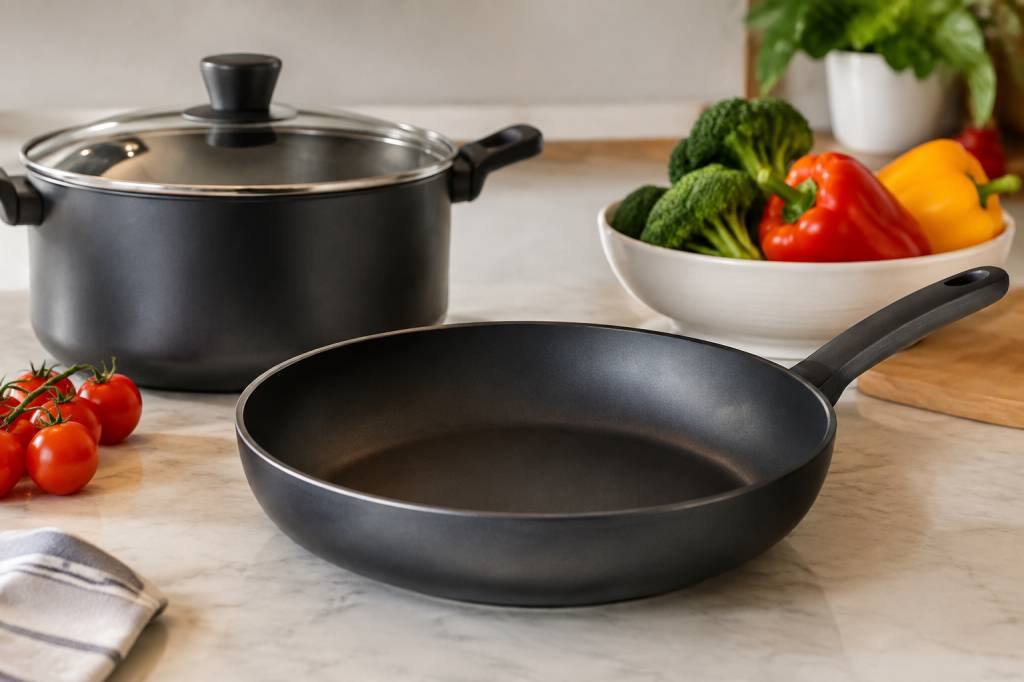
Non-stick cookware has transformed everyday cooking. A fried egg slides neatly from the pan, sauces are easier to clean, and less oil may be needed. But the convenience comes with a question that is increasingly difficult to ignore: is non-stick cookware safe, particularly when it contains PFAS?
The short answer is nuanced. Modern non-stick pans made with polytetrafluoroethylene (PTFE) are generally considered safe when used correctly and kept below extreme temperatures. However, PFAS are a large and persistent family of chemicals, and some substances historically used in the manufacture of non-stick coatings have raised serious concerns for human health and the environment.
Understanding the difference between the finished coating, the chemicals used during production, and the risks associated with overheating or damaged cookware can help you make a more informed choice in the kitchen.
What are PFAS?
PFAS, or per- and polyfluoroalkyl substances, are a group of thousands of synthetic chemicals. They have been used since the mid-20th century because they resist heat, oil, water and stains. These properties make them useful in products ranging from food packaging and waterproof clothing to firefighting foams and industrial equipment.
The same chemical stability that makes PFAS useful also makes many of them extremely persistent. They do not break down easily in the environment, which is why they are often described as “forever chemicals”. Some PFAS can remain in soil and water for years or decades and can travel far from their original source.
Human exposure can occur through contaminated drinking water, food, household dust and consumer products. Research has associated certain well-studied PFAS, including PFOA and PFOS, with effects such as altered immune response, increased cholesterol and developmental impacts. The strength of evidence varies between individual PFAS, but the overall concern is clear: these chemicals can persist and accumulate, while regulation and scientific understanding continue to evolve.
Why are PFAS associated with non-stick pans?
Many traditional non-stick pans use a coating made from PTFE. PTFE is a fluoropolymer belonging to the broader PFAS chemical family. It is valued because it creates a smooth, low-friction surface that food does not easily stick to.
It is important to distinguish PTFE from smaller PFAS such as PFOA. PFOA was historically used as a processing aid in the manufacture of some fluoropolymer coatings. It has been phased out or heavily restricted in many countries because of its persistence and potential health risks. This does not mean that every modern non-stick pan is free from all fluorinated substances. PTFE itself remains a fluorinated polymer, and manufacturing practices and product formulations can differ.
Consumers may also encounter labels such as “PFOA-free” or “PFOS-free”. These claims can be useful, but they do not necessarily mean that a product contains no PFAS at all. “PFOA-free” refers to one specific chemical. It is not the same as “PFAS-free”.
Is PTFE cookware safe at normal cooking temperatures?
When a PTFE-coated pan is used according to the manufacturer’s instructions, the coating is generally regarded as stable at ordinary cooking temperatures. Typical frying and simmering temperatures are well below the point at which PTFE begins to degrade significantly.
Problems arise when an empty pan is left on a high heat for too long. PTFE can begin to break down at very high temperatures, generally around 260°C, with more rapid decomposition occurring at higher temperatures. An empty pan can reach these temperatures surprisingly quickly, especially on a powerful gas or induction hob.
At extreme overheating temperatures, PTFE may release fumes that can cause polymer fume fever, a short-term flu-like illness in people. Symptoms may include chills, headache, fever and body aches. Pet birds are particularly vulnerable to these fumes because of their highly efficient respiratory systems; severe exposure can be fatal.
This is not a reason to panic over an occasional meal cooked in a non-stick pan. It is a reason to avoid preheating an empty coated pan on maximum heat and to treat smoke from cookware as a warning sign rather than part of the recipe.
What if the coating is scratched or peeling?
Small flakes from a damaged PTFE coating are generally considered unlikely to cause harm if accidentally swallowed. PTFE is chemically inert and passes through the digestive system without being absorbed in significant amounts.
That does not make damaged cookware a good choice. Peeling or badly scratched surfaces may no longer perform properly, can contaminate food with fragments and may indicate that the pan has been exposed to excessive heat. Scratches can also make cooking more difficult, encouraging people to use higher temperatures or more oil.
Replace a pan when the coating is visibly peeling, bubbling or flaking, or when the base has become distorted. Avoid using metal utensils, knives or abrasive scouring pads unless the manufacturer specifically states that they are suitable. Silicone, wood or heat-resistant plastic utensils are usually safer options.
How does non-stick cookware affect the environment?
The environmental concern extends beyond what happens during cooking. PFAS pollution can occur during the production, use and disposal of fluorinated materials. Manufacturing facilities, industrial waste and contaminated sites have all contributed to PFAS entering rivers, groundwater and soils.
Because many PFAS persist, contamination can remain long after a product has left the factory. Water treatment is also challenging. Conventional drinking-water treatment methods may not remove PFAS effectively, while advanced treatments such as granular activated carbon, ion exchange and reverse osmosis require careful management of spent media and concentrated waste.
Disposing of a non-stick pan in household recycling is usually not appropriate. Coatings and mixed materials can interfere with recycling processes. Local authority guidance should be followed, and some retailers or cookware manufacturers offer take-back schemes. A durable pan that is used carefully and kept for many years generally creates less waste than repeatedly replacing inexpensive damaged cookware.
Safer ways to use a non-stick pan
If you already own PTFE-coated cookware, practical habits can reduce unnecessary risks and extend its useful life:
-
Do not preheat the pan empty on high heat. Add food, water or cooking oil before the pan becomes hot.
-
Use low to medium heat for most cooking. Non-stick surfaces rarely require maximum temperature.
-
Turn on an extractor fan or open a window when cooking, particularly if a pan has overheated.
-
Keep birds away from the kitchen and move them to well-ventilated areas if fumes are produced.
-
Choose wooden, silicone or plastic utensils designed for high temperatures.
-
Wash coated cookware gently by hand if recommended by the manufacturer.
-
Do not use a pan that is peeling, blistered or severely scratched.
-
Check product information carefully. “PFOA-free” does not necessarily mean “PFAS-free”.
One simple rule is worth remembering: if a non-stick pan starts smoking, switch off the heat, ventilate the room and leave it to cool. Do not add water immediately to a dangerously hot pan, as rapid cooling can cause burns or damage.
Are ceramic-coated pans a safer alternative?
Ceramic-coated cookware is often marketed as a PFAS-free alternative. Many products use a sol-gel coating made from silica-based materials rather than PTFE. If the manufacturer verifies that the coating contains no PFAS, this can reduce concerns associated with fluorinated non-stick surfaces.
However, “ceramic cookware” can describe different products. Some pans have a genuine ceramic surface, while others have a metal body with a ceramic-like coating. Product quality varies, and the coating may lose its non-stick performance more quickly than PTFE if exposed to high heat, abrasive cleaning or frequent use.
Look for clear information from the manufacturer about the coating composition. Avoid relying on vague claims such as “natural” or “toxin-free”, which are not always precise or independently verified. A reputable company should be able to explain whether PFAS, PTFE, PFOA and other fluorinated substances are present.
Other cookware choices to consider
There is no single perfect material for every kitchen. The best choice depends on cooking style, maintenance preferences and how long the cookware is likely to last.
-
Stainless steel: Durable, widely recyclable and free from a synthetic non-stick coating. It may require more oil and careful temperature control to prevent food sticking.
-
Cast iron: Long-lasting and capable of developing a naturally seasoned surface. It is heavy and must be dried properly to prevent rust.
-
Carbon steel: Lighter than cast iron and suitable for high-heat cooking when seasoned correctly.
-
Glass and enamelled cookware: Useful for baking, roasting and slow cooking, although enamel can chip if handled roughly.
-
Verified PFAS-free ceramic cookware: A possible non-stick alternative, provided the manufacturer gives transparent material information.
For many households, a mixed approach works well: stainless steel for searing, cast iron for high-heat cooking and a carefully maintained non-stick pan for delicate foods such as eggs or fish. The most sustainable pan is often the one that performs well and remains in use for years.
What should shoppers look for?
Marketing language can make cookware difficult to compare. Before buying, check the manufacturer’s technical information rather than relying only on front-of-pack claims.
Look for explicit statements about whether the product contains PTFE or other fluoropolymers, and whether it has been tested for substances such as PFOA and PFOS. If a company claims that a pan is PFAS-free, check whether the claim covers the entire coating or only selected chemicals. Independent certification can provide additional reassurance, although certification schemes differ in scope.
It is also worth considering construction quality. A thicker base, robust handle and replaceable or recyclable components may matter more environmentally than a low purchase price. A pan that warps after a few months is unlikely to be a responsible long-term choice, even if its coating makes appealing health claims.
What regulators and researchers are watching
Regulators in the UK, Europe and elsewhere are paying increasing attention to the wider PFAS group rather than only a handful of historically recognised chemicals. This reflects growing evidence that replacing one restricted PFAS with another chemically similar substance may not remove the underlying persistence problem.
Research is also examining how PFAS move through food-contact materials, how coatings age during use and how different disposal methods affect emissions. The science is developing, and product labels do not always keep pace with the complexity of the evidence.
For consumers, the practical message is straightforward: use existing non-stick cookware carefully, replace damaged items, avoid overheating, and choose durable alternatives when buying new equipment. Reducing unnecessary exposure does not require throwing every pan away overnight. It requires informed decisions and sensible kitchen habits.
A practical approach to safer cooking
Non-stick cookware is not automatically dangerous, but it is not entirely free from environmental questions either. The key issues are the type of coating, the chemicals associated with manufacturing, the temperature reached during use and the condition of the pan.
Cooking at moderate temperatures, avoiding empty-pan overheating and replacing deteriorated cookware are simple steps with clear benefits. When it is time to buy again, compare materials, look beyond vague advertising claims and favour products designed to last.
PFAS contamination is a large-scale environmental challenge, from polluted water supplies to persistent industrial waste. Individual cookware choices will not solve it alone, but they can support a broader shift towards safer chemistry, transparent manufacturing and products that do not need to be replaced every few years.
Further reading
-
UK Health Security Agency: information on PFAS exposure and health.
-
United States Food and Drug Administration: safety information on PFAS in food-contact applications.
-
European Chemicals Agency: regulatory developments concerning PFAS restrictions.
-
Agency for Toxic Substances and Disease Registry: toxicological information on PFOA and PFOS.