

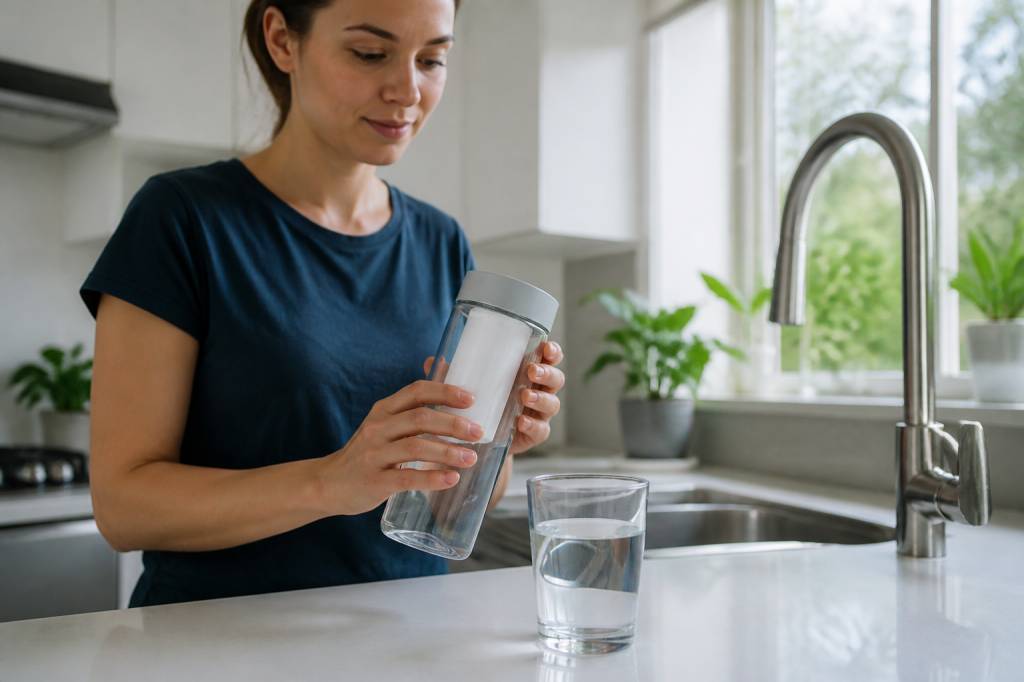
PFAS are often called “forever chemicals” because many of them persist in the environment for years or even decades. They have been used since the 1940s in products designed to resist water, oil, grease and heat—from non-stick cookware and waterproof clothing to food packaging and firefighting foams.
That durability is useful in manufacturing, but it creates a serious environmental problem. PFAS can move through soil and groundwater, enter rivers and reservoirs, and remain in drinking-water sources long after the original product has been discarded.
For people in the UK, completely avoiding PFAS is difficult. These chemicals are widespread, and exposure can occur through food, household dust, consumer products and drinking water. However, practical steps can reduce unnecessary exposure—particularly when it comes to the water we drink and use every day.
What are PFAS and why do they matter?
Per- and polyfluoroalkyl substances, commonly known as PFAS, are a large family of synthetic chemicals. Thousands of different PFAS have been identified, although only a small number have been studied in detail.
Some of the best-known examples include PFOA and PFOS. Their use has been restricted or phased out in many countries, including the UK and the European Union. However, replacement chemicals may also be persistent, and older PFAS can remain in contaminated land and water for a long time.
Scientific studies have associated exposure to certain PFAS with effects including changes to the immune system, altered cholesterol levels, reduced vaccine response and impacts on development. The level of risk depends on the specific chemical, the amount and duration of exposure, and individual factors such as age and health.
The important point is not to panic over a single exposure. The more useful question is: where can avoidable exposure be reduced?
Start with your local water information
Tap water in the UK is subject to extensive regulation and routine testing. Water companies must meet drinking-water standards set under UK legislation, and the Drinking Water Inspectorate oversees compliance in England and Wales. Scotland and Northern Ireland have their own regulatory arrangements.
Even so, PFAS monitoring and reporting can vary by location and by substance. A water company may test for a defined list of PFAS rather than every chemical in the wider PFAS family. Results may also be reported as individual compounds or as a combined total.
Before buying equipment, check the latest information available from your water supplier. Look for:
- water quality reports for your postcode or supply zone;
- information about PFAS, pesticides, industrial chemicals and other emerging contaminants;
- details of current treatment processes;
- contact information for requesting additional water-quality data.
If the information is unclear, ask a specific question. For example: “Do you test for PFAS in my supply, which compounds are included, and what were the latest results?” A precise request is more likely to produce a useful answer than a general concern about “chemicals in the water”.
Households using a private well should take extra care. Private water supplies are not managed in the same way as mains water, and contamination risks can be influenced by nearby industrial sites, airports, landfills, wastewater treatment works or historic firefighting activity. Testing should be carried out by an appropriately accredited laboratory, especially if there is a known contamination source nearby.
Use the right water filter—not just any filter
A water filter can reduce some PFAS, but the word “filter” alone does not guarantee effective treatment. Different technologies remove different contaminants, and performance varies significantly between products.
The main household treatment options are:
- Activated carbon: granular activated carbon and carbon block filters can reduce many PFAS, particularly longer-chain compounds. Performance depends on the type and volume of carbon, water chemistry, flow rate and filter age.
- Reverse osmosis: reverse-osmosis systems can remove a broad range of PFAS and other dissolved contaminants. They typically require more space, maintenance and water than simple carbon filters.
- Ion-exchange resins: these can be effective for PFAS, but their performance depends on the resin design and the presence of competing substances in the water.
Boiling water does not remove PFAS. In fact, boiling reduces the volume of water while leaving non-volatile contaminants behind. A kettle may make water safer from certain microbes, but it is not a PFAS treatment device.
When choosing a filter, look for independent certification or testing specifically covering PFAS reduction. In the UK, consumers may encounter standards from organisations such as NSF International, the Water Regulations Approval Scheme or other recognised certification bodies. Check the exact claim: certification for chlorine, lead or bacteria is not the same as certification for PFAS.
Pay attention to the small print. A product may reduce “up to 99%” under laboratory conditions, but actual performance depends on:
- the specific PFAS compounds present;
- the initial concentration;
- the volume of water treated;
- contact time and flow rate;
- the filter’s replacement schedule.
A filter that is overdue for replacement can become less effective. Some devices may also release previously captured contaminants if they are not maintained correctly. Set reminders, follow the manufacturer’s instructions and do not assume that a filter cartridge is still working simply because water continues to pass through it.
Choose a practical treatment point
There is no need to install a whole-house system automatically. The most important water for exposure reduction is usually the water you drink and use for cooking.
A point-of-use filter attached to a kitchen tap, fitted beneath the sink or used as a dedicated drinking-water unit may be sufficient for many households. Treating all water in the home can be considerably more expensive and may not be necessary unless testing identifies a wider contamination issue.
Remember that filtered water is only protected if it is stored properly. Use clean, covered containers and avoid leaving treated water in warm sunlight. Do not reuse containers that are difficult to clean or that have previously held chemicals.
Do not assume bottled water is PFAS-free
Switching from tap water to bottled water is not a guaranteed solution. PFAS can be present in source water, and contamination may also be introduced through packaging or processing. Bottled water is regulated, but regulation does not mean that every bottle is tested for every PFAS compound.
There are also environmental costs. Producing, transporting and disposing of single-use plastic bottles consumes resources and creates waste. If your concern is specifically PFAS in drinking water, checking local supply data and using a properly certified filter may be more rational than buying bottled water indefinitely.
For occasional use, choose reusable containers made from materials designed for food contact and follow the manufacturer’s cleaning instructions. A metal or glass bottle will not remove PFAS from water, but it can reduce reliance on single-use packaging.
Reduce PFAS in food packaging and cookware
Drinking water is only one possible exposure route. PFAS have historically been used in grease-resistant food packaging, including some takeaway wrappers, microwave popcorn bags, bakery papers and fast-food containers.
Packaging rules and product formulations are changing, but “eco-friendly” or “compostable” does not automatically mean PFAS-free. Some fibre-based packaging has been treated with fluorinated substances to make it resistant to oil and moisture.
Simple habits can help:
- avoid heating food in its original takeaway packaging unless it is clearly labelled for that use;
- transfer greasy food to glass, ceramic or stainless-steel dishes;
- reduce frequent consumption of food wrapped in grease-resistant paper;
- look for brands that provide clear, specific PFAS-free information rather than vague marketing language;
- replace badly scratched or damaged non-stick cookware.
Non-stick pans are not automatically a major source of PFAS exposure when used correctly, and modern products may use different coatings from older formulations. However, overheating or damaging any cookware is poor practice. Use moderate temperatures, avoid empty-pan heating and follow care instructions.
Be selective with waterproof and stain-resistant products
Outdoor clothing, carpets, upholstery, shoes and cosmetics may be marketed as waterproof, stain-resistant or oil-resistant. Those properties can involve fluorinated chemistry, although not every water-resistant product contains PFAS.
Before buying, ask whether the product is explicitly labelled PFAS-free or fluorine-free. A claim such as “PFOA-free” is narrower: it does not necessarily mean that the product contains no other PFAS.
Consider whether the performance feature is genuinely necessary. A waterproof jacket may be useful for walking in heavy rain; a stain-resistant treatment on a decorative cushion may be less essential. Choosing products without unnecessary chemical treatments reduces demand for persistent substances and can simplify disposal.
When cleaning contaminated or treated materials, avoid creating dust. Damp wiping is preferable to dry sweeping, and heavily treated household textiles should not be burned or disposed of improperly.
Protect children and vulnerable household members
Children may receive higher exposure relative to body weight because they drink more water and interact closely with floors, carpets, dust and treated textiles. Babies may also be exposed through formula prepared with drinking water.
If local water data indicate PFAS contamination, ask the water supplier or a qualified professional for advice before choosing treatment for infant formula. A suitable certified point-of-use system may be appropriate, but maintenance is essential. Never improvise with boiling, unverified pitchers or filters that are not designed for PFAS.
Pregnant people, people with compromised immune systems and households with private wells may also wish to discuss local concerns with a healthcare professional or environmental health team. Personal medical advice should be based on the actual circumstances and available testing—not on general online claims.
Dispose of filters responsibly
A used filter may contain the contaminants it has removed. Do not cut open cartridges, rinse activated carbon into the sink or place industrial-scale treatment media in a garden compost bin.
For domestic products, follow the manufacturer’s disposal guidance and check with your local council. If a property is affected by confirmed contamination, specialist advice may be needed for the treatment media and any contaminated soil or waste.
Good disposal matters because PFAS do not disappear simply because they have been transferred from water to a filter. Treatment moves the contamination into another material; it does not destroy it.
What to do if you suspect a problem
If you live near an airport, military site, landfill, industrial facility or location with a history of firefighting-foam use, contact your local water company and environmental regulator. Do not rely on rumours or one-off home test kits without checking how the sample was collected and which compounds the laboratory can detect.
Keep records of responses, test results and filter maintenance. If several households are concerned, coordinated questions to the water supplier, local authority or elected representative can be more effective than isolated complaints.
The UK’s approach to PFAS is continuing to develop as regulators gather more data and consider wider restrictions. Individual choices cannot replace strong monitoring, pollution prevention and effective treatment at source. But households can still take sensible steps today: understand their water supply, choose verified filtration where appropriate, maintain equipment and avoid unnecessary PFAS-treated products.
Forever chemicals may be persistent, but informed decisions do make a difference. The safest strategy is not fear or expensive guesswork—it is targeted action based on reliable evidence.
Useful sources: Drinking Water Inspectorate, UK Health Security Agency, Environment Agency, Scottish Environment Protection Agency, Northern Ireland Environment Agency and your local water supplier’s water-quality reports.