

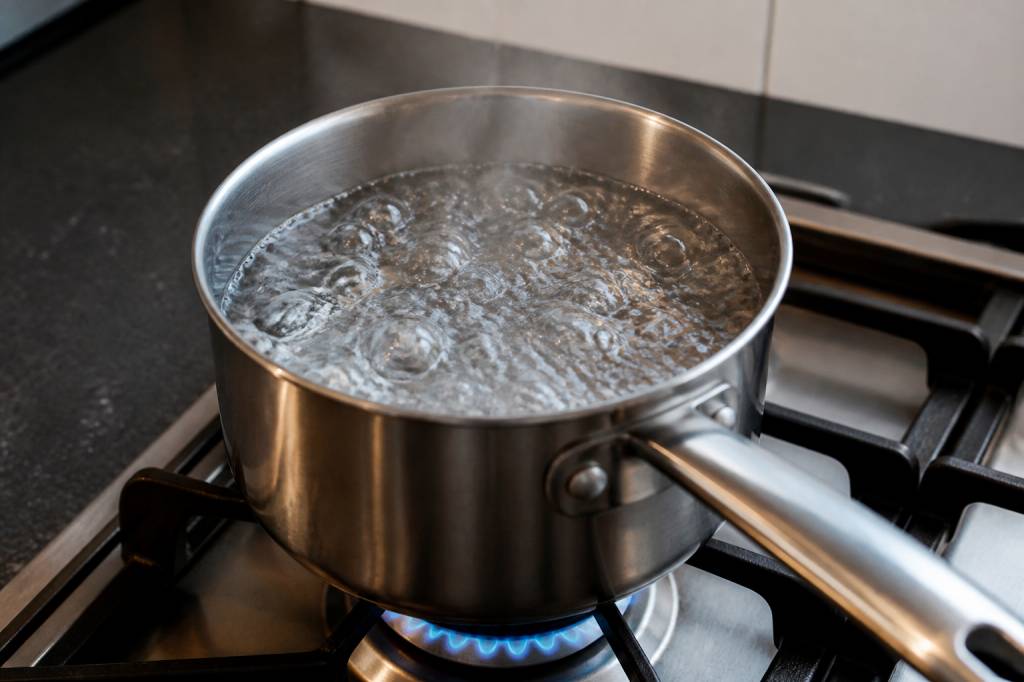
Boiling water is one of the oldest and most trusted ways to make water safer. It is simple, cheap, and requires no special equipment beyond a heat source and a pot. But does boiling water actually remove bacteria? The short answer is yes, if done properly, boiling is effective at killing most disease-causing bacteria, as well as many viruses and parasites.
That said, boiling is not a universal fix for unsafe water. It does not remove chemical contaminants, heavy metals, or substances such as PFAS. And it can even make some contaminants more concentrated if water evaporates during heating. So while boiling is a useful emergency measure, it is not the same thing as proper water treatment.
What boiling does to bacteria
Bacteria are living microorganisms, and most of the harmful ones cannot survive exposure to high heat. When water reaches a rolling boil, the temperature is sufficient to destroy the structures that bacteria need to survive and reproduce. In practical terms, this means boiling water can inactivate common waterborne bacteria such as E. coli, Salmonella, and Campylobacter.
The key word here is inactivate. Boiling does not physically remove bacteria from water. Instead, it kills them or renders them harmless. That distinction matters because dead bacteria may still remain in the water, even though they no longer pose the same health risk.
If you are trying to make water safe during a boil water advisory, this is usually enough. Health agencies around the world recommend boiling as a reliable emergency step when contamination by microbes is suspected.
How long should water be boiled?
A rolling boil is the standard benchmark. Once the water is bubbling vigorously across the surface, keeping it at that boil for at least one minute is generally enough at typical sea level conditions.
At higher altitudes, water boils at a lower temperature, so public health agencies often advise boiling for three minutes instead. Why the difference? Because the lower boiling point means less heat is available to damage microbial cells. A little extra time compensates for that.
Here is the practical rule of thumb:
- At sea level or low altitude: boil for at least 1 minute
- At high altitude: boil for at least 3 minutes
- After boiling: let the water cool naturally before use
It is worth noting that “bringing water to a boil” is not the same as maintaining a rolling boil. A brief burst of bubbles in a pan that is still heating may not be enough to reliably kill pathogens.
Does boiling remove bacteria, or just kill them?
Technically, boiling kills bacteria rather than removing them. This matters because the word “remove” can be misleading. A filter removes particles from water. Boiling, on the other hand, uses heat to destroy living organisms.
If you are looking for a comparison:
- Boiling is a disinfection method
- Filtration is a separation method
- Distillation can remove both microbes and many dissolved contaminants
This is why boiling is excellent for microbiological contamination but poor for chemical contamination. If bacteria are the problem, boiling is very effective. If the issue is pesticides, PFAS, nitrates, or industrial solvents, boiling will not solve it.
What boiling does not remove
This is where many people get caught out. Boiling water can make it microbiologically safer, but it does not clean water in the broader sense.
Boiling does not remove:
- PFAS and other “forever chemicals”
- Heavy metals such as lead or arsenic
- Nitrates
- Pesticides
- Fuel-related chemicals
- Salt or dissolved minerals
In fact, boiling can sometimes increase the concentration of certain contaminants because water evaporates while the dissolved substances remain behind. If the starting water is already contaminated with chemicals, boiling may leave you with a smaller volume of water containing the same amount of contaminant. That is not a good trade.
This point is particularly important in discussions about PFAS. These compounds are heat-stable and do not simply disappear because water is boiled. If your concern is chemical contamination, you need a treatment method designed for that specific problem.
When boiling water is useful
Boiling is most useful when the risk is biological contamination. Think of situations such as:
- A boil water advisory after a water main break
- Flooding that may have introduced sewage into the supply
- Travel in areas where tap water safety is uncertain
- Using untreated surface water from a stream or lake in an emergency
In these situations, the concern is that bacteria, viruses, or parasites may be present. Boiling is a practical, accessible defence. For households without immediate access to a certified water treatment system, it can be the difference between safe hydration and a very unpleasant bout of stomach illness.
There is a reason public health agencies recommend it so often: it works, it is easy to understand, and it does not rely on complex technology.
When boiling is not enough
Boiling is not sufficient if the water is contaminated with chemicals, and this is where public health messaging can become a little too simplistic. Many people assume that “safe” water is just a matter of killing germs. In reality, water quality problems are often more complicated.
Boiling will not help if your water contains:
- PFAS from firefighting foam, industrial discharge, or landfill leachate
- Lead from old plumbing
- Arsenic from geological sources
- Petroleum contaminants from spills or runoff
- High levels of dissolved salts or hard minerals
If the water smells odd, tastes metallic, or has a known chemical contamination issue, boiling is not the answer. You may need a certified filtration system, bottled water, or another specialist treatment option depending on the contaminant.
Can boiling water make it safer in a home kitchen?
Yes, but only in specific circumstances. Imagine you are at home and the local authority issues a boil water notice after heavy rain overwhelms the treatment plant. Boiling your tap water before drinking, brushing teeth, or making ice is the right short-term move.
But if you are worried about what is coming through your pipes every day, boiling is not a long-term solution. It is inconvenient, energy-intensive, and does nothing to address the root cause.
Also, once boiled water cools, it can be re-contaminated if stored in a dirty container or handled with unwashed utensils. Clean storage matters just as much as the boiling step itself. A perfectly boiled glass of water can still be compromised by a grubby jug, which is the sort of kitchen irony nobody needs.
How boiling compares with other water treatment methods
Different water problems require different solutions. Boiling is strong against microbes, but it is not a substitute for filtration or advanced treatment.
Here is a quick comparison:
- Boiling: kills bacteria, viruses, and many parasites
- Activated carbon filters: can improve taste and reduce some organic chemicals, but may not remove microbes unless certified to do so
- Reverse osmosis: can remove many dissolved contaminants, including some PFAS, depending on the system
- UV disinfection: can inactivate microbes but does not remove chemicals
- Distillation: removes many contaminants by turning water into steam and condensing it again
If your goal is overall water safety, it is important to choose the right tool for the job. Boiling is excellent for emergency disinfection. For chemical contamination, you need a treatment method that targets dissolved pollutants.
What about viruses and parasites?
Although this article focuses on bacteria, it is useful to note that boiling also helps with other pathogens. Most viruses are very sensitive to heat, and many parasites are inactivated by boiling as well.
That is one reason boiling is so widely recommended after flooding or when using untreated natural water sources. A stream might look clear, but clear water is not necessarily clean water. Microbial contamination is invisible to the eye, which is part of what makes it so dangerous.
Giardia and Cryptosporidium, for example, are common concerns in untreated water. Boiling is a reliable way to reduce the risk from these organisms, assuming the water is brought to a proper rolling boil for long enough.
Common mistakes people make when boiling water
It is easy to assume boiling is foolproof, but a few simple mistakes can reduce its effectiveness.
- Not boiling long enough: a quick simmer is not the same as a proper boil
- Using contaminated containers: safe water can be re-contaminated after boiling
- Forgetting about altitude: higher elevations need longer boiling times
- Assuming it removes chemicals: boiling does not solve PFAS or metal contamination
- Adding ice from untreated water: that can undo the whole process
These are small errors, but they matter. Water safety is often about getting the basics right consistently, not just doing one thing “mostly correctly.”
So, does boiling water remove bacteria?
Yes, boiling water is highly effective at killing bacteria when done properly. It is one of the simplest and most dependable emergency methods for making microbiologically unsafe water safer to drink.
But boiling has clear limits. It does not remove bacteria; it kills them. And it does not remove chemical contaminants such as PFAS, lead, or nitrates. For that reason, boiling should be seen as a targeted solution for microbial contamination, not a universal water-cleaning method.
If your concern is a boil water advisory or a suspected bacterial problem, boiling is the right response. If your concern is contamination from chemicals, a different treatment approach is needed.
In water safety, the most important question is not just “Is it boiled?” but “What problem are we trying to fix?” That one question can save a lot of confusion, and potentially a lot of stomach aches too.