

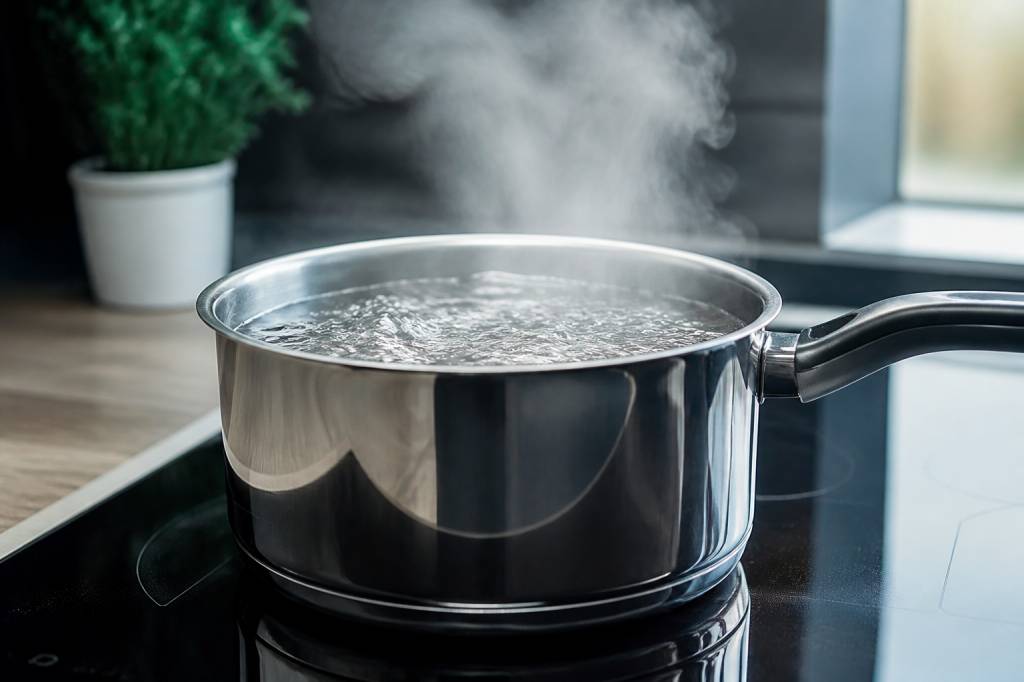
When people hear “boil your water,” they usually think of one simple fix for a wide range of water problems. Cloudy? Boil it. Suspect contamination? Boil it. Want peace of mind? Boil it. But PFAS do not play by the usual rules.
PFAS, or per- and polyfluoroalkyl substances, are a group of persistent synthetic chemicals used in everything from non-stick coatings to waterproof textiles and industrial processes. They are often called “forever chemicals” because they do not break down easily in the environment or in the human body. That persistence matters when we talk about drinking water, because a solution that works for microbes or some volatile compounds may do very little for PFAS.
So what does boiling water actually do when PFAS are present? And more importantly, what does it not do?
Boiling water does not remove PFAS
The short answer is straightforward: boiling water does not remove PFAS in any meaningful way. In many cases, it can make the concentration slightly higher.
Why? Because boiling evaporates water, not PFAS. If you start with a litre of contaminated water and boil some of it off, the PFAS stay behind in the remaining liquid. That means the chemical load is now concentrated in a smaller volume of water. It is a bit like making soup and reducing the broth: the flavour gets stronger because the water leaves, but the ingredients remain. With PFAS, that is not the effect you want.
This is an important distinction because boiling has a strong reputation as a safety measure. It can kill bacteria, viruses, and parasites. But PFAS are not living organisms, so heat does not “kill” them. They are chemically stable and do not simply disappear at boiling point.
For households worried about PFAS in tap water, the key message is simple: boiling is not a treatment method for PFAS removal.
Why PFAS are so resistant
PFAS have carbon-fluorine bonds that are exceptionally strong. That bond is one of the strongest in organic chemistry, which is one reason these compounds are so useful in products that need resistance to heat, water, oil, and staining. Unfortunately, the same durability makes them difficult to destroy or remove.
That chemical stability is also why PFAS persist in groundwater, rivers, soil, and treatment systems. Once they are released into the environment, they can travel long distances and remain detectable for years or even decades. Boiling water does not change that underlying chemistry.
It is worth separating two ideas that often get mixed up:
-
Disinfection: boiling can make water safer by killing pathogens.
-
Contaminant removal: boiling does not remove dissolved chemical pollutants like PFAS.
That difference explains why boiling is useful in a boil-water advisory for microbial contamination, but not as a strategy for chemical contaminants such as PFAS, nitrates, arsenic, or many heavy metals.
Could boiling make PFAS exposure worse?
Potentially, yes. If the water boils for long enough that a noticeable amount evaporates, the PFAS remaining in the pot may become more concentrated. That does not mean boiling creates PFAS, but it can increase the concentration in the water you eventually drink.
There is another practical issue: steam is not a reliable escape route for PFAS in most household settings. Some PFAS are more volatile than others, but the compounds of greatest concern in drinking water are generally not removed effectively through simple boiling. In plain terms, leaving the kettle on longer does not solve the problem.
There is also a common misconception that “hotter is better” when it comes to water quality. In many cases, heat does help, but only for specific contaminants. For PFAS, temperature alone is not the answer.
What boiling can still do for water safety
Boiling has an important role in water safety, just not for PFAS. It remains one of the simplest ways to reduce the risk from biological contamination if you do not have access to a safe water source.
Boiling water is effective against:
-
bacteria
-
viruses
-
parasites such as Giardia and Cryptosporidium, depending on boiling time and altitude
That is why public health agencies often recommend boiling after floods, main breaks, or contamination events where the concern is microbial. If a local authority issues a boil-water notice, it is usually about pathogens rather than chemicals.
But if the issue is PFAS contamination, the advice is different. Boiling can give a false sense of security, which is exactly the kind of confidence you do not want with a persistent chemical exposure.
Common myths about boiling and PFAS
PFAS are one of those topics where half-truths spread quickly. Let’s clear up a few myths.
-
“Boiling kills PFAS.” It does not. PFAS are not living organisms.
-
“If the water tastes fine, it is fine.” PFAS are typically tasteless and odourless at the levels found in drinking water.
-
“A rolling boil will evaporate the chemicals.” Not in any practical household sense.
-
“If the water is filtered first, boiling makes it even safer.” Boiling can disinfect already filtered water, but it does not add PFAS removal if the filter was ineffective.
This is where water quality gets tricky. The absence of visible warning signs does not mean the absence of contamination. PFAS can be present in low concentrations and still matter over time because exposure is cumulative.
What actually removes PFAS from water?
If boiling is not the answer, what is? The main household technologies that can reduce PFAS in drinking water are activated carbon, ion exchange, and reverse osmosis. Not all filters are equally effective, and performance depends on the specific PFAS, the system design, maintenance, and water chemistry.
Activated carbon can reduce certain PFAS, especially longer-chain compounds, though it may be less effective for shorter-chain PFAS. It is commonly used in point-of-use filters and some whole-house systems.
Ion exchange systems can be highly effective, using charged resins to attract and capture PFAS molecules. These are more common in larger treatment applications but also appear in some specialised home systems.
Reverse osmosis can remove a broad range of PFAS and is often considered one of the more reliable household options when properly installed and maintained. It works by forcing water through a semi-permeable membrane that blocks many dissolved contaminants.
That said, no system is “fit and forget.” Filters can become saturated, membranes need replacement, and performance can drop if maintenance is neglected. A filter that was effective six months ago may not be effective today.
How to think about boiled water in a PFAS context
If you suspect PFAS in your water, boiling is not the first response. Instead, it helps to think in layers:
-
Identify the risk: Is the issue microbiological, chemical, or both?
-
Check local guidance: Public water suppliers and local authorities may publish monitoring data or advisories.
-
Use the right treatment: Choose a PFAS-rated filtration method rather than relying on heat.
-
Maintain the system: Replace cartridges and membranes on schedule.
-
Test if needed: If you are on a private supply or live near a known contamination source, water testing can clarify the situation.
In practice, many households do not know whether their water contains PFAS because the contamination is not obvious. That makes regular monitoring and credible public information especially important. Clean water should not require guesswork.
Who should be especially cautious?
Some groups may want to take a more proactive approach to PFAS exposure from drinking water, particularly if they live near industrial sites, airports, military bases, landfill areas, or locations with a history of firefighting foam use. Private well owners may also be at higher risk because their water is not necessarily treated or routinely monitored by a public utility.
Households with pregnant people, infants, or young children may want to pay particular attention. While the health science around PFAS is still evolving, research has linked higher PFAS exposure with a range of concerns, including effects on the immune system, cholesterol levels, liver function, and developmental outcomes. That is not a reason for panic, but it is a strong reason for caution.
And if you are making formula for an infant, the quality of the water matters even more. Boiling can help with microbial safety, but it will not solve a PFAS problem. In that situation, using a verified low-PFAS water source or a suitable filtration system is far more relevant.
Practical steps if you are worried about PFAS in tap water
There is a lot of noise around PFAS, and not all of it is useful. If you want a clear, practical response, start here.
-
Check whether your water supplier publishes PFAS monitoring data.
-
Ask if your area has known contamination sources or ongoing remediation work.
-
If you use a private well, arrange laboratory testing for PFAS.
-
Look for filtration products that specifically state PFAS reduction and have credible performance certification.
-
Follow replacement schedules carefully; a saturated filter is not a filter, it is a storage unit.
-
Do not rely on boiling as a chemical treatment step.
One small but important note: not every product marketed as a “water purifier” is appropriate for PFAS. Some jug filters improve taste and reduce chlorine but do little against PFAS. Always check the claims carefully and look for data, not just slick packaging.
Why this matters for water quality policy
The question of boiled water and PFAS is bigger than the kitchen kettle. It points to a broader issue in water management: our traditional safety habits were built around one kind of risk, while PFAS represent another.
Public health protection depends on understanding the difference between disinfection and contaminant removal. A community can have water that is microbiologically safe yet still carry chemical concerns that need targeted treatment. That is why PFAS monitoring, infrastructure upgrades, and transparent reporting are so important.
For consumers, the takeaway is equally direct: water quality is not a single score. It is a profile. A treatment method that solves one problem may leave another untouched.
The bottom line for households
If you are boiling water because you are worried about PFAS, the answer is simple: stop and reassess. Boiling does not remove PFAS, and it may concentrate them if some water evaporates. It is useful for microbes, not for these persistent chemicals.
For PFAS concerns, focus on testing, transparent local information, and properly designed filtration such as activated carbon, ion exchange, or reverse osmosis. Water safety should be based on evidence, not assumptions, and definitely not on the idea that a kettle can solve chemistry.
If you want, I can also help you turn this into a shorter SEO version, add a meta description, or create a WordPress-ready FAQ section for featured snippets.