

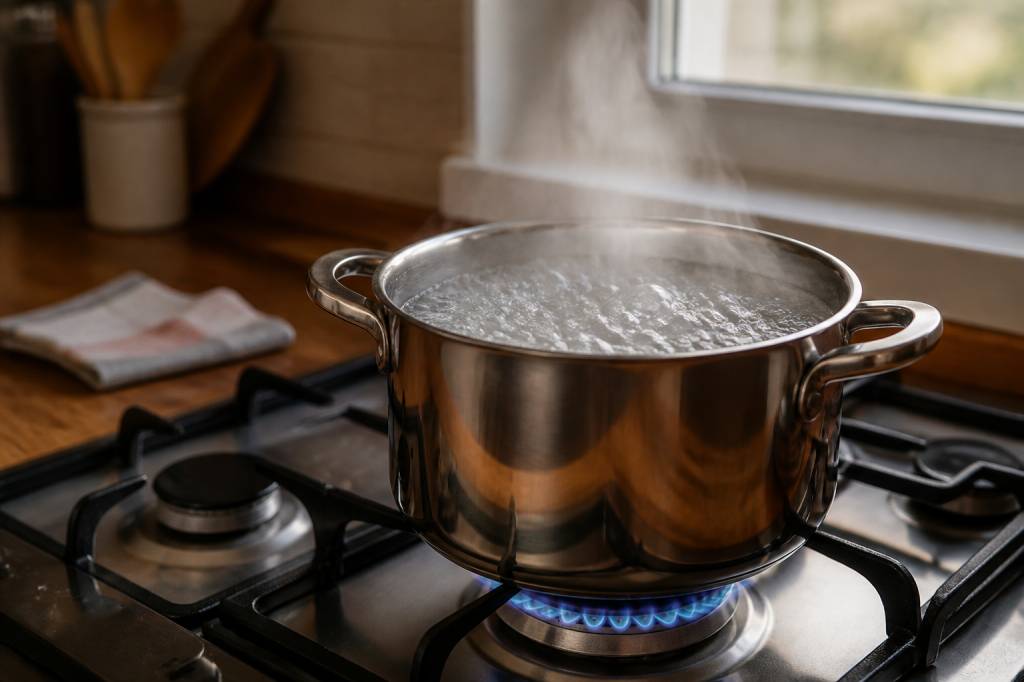
When a boil water warning lands in your inbox, on the local news, or taped to your front door, the first instinct is usually simple: fill a pot, bring it to a rolling boil, and carry on. For many common microbial contaminants, that advice makes perfect sense. But if PFAS are part of the story, the situation gets more complicated.
PFAS, often called “forever chemicals,” do not behave like bacteria, viruses, or parasites. They are highly persistent synthetic compounds used in everything from firefighting foam to food packaging, textiles, and industrial processes. And unlike microbes, boiling water does not remove them. In some cases, it can make the problem worse by slightly concentrating the contaminants as water evaporates.
So what does a boil water warning actually mean when PFAS contamination is also a concern? And what should households do when public health advice seems designed for one problem, but the water supply may be dealing with several?
What a boil water warning is meant to protect you from
A boil water warning is issued when water may be contaminated with disease-causing microorganisms. This can happen after heavy rainfall, flooding, water main breaks, treatment failures, or any event that compromises the integrity of the water system.
The logic is straightforward: heat kills most pathogens. Bringing water to a rolling boil for at least one minute is widely recommended to reduce the risk of infections caused by bacteria, viruses, and parasites. In higher-altitude areas, guidance may be longer because water boils at a lower temperature.
Typical boil water warnings are aimed at biological contamination, not chemical contamination. That distinction matters. Why? Because a treatment method that works beautifully for germs may do almost nothing for PFAS, nitrates, heavy metals, fuel residues, or industrial solvents.
If you remember only one thing, make it this: boiling is a disinfection step, not a chemical filtration step.
Why PFAS are a different problem
PFAS are a large family of fluorinated chemicals valued for their resistance to heat, water, and grease. Those same properties are exactly why they are so difficult to break down in the environment and in the human body.
They are found in drinking water near industrial sites, airports, military bases, landfills, wastewater-affected areas, and some manufacturing zones. Once PFAS reach a water supply, they can persist for years unless removed through specialized treatment such as activated carbon, ion exchange, or reverse osmosis.
Boiling does not destroy PFAS. These compounds are not microbes, so heat at domestic boiling temperatures does not neutralize them. In fact, when water evaporates, the concentration of PFAS in the remaining water can increase slightly. That is not the kind of “concentration” anyone wants.
Another important point: PFAS contamination is often invisible, odorless, and tasteless. A glass of water can look perfectly normal while still containing measurable levels of these chemicals. That makes public guidance especially important, because you cannot rely on sight or smell to assess risk.
Can you use boiled water if PFAS are present?
In short: boiling may address microbial risk, but it does not make PFAS-contaminated water safe from a chemical perspective.
If your area is under a boil water warning and PFAS contamination is also known or suspected, you need to pay close attention to the specific instructions issued by your local water utility or public health authority. The key question is not just “Is the water boiled?” but “What contaminant is the warning targeting?”
Here is the practical takeaway:
- If the warning is for microbial contamination only, boiling water as instructed can make it safe for drinking and cooking.
- If PFAS exceed recommended or regulated limits, boiling will not remove them.
- If both microbial and PFAS concerns exist, you may need an alternative source of water or a treatment method designed for chemical removal.
That can sound frustrating, because it is. Public guidance is often written in broad terms, but real-world water problems rarely arrive one at a time.
What to do during a boil water warning if PFAS are a concern
The most useful response is to separate the immediate microbial risk from the longer-term chemical risk. If you are unsure which applies in your area, check the exact wording of the advisory and the utility’s public notices.
Until you have clarity, the safest steps are usually:
- Use bottled water for drinking and cooking if PFAS contamination is known and no alternative treatment is available.
- Follow boil water instructions for the microbial risk if authorities have issued them.
- Do not assume that boiling alone solves every contamination problem.
- Use boiled water only if officials say it is appropriate for the specific advisory in place.
- Contact your water utility for details on testing results, contaminant type, and recommended household actions.
If babies, pregnant people, immunocompromised individuals, or anyone with specific health concerns is in the household, the threshold for caution should be even higher. Public health agencies often recommend extra care for these groups because the cost of a mistake is greater.
How to check whether PFAS are in your water
One of the hardest parts about PFAS is that many people do not discover the issue until a local report, utility notice, or community campaign brings it to light. But there are several ways to get a clearer picture.
Start with your water supplier’s consumer confidence report, annual water quality reports, or local PFAS monitoring data if available. Many utilities now publish results for PFOS, PFOA, and other PFAS compounds. If results are not easy to find, ask directly. Water providers are often required to share what they know, even when the answer is uncomfortable.
You can also look for state or national public health updates, especially if your region has a history of industrial pollution, firefighting foam use, or landfill leachate issues. In many countries, regulatory standards for PFAS are tightening, but monitoring practices still vary significantly from place to place.
If you want a household-specific answer, point-of-use water testing can help. Just make sure the test is designed for PFAS and is performed by a credible laboratory. A generic “water quality” kit is not enough. PFAS analysis requires specialized methods, and cheap shortcuts tend to produce expensive confusion.
Which water treatment methods actually reduce PFAS?
When PFAS are present, the right treatment matters more than good intentions. Not all filters are equal, and some barely scratch the surface.
Evidence-based options for PFAS reduction include:
- Activated carbon filters: Can reduce some PFAS, especially longer-chain compounds, depending on the system design and maintenance.
- Ion exchange systems: Effective for certain PFAS and often used in larger treatment setups.
- Reverse osmosis: Generally one of the most effective household options for reducing PFAS in drinking water.
Here is the catch: performance depends on the specific PFAS compounds, filter quality, contact time, water chemistry, and whether the filter is replaced on schedule. A filter that starts out effective can become a very expensive ornament if it is ignored for six months.
Also, boiling does not count as a PFAS treatment method. It is useful for pathogens, not forever chemicals.
Why boil water warnings and PFAS often overlap
At first glance, microbial contamination and PFAS contamination might seem unrelated. In practice, they can overlap in communities facing aging infrastructure, industrial pollution, stormwater runoff, or compromised treatment systems.
Flooding can trigger boil water warnings because pathogens can enter the distribution network. At the same time, flooding can mobilize contaminants from contaminated soils, storage areas, or wastewater systems. In industrial or military-adjacent regions, that can mean multiple risks at once.
PFAS are also frequently detected in surface water and groundwater sources that feed municipal systems. If a utility is already under pressure from a microbial incident, it may have limited immediate capacity to address chemical contaminants too. That is one reason why communication from water authorities needs to be precise, timely, and specific.
In other words, “boil your water” is not a universal safety spell. It works well for one class of contaminants, and that’s it.
What households can do right away
If you live in an area where boil water advisories and PFAS concerns are both on the radar, a few practical habits can reduce confusion and risk.
Keep a small supply of safe drinking water at home, especially if advisories are common in your area. Know whether your household filter is certified for PFAS reduction, and replace cartridges on schedule. If you use bottled water during an advisory, check that it is from a reputable source and stored properly.
It also helps to know the difference between water used for drinking and water used for other purposes. Boil water warnings usually focus on drinking, brushing teeth, washing produce, and food preparation. But if PFAS are the issue, the concern extends to any activity where chemical exposure could occur.
Common-sense steps include:
- Use certified PFAS-reducing filtration for drinking water when appropriate.
- Store emergency water for short-term use.
- Read utility alerts carefully instead of relying on headlines or social media reposts.
- Ask whether the advisory concerns microbes, PFAS, or both.
- Keep records of water notices and test results for your home and community.
What public agencies and utilities should communicate better
From a public health perspective, the biggest problem is often not just contamination itself, but ambiguity. Residents can handle bad news more easily than unclear news.
Utilities and health agencies should specify:
- What contaminant is causing the advisory
- Whether the risk is microbial, chemical, or both
- What actions are effective and what actions are not
- Whether boiling is recommended, neutral, or insufficient
- How long the advisory is expected to remain in place
That kind of clarity matters because people make fast decisions under pressure. Parents prepare bottles. Restaurants adjust operations. Schools and care homes need immediate guidance. And if PFAS are involved, waiting for a generic advisory to be “good enough” is not a safe strategy.
The bottom line for your tap water
If a boil water warning is issued, it usually means your water may contain harmful microbes, and boiling is the correct immediate response. But if PFAS contamination is part of the picture, boiling will not remove those chemicals. It can protect against some biological risks while leaving chemical exposure untouched.
That is why it is essential to read advisories carefully, ask direct questions, and use treatment methods that match the contaminant. For PFAS, that means looking at specialized filtration, verified testing, and transparent reporting from your water supplier.
Water safety is not just about treating what you can see. Sometimes the most serious threats are the ones that are invisible, persistent, and perfectly happy to survive a pot of boiling water.