

Glyphosate dangers: what are the risks to health and water quality?
Glyphosate is one of the most widely used herbicides in the world. It is applied to control weeds in agriculture, public spaces and gardens, and is best known as the active ingredient in products such as Roundup. Its widespread use has made it a recurring subject of debate: could exposure harm human health, and can the chemical contaminate drinking water?
The evidence is not as simple as “safe” or “dangerous”. Risk depends on how much glyphosate someone encounters, how they are exposed and for how long. Scientific agencies have also reached different conclusions, in part because they assess the evidence and the question of “hazard” differently. Here is what we know about glyphosate, health and water quality—and what remains uncertain.
What is glyphosate, and how does it reach water?
Glyphosate works by blocking an enzyme pathway plants and some microorganisms need to produce certain amino acids. Humans and other animals do not have this pathway, which is one reason regulators consider its direct toxicity comparatively low. That does not, on its own, settle questions about long-term effects or the impacts of other ingredients in herbicide formulations.
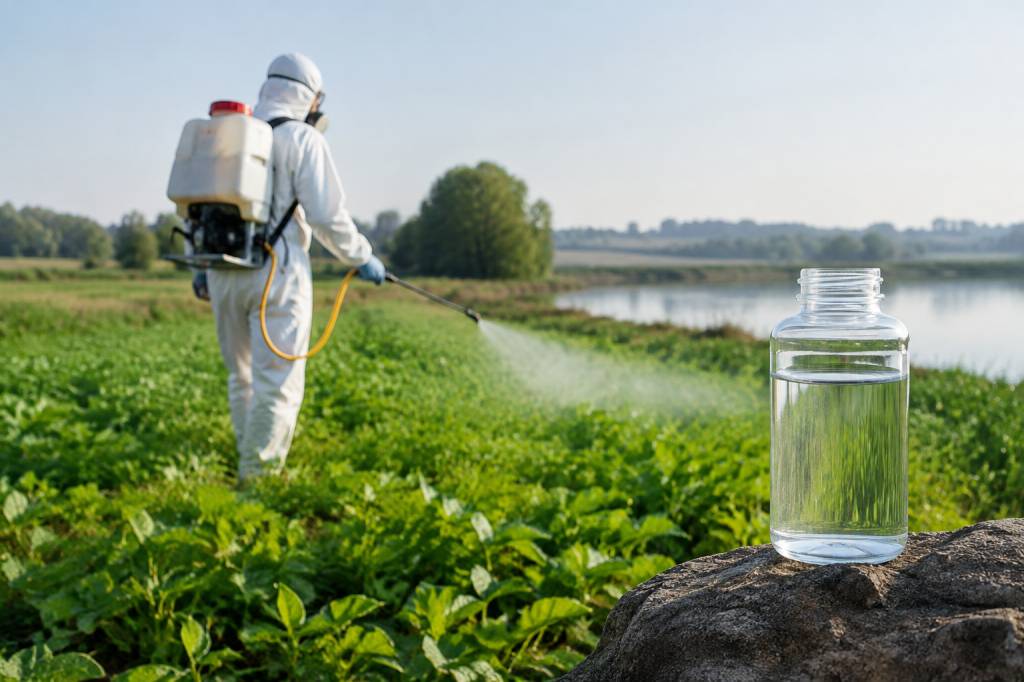
After application, glyphosate can reach rivers, lakes and groundwater through spray drift, runoff from fields, soil erosion or drainage. The amount that reaches water varies with weather, soil type, timing and farming practices. Heavy rain soon after spraying can increase the likelihood of runoff, particularly where land is sloped or soil is bare.
In soil and water, glyphosate can break down into aminomethylphosphonic acid, commonly known as AMPA. Both compounds may be monitored, but they are not interchangeable: AMPA can also form from the breakdown of other chemicals. Finding glyphosate or AMPA in a water sample is evidence of contamination, not by itself proof of a health effect.
What does the evidence say about health risks?
For most people, the main route of exposure is through food, with smaller or more direct exposures possible during mixing, spraying or contact with treated areas. People who handle herbicide concentrates may face a different level of exposure from someone who eats food carrying trace residues. That distinction matters when interpreting studies and assessing risk.
Glyphosate’s possible link to cancer has received particular attention. In 2015, the International Agency for Research on Cancer (IARC), part of the World Health Organization, classified glyphosate as “probably carcinogenic to humans” (Group 2A). IARC conducts hazard assessments: it asks whether an agent is capable of causing cancer under some circumstances, not how likely a person is to develop cancer at typical exposure levels.
Other regulatory reviews have reached different overall judgments. The European Food Safety Authority (EFSA), in its 2023 peer review, reported that it did not identify a critical area of concern that would prevent approval, while noting data gaps and specific issues requiring follow-up. The European Chemicals Agency (ECHA) concluded that the available evidence did not justify classifying glyphosate as a carcinogen under its hazard-classification system. The US Environmental Protection Agency has also assessed glyphosate and does not classify it as likely to be carcinogenic to humans.
These differences are important, but they do not mean that one agency has proved the chemical harmless and another has proved it causes cancer. Agencies may use different evidence-selection methods, legal frameworks and questions. Scientific evaluations also continue to be updated as new studies become available.
Research has investigated other possible effects, including impacts on the liver, kidneys, reproductive health and the gut microbiome. Some laboratory and animal studies report biological effects, but results from experimental conditions do not automatically translate into risk at ordinary human exposure levels. Human studies can be difficult to interpret because exposure is often estimated rather than measured directly, and people may encounter mixtures of pesticides.
There is an additional complication: a pesticide product is not always just glyphosate. Formulations can contain other ingredients that help the product work, and their composition varies. Some glyphosate-based formulations have shown greater toxicity in certain experimental tests than glyphosate alone. Findings about a complete product should therefore not be casually attributed to the active ingredient alone—or assumed to apply to every formulation.
How worried should consumers be about food residues?
Food monitoring programmes sometimes detect pesticide residues, including glyphosate, at low levels. A detection means the analytical method found the substance; it does not automatically mean the food presents a health risk. Regulators compare measured residues with legal maximum residue levels and assess dietary exposure against toxicological reference values.
People who work with pesticides, mix concentrates or regularly spray crops may need to take more care than consumers whose exposure is mainly dietary. Following product instructions, wearing the specified protective equipment and preventing spray drift are practical ways to reduce exposure. It is also sensible to keep pesticides away from children, pets, drains and watercourses.
For consumers, the most useful response is not panic over a single detection. It is to look at the concentration, the pattern of exposure and the assessment behind the reported result. A headline saying “glyphosate found” often leaves out the detail needed to judge what that finding means.
What does glyphosate in water mean for drinking water?
Glyphosate can be detected in surface water and, less commonly, in groundwater, depending on local use and conditions. Monitoring results vary considerably by location and sampling time. A sample taken shortly after application or heavy rainfall may tell a different story from one collected at another point in the season.
In the UK, the drinking-water standard for an individual pesticide is generally 0.1 micrograms per litre (µg/L), with a standard of 0.5 µg/L for total pesticides. These are precautionary, very low limits that apply to pesticides in drinking water; they should not be confused with a toxicological threshold at which a health effect is expected. Water companies must monitor supplies and take action when standards are not met.
That distinction is easy to miss. A concentration above a legal pesticide standard signals that water treatment or management action is required; it does not automatically mean that consumers have suffered harm. Conversely, compliance with a standard does not make monitoring unnecessary. Regular testing helps identify contamination trends and check that treatment is working.
Private water supplies deserve particular attention. A household relying on a well or borehole may not receive the same routine monitoring as a public supply. If there is intensive herbicide use nearby, or if local authorities advise testing, owners should use an accredited laboratory and ask whether the analysis includes both glyphosate and AMPA. A general water test may not include either compound.
Can water treatment remove glyphosate?
Removal depends on the treatment system and the water being treated. Conventional treatment processes can reduce some pesticide concentrations, but performance is not guaranteed for every chemical or set of conditions. Activated carbon can remove a range of organic contaminants, although effectiveness depends on the carbon type, contact time, maintenance and the presence of competing substances in the water.
Reverse osmosis may reduce many dissolved contaminants, but performance depends on the specific equipment and proper operation. No filter should be assumed to remove glyphosate simply because its packaging promises “pesticide reduction”. Check for independent, product-specific test data that identifies the contaminant, reduction achieved and testing conditions. Replace cartridges on schedule; an old filter is not a permanent safety net.
Public water suppliers can use monitoring data to select appropriate treatment and manage risks at source. That may include adjusting treatment, working with land managers or investigating a suspected contamination pathway. Preventing chemicals from entering waterways is often more effective than relying on treatment after pollution has occurred.
What can communities and individuals do?
Reducing unnecessary use is a straightforward way to limit the chance of glyphosate reaching water. Farmers can consider integrated weed management, combining methods such as crop rotation, mechanical control and targeted application where appropriate. For gardens and public spaces, hand-weeding, mulching and other non-chemical options may be practical alternatives, depending on the site.
Anyone applying a herbicide should follow its label and local rules. Avoid spraying in windy conditions or before heavy rain, and never rinse equipment or pour leftover product into a drain, stream or surface-water gully. These precautions help reduce exposure and protect aquatic environments, regardless of the wider debate about glyphosate’s health effects.
- Check local water-quality reports if you use a public supply.
- Ask an accredited laboratory about testing if you rely on a private well or borehole.
- Look for evidence specific to glyphosate and AMPA when choosing a filter.
- Use pesticides only as directed and keep them away from drains and watercourses.
- Read scientific assessments in context: hazard, exposure and risk are related, but they are not the same thing.
Making sense of an evolving debate
Glyphosate’s widespread use makes careful monitoring worthwhile, particularly in areas where agricultural runoff can affect rivers or drinking-water sources. The health evidence is contested, and major agencies have not all reached the same conclusions. At the same time, detection in water or food should be interpreted using concentration, exposure and the relevant regulatory standard—not treated as proof of harm.
For households, the practical priorities are clear: understand the source of your drinking water, use reliable testing where needed and choose filtration based on verified performance. For communities and policymakers, reducing avoidable pesticide runoff and keeping monitoring transparent can help protect water quality while the scientific evidence continues to develop.
Sources and further reading
- International Agency for Research on Cancer: Glyphosate evaluation
- European Food Safety Authority: Glyphosate
- European Chemicals Agency: Glyphosate
- Drinking Water Inspectorate: Drinking water standards