

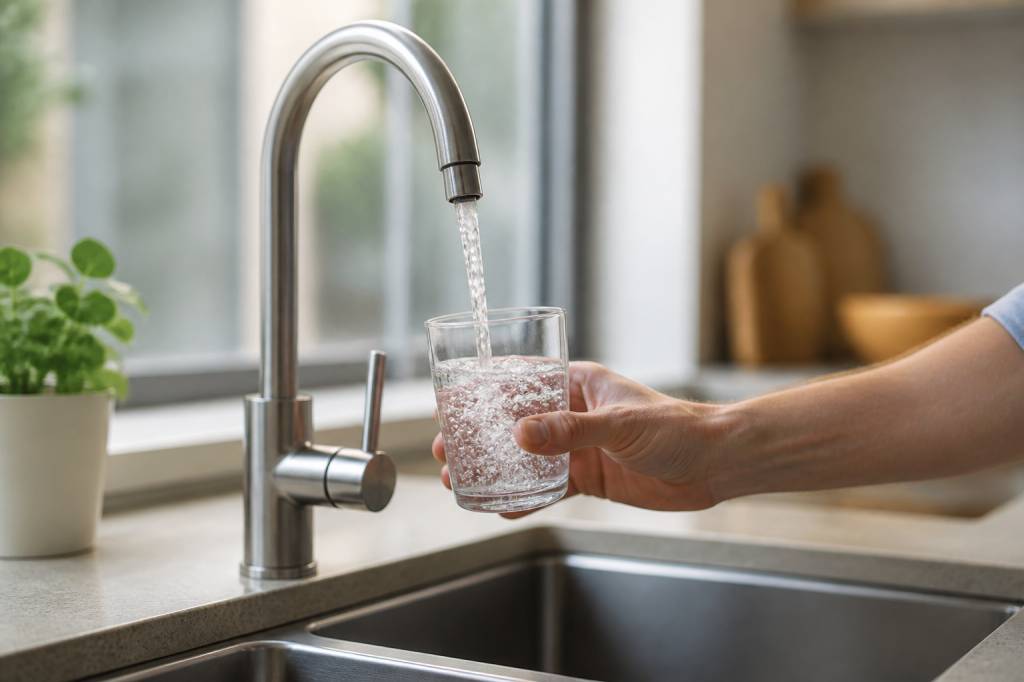
“PFAS-free” sounds reassuring. On a bottle of drinking water, a filtration product or a household tap, the phrase appears to promise a simple answer to a complex chemical problem. But what does it actually mean?
For drinking water, “PFAS-free” rarely means that every single molecule of every possible PFAS has been proven absent. More often, it means that tested PFAS were not detected above a particular laboratory reporting limit—or that a product has been designed to reduce PFAS to a specified standard. The difference matters.
PFAS, or per- and polyfluoroalkyl substances, are a large family of manufactured chemicals valued for their resistance to heat, water, oil and stains. That same durability has allowed them to persist in the environment and, in some cases, move into rivers, groundwater and drinking-water sources.
Understanding the language behind “PFAS-free” can help households, water suppliers and businesses make more informed decisions. It also prevents a common mistake: treating a marketing phrase as if it were a universal scientific guarantee.
What are PFAS?
PFAS are not one chemical but a group containing thousands of individual substances. Some of the best-known examples are perfluorooctanoic acid, or PFOA, and perfluorooctanesulfonic acid, or PFOS. These substances were used in applications including non-stick coatings, stain-resistant textiles, food packaging, firefighting foams and industrial processes.
Their chemical structure includes exceptionally strong carbon-fluorine bonds. This gives PFAS useful technical properties, but it also makes many of them highly persistent. They do not readily break down in the natural environment, which is why they are often described as “forever chemicals”.
People can be exposed to PFAS through food, consumer products, indoor dust and contaminated water. Drinking water may be an important exposure pathway in areas affected by industrial activity, waste sites, airports, military facilities or historical use of firefighting foams.
Research has linked exposure to certain PFAS with effects including changes in cholesterol levels, reduced vaccine response and impacts on liver function. Some PFAS have also been associated with developmental and immune-system effects. The strength of evidence varies between substances, and scientists continue to study the health implications of exposure to different PFAS mixtures.
Why “PFAS-free” is not always an absolute claim
Testing has practical limits. Laboratories cannot normally analyse every PFAS that may be present in a water sample. They test for a defined list of substances using a specific analytical method, and the result is influenced by the method’s sensitivity.
When a report says that PFAS were “not detected”, it does not necessarily mean that the water contains zero PFAS. It means that the chemicals included in the test were below the laboratory’s reporting limit, or were not identified using that method.
For example, imagine a laboratory can reliably report a PFAS concentration at or above 2 nanograms per litre. A result reported as “less than 2 ng/L” indicates that the chemical was not measured at or above that threshold. It does not prove that the concentration is exactly zero.
This is not a reason to dismiss testing. It is a reminder to read the result accurately. “Not detected” is a technical finding, not a guarantee of chemical impossibility.
The term can also be used differently depending on the product or service:
- Untreated water described as PFAS-free: this may refer to a test covering selected PFAS below specified detection limits.
- A filter marketed as PFAS-free: this may mean the filter material does not intentionally contain PFAS, or that it reduces certain PFAS in laboratory testing.
- PFAS-free packaging: this usually refers to the absence of intentionally added PFAS, rather than proof that no trace contamination exists.
- A treatment system described as PFAS-free water technology: this may indicate a performance claim, but the details should explain which PFAS were tested, under what conditions and for how long.
In other words, the label needs context. Without test methods, target compounds and performance data, “PFAS-free” is difficult to interpret.
How PFAS are measured in drinking water
PFAS concentrations in water are commonly expressed in nanograms per litre, or ng/L. One nanogram is one billionth of a gram. This is an extremely small unit, but small concentrations can still matter when a chemical is persistent and exposure occurs repeatedly over time.
Different authorities use different approaches to regulate or assess PFAS. Some set limits for individual substances such as PFOA and PFOS. Others establish limits for a group of PFAS or use a total PFAS value. The number of substances included in the assessment can therefore change the result.
A laboratory report should ideally make clear:
- Which PFAS were included in the analysis.
- Which analytical method was used.
- The detection or reporting limit for each substance.
- Whether the sample was collected before or after treatment.
- The date, location and conditions of sampling.
- Whether quality-control procedures were followed.
These details are particularly important when comparing results from different laboratories. Two tests may produce apparently different answers simply because they looked for different chemicals or used different reporting limits.
PFAS testing can also be complicated by contamination during sampling. PFAS have been used in many industrial and consumer applications, so laboratories and field teams must follow careful procedures to avoid introducing the chemicals into samples through equipment, clothing, containers or handling materials.
What does PFAS-free mean for tap water in the UK?
In the UK, public drinking water is regulated through drinking-water standards designed to protect public health. Water companies monitor a range of chemical parameters, and requirements may develop as scientific evidence and regulatory policy evolve.
England and Wales introduced a drinking-water standard for PFAS as a group, alongside requirements relating to individual substances such as PFOA and PFOS. Scottish and Northern Irish water systems operate under their own regulatory frameworks, although the underlying concern is the same: identifying contamination and reducing exposure.
Consumers should distinguish between three different situations:
- Compliant public water: water meets the applicable legal requirements at the time of testing.
- Low or non-detectable PFAS: selected PFAS were not detected above the laboratory’s reporting limits.
- Absolutely PFAS-free: no PFAS of any kind are present at any concentration.
The third statement is rarely something a routine drinking-water test can prove. A more scientifically responsible description is often “PFAS not detected above the method reporting limit” or “PFAS concentrations are below the applicable regulatory value”.
For most households connected to a regulated public supply, the local water company is the best first source of information. Water-quality reports, customer-service teams and public notices may provide information about monitoring and treatment. If there is a known local contamination incident, follow advice from the water supplier or relevant public-health authority rather than relying on an unverified online claim.
Can household water filters make water PFAS-free?
Some household treatment systems can reduce PFAS, but performance varies considerably. A filter that improves taste or removes chlorine is not automatically effective against PFAS.
Activated carbon is widely used for PFAS treatment. Its performance depends on the type and amount of carbon, the design of the system, contact time, water chemistry and the specific PFAS present. Some longer-chain PFAS are often more readily captured than shorter-chain compounds, although real-world performance depends on several interacting factors.
Reverse osmosis systems can also reduce many PFAS because water passes through a semi-permeable membrane. However, the system must be correctly installed and maintained. Membrane condition, water pressure, pre-treatment and filter replacement schedules all affect performance.
When choosing a household filter, look for independent evidence rather than relying on phrases such as “advanced purification” or “chemical-free water”. Useful questions include:
- Has the system been tested specifically for PFAS reduction?
- Which PFAS were included in the test?
- What were the influent and treated-water concentrations?
- What reduction percentage was achieved?
- How many litres or gallons were treated during testing?
- Was the test conducted by an independent laboratory?
- Does the manufacturer provide a replacement schedule?
- What happens if the filter is used beyond its rated capacity?
Certification can provide an additional layer of confidence, but it is important to check what the certification covers. A product may be certified for material safety, structural integrity or a specific contaminant-reduction claim. Those are not interchangeable. Read the exact performance standard and the list of contaminants included.
Maintenance is not optional. An exhausted activated-carbon cartridge may stop removing contaminants effectively, and poorly maintained equipment can create other water-quality problems. A filter with impressive laboratory results is only useful if it is correctly sized, operated and replaced.
Does boiling water remove PFAS?
No. Standard boiling is not a reliable method for removing PFAS from drinking water. PFAS are highly stable and do not simply evaporate when water is heated. As water volume decreases through evaporation, the concentration of non-volatile substances may even increase.
Boiling remains useful for controlling many microorganisms during specific public-health emergencies, but it should not be treated as a PFAS treatment method. If local authorities issue advice about contaminated water, follow the instructions provided for that particular incident.
What about bottled water?
Bottled water is not automatically PFAS-free. PFAS can enter water from its source, processing equipment, packaging materials or the surrounding environment. Testing requirements and reporting practices also differ between products and jurisdictions.
Choosing bottled water may reduce exposure in a specific short-term situation if reliable local advice recommends it, but it is not a universal solution. Producing, transporting and disposing of plastic bottles also carries environmental costs. Where possible, decisions should be based on verified water-quality information rather than the assumption that bottled means uncontaminated.
How to interpret PFAS-free claims responsibly
A credible claim should explain its boundaries. Look for precise wording and supporting documentation. Claims based only on “free from intentionally added PFAS” are different from claims based on laboratory analysis of the finished water.
Be cautious when a company does not identify the chemicals tested, provides no reporting limits or uses broad language without technical evidence. A product may still be useful, but the claim does not provide enough information to judge its effectiveness.
For consumers, a practical checklist is:
- Check whether the claim applies to the water, the filter materials or the packaging.
- Ask whether “free” means non-detectable or simply not intentionally added.
- Review the test date and the laboratory’s accreditation.
- Confirm that the test covered the PFAS relevant to your concern.
- Compare the reported concentration with current official guidance.
- Follow installation and maintenance instructions precisely.
- Seek advice from your water supplier or public-health authority when contamination is suspected.
The more useful question: how much PFAS is present?
“PFAS-free” is an attractive phrase because it suggests a yes-or-no answer. Water quality is rarely that simple. A better question is: which PFAS were measured, at what concentration, using which method, and how does that result compare with the relevant health or regulatory benchmark?
This approach does not minimise the concern. It makes the discussion more accurate. It helps identify genuine contamination, distinguish effective treatment from vague marketing and focus resources where they can reduce exposure most effectively.
For households, the next step may be checking a water company report. For a business or private-water-supply owner, it may involve commissioning targeted testing and reviewing the catchment for potential contamination sources. For anyone buying a treatment device, it means looking beyond the label and examining independent performance evidence.
PFAS are persistent chemicals, but public understanding does not have to be vague. When “PFAS-free” claims are supported by transparent testing, clear reporting limits and appropriate regulation, they can be useful. Without that information, the phrase is little more than a reassuring label—one that deserves a closer look before it reaches your glass.