

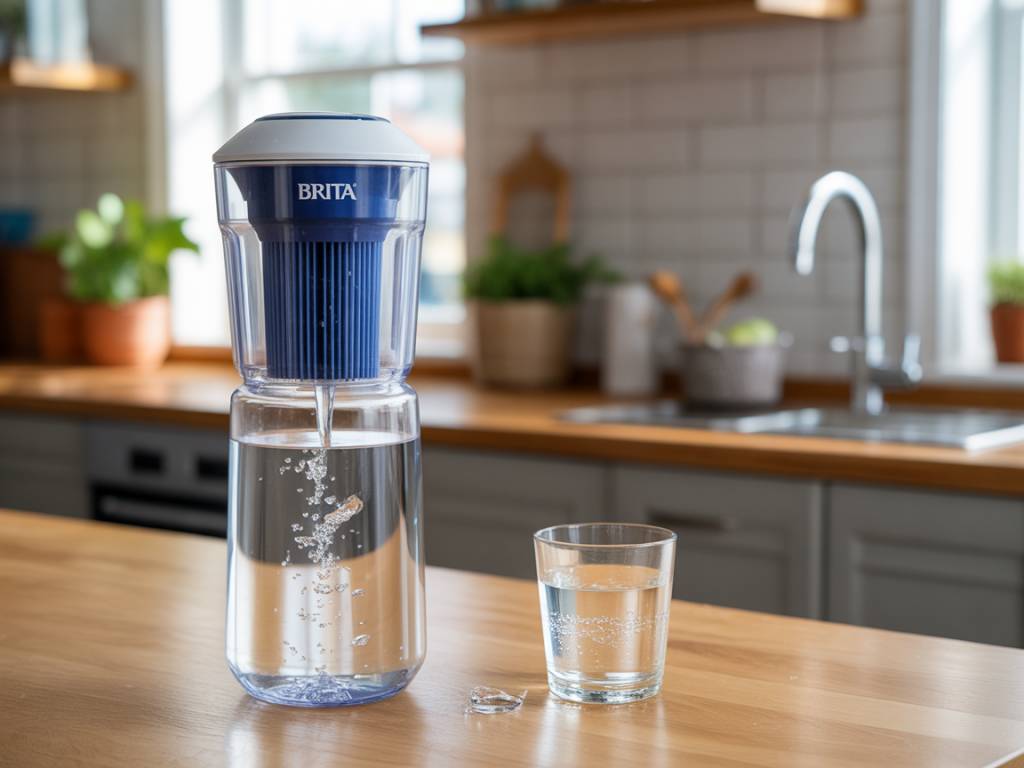
Walk down the water filter aisle in any UK supermarket and you’ll see Brita front and centre. For many households, “filtered water” simply means “water from the Brita jug in the fridge”. But what does a Brita filter actually do to your tap water – and, just as important, what can it not remove?
If you’re worried about PFAS (“forever chemicals”), lead, pharmaceuticals or microplastics, the distinction matters. A lot.
How Brita filters work in simple terms
Most Brita pitcher and jug filters use a combination of two main components:
- Activated carbon – highly porous carbon (often from coconut shell or coal) with a huge surface area that adsorbs certain dissolved chemicals.
- Ion-exchange resin – tiny polymer beads that swap “unwanted” ions (like some heavy metals) for less problematic ones (often sodium or hydrogen).
Water passes through the carbon and resin. As it flows, some contaminants stick to the carbon or get captured by the resin, while others pass straight through. The details depend heavily on:
- Which Brita model and cartridge type you’re using (e.g. Standard, Longlast/Elite, MAXTRA+ in the UK, etc.)
- How old the filter is and whether it’s been changed on time
- Your local tap water quality and specific contaminants present
This is why you’ll see wording like “helps reduce” and “up to” in marketing rather than “removes everything harmful from tap water”. Brita filters are targeted tools, not universal purifiers.
What Brita filters are good at removing
Used correctly, Brita filters can make tap water taste better and reduce some specific contaminants. Here’s where they generally perform well.
Chlorine, taste and odour
Chlorine is one of the main reasons tap water can taste or smell “swimming pool-ish”. Activated carbon is very effective at removing free chlorine and many chlorine by-products within its capacity.
So for most users, the most noticeable effects of a Brita filter are:
- Milder taste and smell
- Less “chemical” aftertaste
- More consistent flavour in tea and coffee
If you’re mainly using Brita for aesthetics – taste, odour, the look of your tea – it usually does exactly what you expect.
Some heavy metals (depending on the cartridge)
Certain Brita cartridges, especially the more advanced models, are designed to reduce some heavy metals. These may include:
- Lead – in systems certified under NSF/ANSI Standard 53 for lead reduction
- Copper, cadmium, mercury – sometimes reduced via ion-exchange, depending on the filter
But the details really matter here:
- Not all Brita filters are certified for lead reduction.
- Performance depends on cartridge model, proper installation and replacement on schedule.
- Certification is done at specific contaminant levels and flow conditions, not for every real-world scenario.
If you are specifically concerned about lead (e.g. older plumbing, lead service lines), a generic “Brita-style” jug is not enough information. You need to know exactly which model you’re using and whether it is NSF/ANSI 53 certified for lead reduction.
Some particles and sediment
Brita cartridges can capture:
- Certain fine particulates
- Visible sediment
- Some rust particles from pipes
However, their primary purpose is not to act as a full mechanical sediment filter like what you’d find in a whole-house system. If your tap water is visibly cloudy or sandy, your first step should be to talk to your water supplier, not just rely on a jug filter.
Some organic chemicals – but not all
Activated carbon can adsorb a range of organic (carbon-based) chemicals, including some:
- Disinfection by-products (e.g. some trihalomethanes)
- Pesticides and herbicides
- Industrial organic compounds with hydrophobic (water-repelling) properties
That said, the list of organic chemicals in the environment is endless. Carbon has a finite capacity, and effectiveness varies widely. Just because a contaminant is “organic” does not mean it will be removed efficiently by a Brita jug.
What Brita filters cannot remove (or only remove partly)
This is where expectations often clash with reality. A Brita jug can noticeably improve water taste and reduce some pollutants, but it is not designed to be a comprehensive barrier against all chemical and microbial risks.
PFAS (“forever chemicals”)
For a site like PFAS-Water, this is the obvious question: does a Brita filter remove PFAS?
The honest answer, for most common Brita jug filters, is:
- They are not specifically designed or universally certified for PFAS removal.
- Some PFAS compounds may be partially reduced by the activated carbon, but performance is highly variable.
- Most consumer Brita products in the UK and EU do not advertise PFAS reduction, and that omission is significant.
When it comes to PFAS, you want to see very specific language, such as:
- NSF/ANSI certification for PFOA/PFOS reduction
- Independent lab data with tested PFAS species and reduction percentages
In the absence of clear, third-party proof, you should not assume that your Brita jug is protecting you from PFAS. Some advanced carbon blocks and some reverse osmosis systems can achieve meaningful PFAS reductions, but that is a different category of filtration.
Bacteria, viruses and other pathogens
Brita jugs are not microbiological purifiers. They are not designed or certified to make microbiologically unsafe water safe to drink.
- They do not reliably remove or inactivate bacteria, viruses or protozoa like Giardia or Cryptosporidium.
- They should only be used on treated, potable tap water, not on river water, private wells with contamination issues, or water from questionable sources.
In some cases, if a filter is left too long or used incorrectly, biofilms (microbial colonies) can form inside the cartridge. That’s another reason why replacing cartridges on schedule and following hygiene instructions matters.
Nitrates and many dissolved inorganic salts
Brita filters are not designed to remove most fully dissolved inorganic ions, including:
- Nitrate and nitrite – common in agricultural areas, problematic for infants and vulnerable populations.
- Fluoride – if you want to remove fluoride, you’ll need a specific technology such as reverse osmosis or activated alumina, not a standard Brita jug.
- Sodium, calcium, magnesium – these are the minerals that contribute to hardness and total dissolved solids (TDS).
Because of this, if you measure your filtered water with a cheap TDS meter, you might find that the reading doesn’t change much before and after a Brita jug. That doesn’t mean “the filter does nothing”; it means TDS meters are not a good proxy for the kinds of contaminants Brita is designed to remove.
Hardness and limescale (partly, and not always reliably)
Some Brita cartridges, especially in Europe (like MAXTRA+), are marketed for reducing carbonate hardness, helping to limit limescale in kettles and coffee machines.
In practice:
- They may reduce some carbonate hardness via ion-exchange, especially when the cartridge is new.
- Effectiveness declines as the cartridge exhausts its capacity.
- They are not equivalent to a dedicated water softener, especially for very hard water.
This is more about appliance protection and taste than about health. Hard water is generally a nuisance, not a toxic hazard.
Most pharmaceuticals and emerging contaminants
Modern tap water can contain trace levels of pharmaceuticals, hormones, personal care product residues and other so-called “emerging contaminants”.
Some of these can be reduced by high-performance carbon filters, but:
- Standard Brita jugs are not comprehensively tested for most of these compounds.
- Without explicit NSF/ANSI 401 or equivalent certifications, performance is uncertain and pollutant-specific.
If pharmaceuticals are your main concern, you should be looking at more advanced point-of-use systems with explicit test data, not relying on a basic jug filter.
Microplastics
The science around microplastics and domestic filtration is evolving. Some microplastics can be removed by fine mechanical filtration and some carbon-based filters, but:
- Most Brita jugs are not explicitly engineered or certified as microplastic filters.
- Particle size and shape matter; smaller microplastics may pass through.
Again, in the absence of clear, third-party test data, it’s safer to assume that a standard Brita jug might reduce some fraction of microplastics incidentally, but will not reliably remove all of them.
Why filter certifications matter more than brand names
“Brita filter” is a bit like saying “car”. What matters is not just the brand, but the exact model and its tested performance. For any drinking water filter you buy, ask:
- Is it certified by an independent body (e.g. NSF, WRAS, KIWA) for specific contaminants?
- Which NSF/ANSI standards apply (42 for aesthetics, 53 for health-related contaminants, 401 for emerging contaminants, etc.)?
- Is there published lab data for PFAS reduction, if that’s your priority?
A jug labelled “reduces chlorine and limescale” is not the same as a system certified to reduce lead, PFOS and PFOA. The logo on the box doesn’t tell the whole story; the small print does.
When a Brita jug is a good choice – and when it isn’t
So where does that leave us? For many households, Brita filters are a reasonable, low-cost step – but only in the right context.
A Brita jug is usually a good fit if:
- Your tap water is already microbiologically safe and compliant with UK/EU regulations.
- Your main concerns are taste, chlorine and minor aesthetic issues.
- You want a relatively affordable, simple product with low maintenance.
It is not sufficient as your only line of defence if:
- You live in an area with known or suspected PFAS contamination.
- You have an identified problem with lead, nitrates or specific industrial chemicals.
- You’re on a private well with microbial or chemical safety issues.
- You need a system specifically validated to remove a particular contaminant of concern.
In these scenarios, you should be looking at:
- Certified PFAS filters (e.g. granular activated carbon systems with proven PFAS reduction, advanced carbon blocks, or reverse osmosis units with PFAS data).
- Point-of-use reverse osmosis for broad-spectrum chemical reduction, including many PFAS, nitrates, and other inorganic contaminants.
- Whole-house treatment if contamination affects showering and other non-drinking uses.
A Brita jug can still be part of your setup, but it shouldn’t be treated as a magic shield.
How to find out what’s actually in your tap water
Before deciding whether a Brita filter is “enough”, it helps to know what you’re filtering in the first place.
Some practical steps:
- Check your water supplier’s quality reports – In the UK, water companies publish annual water quality data for each supply zone. This tells you if they’re meeting regulatory limits for standard parameters.
- Ask specifically about PFAS – Many routine reports still don’t list PFAS. You may need to contact your water company, local authority or environment agency directly, or check published PFAS monitoring reports.
- Consider independent testing – If you have strong reason to suspect contamination (near a military base, industrial site, landfill, etc.), a targeted lab test for PFAS or other specific pollutants can be informative.
Once you know your likely risk profile, you can match filtration technology to the contaminants that actually matter in your case.
Using Brita filters safely and effectively
If you decide a Brita jug is appropriate for your needs, there are a few ways to get the best (and safest) performance from it:
- Replace filters on time – Overused cartridges lose effectiveness and may become a breeding ground for microbes. Follow the replacement schedule recommended for your model and water hardness.
- Store filtered water in the fridge – Cooler temperatures slow down bacterial growth and keep water fresher.
- Keep the jug clean – Wash the jug and lid regularly with warm soapy water, as per manufacturer instructions.
- Use only on potable tap water – Do not use Brita jugs as a substitute for boiling or disinfecting microbiologically unsafe water.
- Don’t ignore unusual taste or smell – If the water suddenly tastes strange even with a new filter, contact your water supplier.
And if you are relying on Brita for a specific contaminant (e.g. lead), double-check that your exact cartridge model is actually certified for that contaminant – don’t rely on assumptions or general brand reputation.
Putting Brita in context: a useful tool, not a cure-all
Brita filters occupy a particular niche in the filtration landscape:
- They are good at improving aesthetic quality (taste, odour, some colour issues).
- Certain models can reduce specific contaminants like lead and some organic compounds when properly certified.
- They are not general-purpose purifiers and should not be treated as a sure defence against PFAS, pathogens or all industrial chemicals.
If your primary goal is nicer-tasting water and a bit less chlorine in your tea, a Brita jug is a perfectly sensible choice. If your concern is chronic exposure to “forever chemicals” or documented contamination events, you need to move beyond the jug and into technologies explicitly designed and tested for those risks.
In other words: Brita can make good water taste better. It cannot turn contaminated water into fully safe water – and it was never meant to. Understanding that difference is the first step towards making informed, science-based decisions about what you drink.