


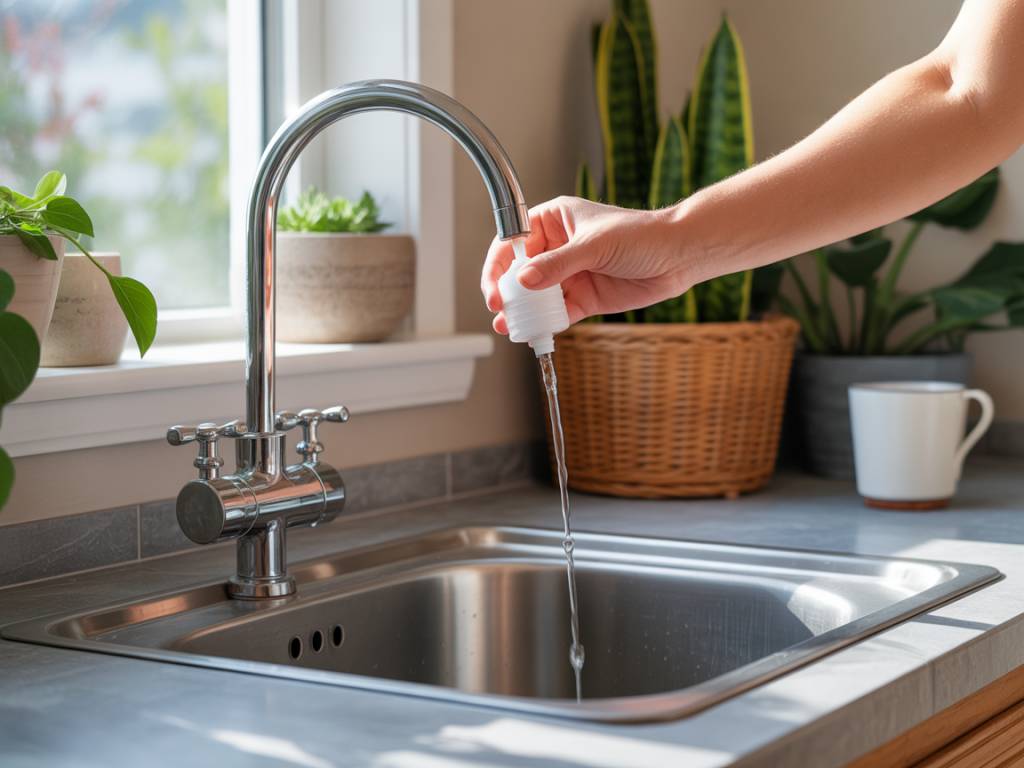
Every time you turn on a tap, you expect clean water. But across the UK, the US and many other countries, testing increasingly reveals trace levels of PFAS — per- and polyfluoroalkyl substances — in household water supplies. These synthetic chemicals don’t break down naturally. They accumulate in the environment, in water sources, and in the human body. And critically, they don’t just enter through the kitchen tap. That’s exactly why PFAS water filter whole house systems to protect every tap from forever chemicals are becoming one of the most searched and most purchased home water solutions right now.
Why PFAS Are a Whole-House Problem, Not Just a Drinking Water Issue
Most people’s first instinct is to filter drinking water at the kitchen sink. That’s a reasonable start — ingestion is the primary exposure route for PFAS. But it is far from the only one.
PFAS have been detected in water across the UK near industrial sites, airports, military bases and areas where firefighting foams containing PFOS and PFOA were historically used. Once in the water supply, these chemicals reach every outlet in your home — not just the kitchen tap.
Scientific reviews have increasingly highlighted that dermal absorption and inhalation of steam during hot showers or baths may contribute to overall PFAS exposure, particularly in households where contamination levels are elevated. You’re also exposed when:
- Bathing young children or infants
- Brushing teeth at the bathroom sink
- Using tap water in humidifiers, steam irons or baby formula
- Filling pet bowls or rinsing vegetables under a utility tap
A point-of-use filter under the kitchen sink addresses none of these. A whole house PFAS water filter system does — by treating water at the point it enters your property, so every outlet benefits from the same level of filtration.
Health Risks Linked to PFAS Exposure
Understanding why whole-house protection matters starts with understanding what PFAS can do at low concentrations. Even at levels measured in parts per trillion, long-term PFAS exposure has been associated with:
- Reduced immune response and lower vaccine efficacy, particularly in children
- Elevated cholesterol levels
- Increased risk of certain cancers, including kidney and testicular cancer
- Thyroid disruption and hormonal imbalances
- Developmental issues in foetuses and young children
- Liver damage and metabolic effects
Regulatory thresholds are tightening. In 2024, the US EPA set Maximum Contaminant Levels (MCLs) for six PFAS — including PFOA and PFOS at just 4 parts per trillion each. The UK is also evolving its guidance as monitoring expands. These moves reflect a scientific consensus that there is no known safe threshold for some of these compounds.
How PFAS Water Filter Whole House Systems to Protect Every Tap from Forever Chemicals Actually Work
A whole house system is installed on your main water line, typically just after it enters the property near the stopcock. All water — whether bound for the kitchen, bathrooms, utility room or outdoor taps — passes through the filtration media before reaching any outlet.
Because PFAS is a family of thousands of different compounds with varying chain lengths and chemical structures, no single technology removes them all with equal efficiency. Most effective whole house systems combine two or more of the following approaches:
Granular Activated Carbon (GAC)
The most widely used technology for PFAS removal. GAC works by adsorption — PFAS molecules bind to the enormous internal surface area of the carbon granules. It is highly effective for long-chain PFAS such as PFOA and PFOS, and provides meaningful reduction of many short-chain compounds. A large-capacity GAC tank is the backbone of most residential whole house systems.
Catalytic Carbon and Advanced Carbon Media
Engineered carbons with modified surface chemistry and optimised pore structures. These perform better than standard GAC in water containing high levels of chlorine or natural organic matter, which can compete with PFAS for adsorption sites. They also tend to have longer service lives before media replacement is needed.
Anion Exchange Resins
Synthetic resins that chemically exchange ions with PFAS molecules in the water. Certain single-use or regenerable resins are specifically engineered to target PFAS at very low concentrations — including short-chain compounds that GAC can miss. Originally used in municipal and industrial treatment, they are increasingly available in residential whole house formats.
Sediment and Polishing Stages
Most systems also include a sediment pre-filter (typically 5–20 microns) to remove sand, silt, rust and particulates that would otherwise clog or reduce the effectiveness of the main media. A polishing carbon stage is sometimes added at the end to improve taste and remove any residual organics or chlorine.
This multi-stage design is key: it protects the investment, extends media life and maintains consistent performance over months and years of use.
What Whole House PFAS Systems Can — and Cannot — Do
A well-specified whole house PFAS filtration system can substantially reduce concentrations of regulated PFAS — often to below current guideline values — across every tap in your home. It can also lower your overall exposure from showering and bathing, not just drinking.
However, there are important limitations to understand before purchasing:
- PFAS is a vast chemical family. Lab testing typically covers a defined list of compounds. A filter certified for PFOS and PFOA may perform differently against newer or novel short-chain PFAS not yet included in standard test panels.
- Media has a finite capacity. Once GAC or resin becomes saturated, PFAS can begin to pass through untreated — a phenomenon called « breakthrough. » Regular media replacement or regeneration is non-negotiable.
- Performance depends on sizing. A system sized for a small flat will be quickly overwhelmed in a large family home. Flow rate, household water usage and incoming PFAS concentration all affect how long the media lasts.
- Other contaminants may need separate treatment. PFAS-focused systems generally do not address water hardness, heavy metals such as lead, or microbial contamination unless those stages are explicitly included.
Do You Need a Whole House System — or Would a Point-of-Use Filter Be Enough?
The honest answer depends on three things: what’s in your water, how your household uses water, and what level of protection you want.
A targeted under-sink reverse osmosis system can reduce PFAS in drinking water to extremely low levels and may be sufficient if your main concern is ingestion and your tap water PFAS levels are relatively low. However, whole house PFAS water filter systems are the stronger choice when:
- Your home is in or near a known PFAS contamination zone — downstream of a fluorochemical plant, near an airport or military base, or in an area where firefighting foams were used
- PFAS levels in your tap water are at or above regulatory guideline thresholds
- Your household includes pregnant individuals, infants, young children or immunocompromised members
- You want comprehensive protection across showers, baths and all household water use — not just the kitchen tap
Start with testing. Your water supplier may publish PFAS data, but coverage is often limited to a narrow set of compounds. A third-party lab test — ideally covering 40+ PFAS including short-chain variants — gives you a much clearer picture of what’s actually in your water before you invest in any system.
Certifications and Standards to Look For
When evaluating any whole house PFAS filter, look for third-party testing and certification rather than relying solely on manufacturer claims. In the UK and internationally, key benchmarks include:
- NSF/ANSI 58 — covers reverse osmosis systems and their performance against a range of contaminants including PFOA and PFOS
- NSF/ANSI 53 — for activated carbon filters with verified health-effects reduction claims
- NSF/ANSI 61 — ensures materials in contact with drinking water do not leach harmful substances
- WRAS approval — the UK standard for water fittings and components used in drinking water systems
Certification does not guarantee that every PFAS compound will be removed to zero, but it does provide independently verified evidence that the system performs as claimed under standardised test conditions.
Maintaining Your Whole House PFAS Filter
Even the best-designed system will fail without proper upkeep. Key maintenance tasks include:
- Replacing sediment pre-filters every 3–6 months, depending on incoming water quality
- Replacing or regenerating GAC or resin media according to the manufacturer’s schedule — typically every 12–24 months, but this varies with water usage and contamination levels
- Monitoring water pressure: a significant drop often indicates a clogged pre-filter or exhausted media
- Scheduling periodic PFAS testing (annually or bi-annually) to confirm the system is still performing effectively
Skipping maintenance is the most common reason whole house systems underperform. Budget for replacement media when you budget for the system itself.
Protecting your household from forever chemicals is not about perfection — it is about meaningful, consistent reduction across every tap, every shower and every litre of water your family uses. A properly specified, well-maintained PFAS water filter whole house system is currently the most comprehensive residential tool available to achieve that goal.