


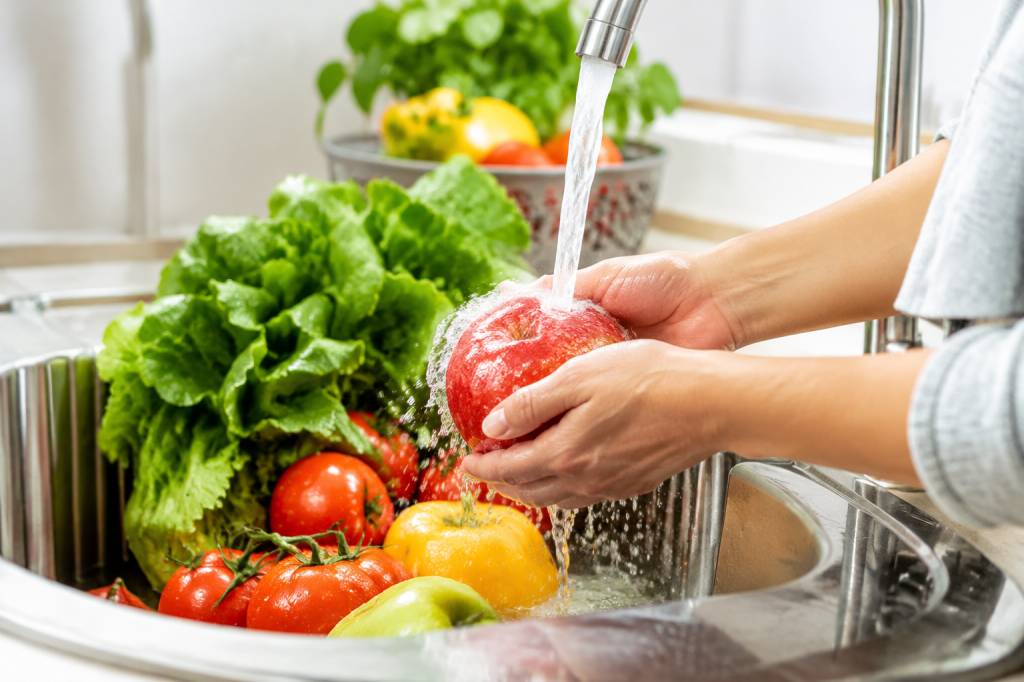
A quick rinse under the tap can make fruit look cleaner. But does it remove pesticide residues—and is washing with vinegar, baking soda or special produce sprays any better? The answer depends on the pesticide, the food and how it was grown. Washing is worthwhile, but it is not a way to remove every residue or guarantee that produce is pesticide-free.
For most people, the practical message is reassuring: fruit and vegetables remain an important part of a healthy diet. A few straightforward handling habits can reduce dirt, microbes and some surface residues without turning the kitchen sink into a chemistry lab.
What pesticide residues are—and why they can be present
Pesticides are substances used to control pests, plant diseases and weeds. The term covers several groups of chemicals, including insecticides, fungicides and herbicides. They can be applied to crops before or after harvest, depending on the crop and the product’s authorised use.
A residue is a small amount of a pesticide, or a product formed as it breaks down, that remains on or in food. Residues may be on the surface, trapped in folds or crevices, or present within plant tissue. The latter matters: a pesticide absorbed by a plant cannot necessarily be rinsed off its skin.
Finding a residue does not automatically mean that a food is unsafe. In the UK, pesticide products must be authorised for use, and maximum residue levels (MRLs) are set for foods. An MRL is the highest residue legally permitted when a pesticide is used according to its approved conditions. It is not, by itself, a line between “safe” and “poisonous”; safety assessments also consider how much people might eat and the potential health effects.
The Food Standards Agency (FSA) monitors residues in food through testing. Its results help regulators identify foods that may not meet legal requirements and assess whether further action is needed. For current information, consult the FSA’s pesticide-residue monitoring reports rather than relying on a social media list or a single test result without context.
Does washing fruit and vegetables help?
Yes. Rinsing under clean, cool running water can remove soil, some microbes and some pesticide residues on the surface. The Food Standards Agency and other food-safety authorities advise washing produce before eating or preparing it, even when the peel will be removed. A knife can transfer dirt or microbes from the outside to the flesh.
How much washing removes varies. A residue that sits on the surface may be easier to reduce than one that has penetrated the skin or been taken up by the plant. The type of produce, the chemical’s properties and the time since application also matter. There is no single percentage that applies to every food and pesticide.
Think of washing as a useful reduction step, not a complete clean-up. It can lower exposure to some surface contaminants, but it cannot guarantee that all residues are gone. Nor does washing replace safe food handling: clean hands, clean utensils and proper storage still matter.
A simple, safer way to wash produce
You do not need a special product for routine washing. Follow these steps:
-
Wash your hands with soap and water before handling food.
-
Rinse fruit and vegetables under clean, cool running water. Gently rub firm produce, such as apples, cucumbers and potatoes, with your hands.
-
For firm-skinned produce, use a clean produce brush if needed. Keep that brush clean and use it for food only.
-
Remove outer leaves from items such as lettuce and cabbage, then rinse the leaves you plan to eat.
-
Dry produce with a clean paper towel or cloth if you wish. Drying may remove further surface material, and it can reduce moisture that encourages spoilage.
-
Wash produce just before use, rather than washing everything as soon as you bring it home. Excess moisture can shorten storage life.
Do not use soap, washing-up liquid, bleach or household disinfectants on food. Produce can absorb some of these substances, and they are not intended to be eaten. If you are preparing a ready-to-eat salad, follow the package instructions; washing a product labelled “washed and ready to eat” is generally unnecessary unless the label says otherwise.
What about vinegar, baking soda and commercial washes?
Online advice often promises that vinegar or baking soda will remove pesticides more effectively than water. Some laboratory studies have found that particular washing treatments reduce particular residues on particular foods. That does not mean the method works equally well for every pesticide or crop, or that it is needed in an ordinary kitchen.
There is no general UK food-safety recommendation to soak produce in vinegar or baking soda to remove pesticide residues. These treatments may change taste or texture, and a soak can spread contamination if the water is reused. If you choose to use a homemade rinse for another reason, rinse the food with clean water afterwards and do not treat it as a guarantee of residue removal.
Commercial fruit and vegetable washes are also not essential. Check the product label and make sure it is specifically intended for food. A more expensive wash is not automatically more effective or safer than running water and gentle rubbing.
Peeling and cooking: useful, but not perfect
Peeling can reduce some residues on or just beneath the skin, but it also removes fibre and nutrients. It will not remove chemicals that have moved into the flesh. For many foods, eating the skin after washing is a nutritious choice; for others, peeling is simply part of preparation or personal preference.
Cooking can reduce some pesticide residues, but the effect depends on the chemical and cooking method. Heat may break down certain compounds, while boiling can move some residues into the cooking water. Cooking is not a reliable substitute for washing, and it does not make every food residue-free.
There is no need to discard a fruit or vegetable simply because you cannot peel it. Wash it carefully, remove damaged or soiled areas, and prepare it using clean equipment.
Organic produce: a different system, not a residue-free promise
Organic farming restricts the pesticides that can be used and follows specific production rules. However, “organic” does not mean “never treated with pesticides” or “guaranteed to contain no residues.” Organic crops may use certain permitted plant-protection products, and residues can sometimes occur through environmental contamination or accidental contact.
Conventional produce is also subject to legal controls and residue monitoring. Choosing organic may reflect environmental, farming or personal priorities, but it is not a reason to skip washing. Whatever the label, rinse produce before eating it.
Should consumers avoid particular fruits and vegetables?
Lists that rank produce by pesticide residues can attract attention, but they rarely tell the whole story. Rankings may be based on samples from a particular country, year or testing programme. They can also count how often residues are detected without fully explaining the amount, the pesticide involved or how that amount compares with health-based limits.
A detection is not the same as a health risk. Risk depends on factors such as the substance, dose, frequency of exposure and the person exposed. Children, for example, eat less food in total than adults but may consume more of a particular food relative to their body weight. Regulators account for dietary exposure when assessing pesticide safety.
If cost, availability or personal preference leads you to choose conventional produce, that is not a reason to avoid fruit and vegetables. A varied diet is more useful than trying to make decisions from a simple “good” or “bad” list. If a food is part of your regular diet, varying the types you buy can also help broaden your intake of nutrients.
What residue tests can—and cannot—tell us
Laboratory testing can identify and measure residues in sampled foods. But a test result is a snapshot of those samples, not a measurement of every item in a shop or every person’s exposure. Results depend on which foods are sampled, the analytical methods used and the substances the laboratory is looking for.
When regulators find residues above an MRL, they investigate and may take enforcement action. Such a result is a compliance concern; it does not automatically mean that everyone who ate the food has been harmed. Conversely, a result below an MRL should not be interpreted as proof that exposure to any amount is desirable. The purpose of monitoring is to check legal compliance and help protect public health.
For reliable updates, look for reports from the FSA, the UK government and relevant scientific regulators. Be cautious with claims that quote a residue figure but leave out the food tested, the measurement units, the legal limit and the source of the data.
Practical takeaways for your kitchen
-
Rinse produce under clean, cool running water and rub or brush firm surfaces gently.
-
Do not use soap, bleach or household cleaners on food.
-
Remember that washing can reduce some surface residues, but cannot remove every pesticide or residue inside the plant.
-
Peeling and cooking may reduce certain residues, but neither is a universal solution.
-
Do not assume that organic produce is residue-free, or that a detected residue automatically means a health risk.
-
Keep eating a varied range of fruit and vegetables. Proper washing is a sensible routine—not a reason to fear fresh food.
Good food hygiene does not require complicated gadgets or dramatic claims. A clean rinse, gentle rubbing and sensible handling are practical steps most households can use every day. They will not answer every question about pesticide exposure, but they do help make fresh produce safer to prepare and enjoy.