


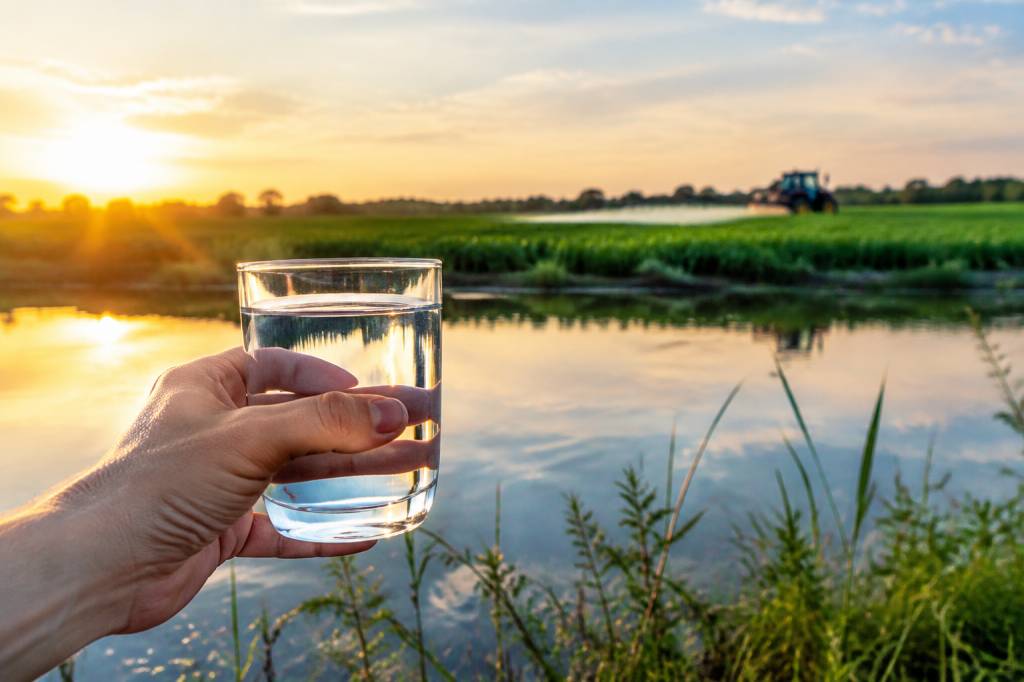
Why pesticides and herbicides can reach drinking water
Pesticides and herbicides are designed to control unwanted plants, insects and other pests. Used correctly, they can support food production and protect crops. But some of these chemicals, or the substances formed as they break down, can move from fields, gardens and other treated land into rivers, reservoirs and groundwater.
Rainfall is one route. Water can wash residues from soil into streams, or carry them down through the ground towards aquifers. Some compounds bind strongly to soil; others are more mobile and can travel farther. Their persistence also varies. A chemical may disappear relatively quickly, while a breakdown product remains in water for much longer.
In the UK, water companies treat and monitor public drinking water, and must meet legal quality standards. That means a detection does not automatically mean tap water is unsafe. It does, however, show why monitoring matters: contamination can vary by location, season and the chemicals being used upstream.
What counts as pesticide contamination?
“Pesticides” is a broad term covering products used against weeds, insects, fungi and other pests. Herbicides are a type of pesticide used to control unwanted plants. Water testing may look for individual active substances as well as relevant metabolites: the compounds produced when a substance breaks down.
A test result needs context. Laboratories report concentrations, often in micrograms per litre (µg/L), and the significance depends on the chemical, the amount present, how long exposure lasts and the applicable standard. A trace detection is not the same as a confirmed health risk. Conversely, a result below a legal limit does not mean the chemical is absent.
For public water supplies in England and Wales, drinking-water rules set a parametric value of 0.1 µg/L for an individual pesticide and 0.5 µg/L for total pesticides, with specified exceptions and additional requirements for certain substances. These are regulatory compliance values, not a simple ranking of the toxicity of every pesticide. The standards and their application can differ across the UK, so consumers should check the relevant national regulator for current information.
Potential health and environmental effects
Health effects vary widely between chemicals. They can depend on dose, route of exposure and duration, as well as age and health. Some pesticides are associated with acute poisoning at high doses. For low-level, long-term exposure through drinking water, the evidence is more complex: research may examine possible links to outcomes such as effects on the nervous system, hormones, reproduction or cancer, but findings for one substance cannot automatically be applied to another.
That uncertainty is not a reason to panic—or to dismiss the issue. It is a reason to rely on measured concentrations, robust toxicological assessments and careful monitoring rather than broad claims that all pesticides are either harmless or dangerous. Infants and young children can be more vulnerable to some contaminants because their bodies are still developing and their water intake is higher relative to body weight.
The environmental effects can be clearer in some settings. Pesticides entering waterways may affect aquatic plants, insects and other organisms, sometimes at concentrations that do not create an immediate drinking-water concern. Reducing contamination at source therefore protects ecosystems as well as water supplies.
How UK drinking water is monitored
Public water suppliers carry out routine sampling and treatment to meet drinking-water requirements. The monitoring programme is informed by risks in the catchment and by the substances that could be present. If a pesticide is detected, the supplier and relevant authorities can investigate the source, assess the result and take steps such as adjusting treatment or increasing monitoring.
Customers can usually find water-quality information through their supplier’s website or annual reports. If you receive water from a private well or borehole, the situation is different: there may be no routine treatment or monitoring by a water company. The property owner is responsible for arranging suitable testing and maintenance. This is particularly important where farmland, orchards, golf courses or pesticide-treated land lies nearby.
A single test gives a snapshot, not a full picture. Concentrations can change after heavy rain, seasonal application or changes in land use. For a private supply, ask an accredited laboratory which pesticide panel is appropriate for the local risks, and whether testing should include relevant breakdown products. A basic test may not cover every chemical used in the area.
Can household filtration remove pesticides?
Some treatment technologies can reduce certain pesticides, but performance depends on the particular compound, filter design, water chemistry and maintenance. No single household filter should be assumed to remove every pesticide. Look for independent, substance-specific performance data—not just a general claim that a product “improves water quality.”
-
Granular activated carbon (GAC): Carbon can adsorb many organic chemicals, including some pesticides and herbicides. Its effectiveness depends on the chemical’s properties and how long the water remains in contact with the carbon. As the media becomes exhausted, removal can decline, so replacement schedules matter.
-
Carbon block filters: These use compressed carbon and may offer effective reduction for particular compounds when the product has been tested for them. Check the certification and test conditions; a claim for taste or chlorine reduction does not prove pesticide removal.
-
Reverse osmosis (RO): RO membranes can reduce a range of dissolved contaminants, including some pesticides, but rejection varies by substance and system. RO units also require maintenance and produce a wastewater stream. Check whether the manufacturer provides verified performance data for the chemicals of concern.
-
Other treatment systems: Some specialist systems combine carbon, membranes or other media. Their suitability depends on the contaminant and the water supply. An ion-exchange unit designed for hardness, for example, should not be presumed to remove pesticides.
When comparing products, look for certification from a recognised independent body and confirm exactly which substances were tested. Standards such as NSF/ANSI 53 or NSF/ANSI 58 cover specific contaminant-reduction claims for certain products, but certification does not mean a filter removes every pesticide. Read the performance sheet, including the tested chemicals, capacity and required replacement interval.
What filtration cannot do
Boiling water is not a reliable way to remove pesticides. It can kill many disease-causing microorganisms, but it does not destroy most dissolved chemical contaminants. As water evaporates, some non-volatile substances may become more concentrated. Follow public-health instructions if boiling is advised for a microbial issue, but do not use boiling as a pesticide treatment.
Filter maintenance is just as important as choosing the right technology. A cartridge left in place beyond its rated capacity may no longer perform as intended. Keep records of installation and replacement, use compatible parts, and follow the manufacturer’s instructions. Poorly maintained equipment can also create other water-quality problems.
For a private supply with a confirmed pesticide detection, do not choose a filter based only on a general online recommendation. Ask the laboratory or a qualified water-treatment professional to interpret the result and identify a system with evidence for that specific compound. If the result exceeds the applicable standard, contact your local authority or environmental health team for advice about immediate steps and follow-up testing.
Practical steps for households and communities
If you are concerned about pesticide contamination, start with the evidence available for your supply. Public-supply customers can contact their water company and consult its published quality data. Private-supply users should arrange testing through an accredited laboratory, especially if the supply is close to treated land or has not been tested recently.
-
Ask what substances were tested, when the sample was collected and whether results include relevant metabolites.
-
For private wells, follow local guidance on sampling and test after changes in land use, flooding or other events that could affect the source.
-
Choose filtration based on measured contaminants and independent performance data, then maintain it on schedule.
-
Report suspected pollution to the relevant environmental regulator or local authority. Avoid drawing conclusions from a smell or taste alone: many pesticides cannot be detected by either.
Prevention upstream is often more effective than treating contamination after it reaches a drinking-water source. Measures can include careful pesticide application, avoiding use before heavy rain, maintaining vegetated buffer strips beside waterways and improving storage and handling. Farmers, land managers, regulators and water companies all have a role in reducing the amount that escapes into the environment.
What the issue means for PFAS concerns
Pesticides and PFAS are different groups of chemicals, and their behaviour and treatment requirements are not interchangeable. Some filtration technologies, particularly activated carbon and reverse osmosis, are used to reduce certain PFAS and certain pesticides, but success for one contaminant does not prove performance for another. Always check the exact test claim.
The shared lesson is that “water filter” is not a complete answer. Effective protection starts with identifying the contaminant, understanding the concentration and selecting a treatment system validated for that specific problem. Monitoring, transparent reporting and reducing pollution at source remain essential, whether the concern is a pesticide, a PFAS compound or another chemical in the water supply.