


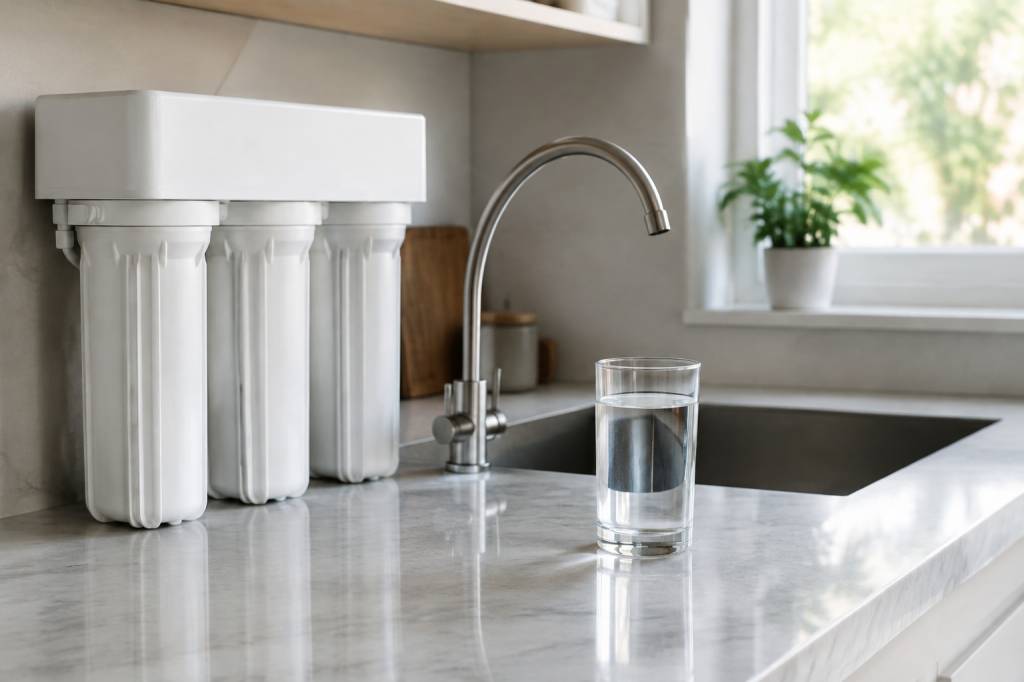
Choosing a water filter for PFAS removal is not as simple as picking the product with the largest number of claims on its packaging. “Reduces contaminants” can mean many things, and a filter that improves taste or removes chlorine may have little effect on per- and polyfluoroalkyl substances (PFAS).
PFAS are a large group of persistent chemicals used in applications ranging from firefighting foams and non-stick coatings to water-resistant textiles and food packaging. Some PFAS have been linked to effects on the immune system, cholesterol levels, liver function and development. Because they are highly persistent and can travel through water systems, they are often described as “forever chemicals”.
If you are considering a domestic water filter, the key question is not simply “Does it filter water?” It is: “Has this specific model been independently tested to reduce the PFAS that matter, under conditions similar to those in my home?”
Start by understanding the PFAS risk in your water
A filter is only as useful as the problem it is designed to address. Before buying one, find out whether PFAS have been detected in your local water supply, private well or source water.
In the UK, public water suppliers publish information about water quality, although PFAS data may not always be presented in a straightforward format. You can contact your water company and ask specifically whether monitoring has been carried out for substances such as:
- PFOS, or perfluorooctane sulfonic acid;
- PFOA, or perfluorooctanoic acid;
- PFHxS and PFHxA;
- GenX chemicals, where relevant;
- the wider group of PFAS included in the company’s monitoring programme.
If you use a private well, responsibility for testing rests with you. A laboratory accredited to ISO/IEC 17025 can advise on sampling and analysis. PFAS testing is technically demanding, and ordinary water testing kits are unlikely to provide reliable results. A laboratory report should identify the analytical method, reporting limits and individual PFAS measured.
It is also important to remember that a non-detect result does not necessarily mean that no PFAS are present. It means that the concentration was below the laboratory’s reporting limit. That distinction matters when dealing with contaminants that may be present at very low levels.
Look for a specific PFAS reduction claim
The first filter-selection rule is simple: avoid vague wording.
Terms such as “purifies water”, “removes toxins” or “advanced filtration” are not proof of PFAS performance. Neither is a general claim that a filter removes “chemicals”. Ask for evidence that the product has been tested specifically for PFAS reduction.
A credible product page or performance data sheet should state:
- which PFAS have been tested;
- the percentage or concentration reduction achieved;
- the starting concentration used in the test;
- the total volume of water treated;
- the flow rate and pressure conditions;
- the replacement interval;
- the testing organisation and applicable standard.
Pay close attention to the difference between tested for and certified to reduce. A manufacturer may say that a filter has been assessed in a laboratory, but this is not necessarily the same as independent certification against a recognised standard.
Ideally, the evidence should cover both PFOA and PFOS, as well as additional PFAS where possible. Some products are tested only against one compound. That may provide useful information, but it should not be presented as proof that the filter removes the entire PFAS family. There are thousands of PFAS, and they do not all behave identically in water.
Understand the main certification standards
Independent certification can make product comparisons easier, but it is essential to check what the certification actually covers.
In North America, NSF/ANSI 53 is commonly associated with the reduction of certain health-related contaminants, including some PFAS claims. NSF/ANSI 58 applies to reverse osmosis systems. NSF/ANSI 401 covers emerging contaminants, although a standard number alone does not guarantee that a particular product has a PFAS reduction claim.
For PFAS, look for certification listings that explicitly name the relevant substances. A filter certified under a standard for lead, chlorine or cyst reduction is not automatically certified for PFAS.
In the UK and Europe, consumers may encounter references to standards such as BS, EN or ISO documents, alongside manufacturer testing and drinking-water contact requirements. The regulatory landscape is developing, and there is not one universal label that answers every PFAS question for every household filter.
For this reason, check the certifier’s own online database rather than relying only on a logo printed on the box. Search for the exact model number. Certification may apply to one version of a product but not to another, even when the names look almost identical.
A useful rule is this: if you cannot locate the model in an independent certification directory or obtain a complete performance data sheet, treat the PFAS claim with caution.
Compare the technologies used to remove PFAS
Different filter technologies have different strengths. The best choice depends on the PFAS concentration, the volume of water required and the maintenance you are prepared to carry out.
Activated carbon
Granular activated carbon and carbon block filters can reduce several PFAS, particularly longer-chain compounds such as PFOS and PFOA. Their performance depends on the carbon type, bed depth, contact time, flow rate and contaminant concentration.
Carbon filters may be installed under the sink, in a countertop unit, inside a refrigerator or as part of a whole-house system. They can be practical and relatively affordable, but they are not maintenance-free. Once the carbon becomes saturated, contaminants may begin to pass through. In some circumstances, breakthrough can happen gradually without any change in taste or smell.
A filter with a small carbon cartridge and a high flow rate may offer less protection than a larger system designed to provide longer contact time. Do not compare products based solely on the amount of carbon claimed by the manufacturer; look for independently verified capacity and operating conditions.
Reverse osmosis
Reverse osmosis (RO) pushes water through a semi-permeable membrane under pressure. Properly designed systems can remove a broad range of dissolved contaminants, including many PFAS, along with salts, metals and other substances.
RO systems are often installed under the kitchen sink and typically include pre-filters, a membrane and a post-filter. They may require a storage tank and can produce wastewater during operation. Some modern systems reduce the wastewater ratio, but the product specification should state this clearly.
RO is not automatically the best option for every household. It usually costs more, needs regular servicing and may remove minerals that some users prefer to retain. The membrane and cartridges must be replaced according to the manufacturer’s schedule. A neglected RO unit is not a high-tech solution; it is simply an overdue maintenance problem.
Ion exchange and other media
Ion exchange resins can remove particular PFAS, especially when used in engineered treatment systems. However, performance varies considerably between resin types and operating conditions. Household buyers should be cautious of products that mention “special media” without explaining what has been tested.
Some systems combine activated carbon, ion exchange and membrane filtration. Multiple stages can provide broader treatment, but more stages also mean more components to maintain. Complexity is useful only when the performance data support it.
Choose between point-of-use and whole-house filtration
For most households, a point-of-use filter treats water at a single tap, usually the kitchen tap used for drinking and cooking. This is often the most economical approach because it focuses treatment where exposure through ingestion is most relevant.
Point-of-use options include:
- under-sink carbon or reverse osmosis systems;
- countertop units;
- certified filter jugs;
- filtered-water dispensers;
- refrigerator filters with a verified PFAS claim.
A whole-house filter treats water entering the property. This may be appropriate where PFAS levels are elevated, several occupants need treated water or there is a private well with broader contamination concerns. However, whole-house systems are more expensive and may require professional installation, larger replacement cartridges and careful management of flow rates.
Whole-house treatment may also create a false sense of security if the product has not been tested at the home’s actual flow demand. A system that performs well in a laboratory at a low flow rate may not provide the same contact time when several showers, taps or appliances operate simultaneously.
Where the main concern is drinking water, a certified point-of-use system can be a more practical starting point than treating every litre used for toilet flushing, gardening and cleaning.
Check capacity, flow rate and replacement intervals
Filter performance is not permanent. Every cartridge has a treatment capacity, even if the packaging does not make that limitation prominent.
When comparing products, ask:
- How many litres can the filter treat before replacement?
- Is that capacity based on PFAS testing or only on chlorine reduction?
- Does the capacity change when the incoming water contains high levels of organic matter?
- What happens if the filter is used beyond the stated interval?
- Is there a flow indicator or replacement reminder?
Estimate your household’s water use. A small filter rated for 1,000 litres may last much longer in a one-person household than in a family of four. But the calendar interval also matters. Manufacturers may recommend replacement after a set number of months, even if the maximum volume has not been reached, because stored cartridges can become unhygienic or lose performance.
Do not wait for an unpleasant taste before replacing the cartridge. PFAS are generally tasteless and odourless. Taste is a poor warning system.
Inspect the installation and maintenance requirements
A certified filter can still perform poorly if it is installed incorrectly. Check whether the system requires a specific pressure range, a dedicated tap, a restrictor or a pre-treatment stage for sediment and hardness.
Follow the instructions for flushing a new cartridge. This may remove manufacturing dust or carbon fines and ensure that the media is properly wetted. Replace damaged housings, seals and tubing promptly, and clean reusable components as directed.
Keep a simple maintenance record showing:
- the installation date;
- the cartridge model;
- the date and volume of replacement;
- any changes in water pressure, taste or leakage.
If a household filter is connected directly to drinking-water plumbing, use components suitable for potable water. A product made for aquarium use, shower water or general utility water should not automatically be assumed safe for drinking water.
Be careful with marketing language
PFAS marketing has become more common, and not every claim is equally meaningful. Watch for phrases such as “tested to NSF standards” without a statement of which standard, contaminant and model are involved. “Removes up to 99%” also needs context: 99% of what, under which conditions, and for how many litres?
Look for a downloadable performance data sheet rather than relying on customer reviews. Reviews can reveal installation problems and usability issues, but they cannot verify chemical removal. A filter may make water taste better while having no measurable effect on PFAS.
Be wary of products that claim to remove all PFAS without qualification. A responsible manufacturer should explain the compounds tested and the limits of the technology. Precision is more reassuring than a miracle claim.
Use independent testing when the stakes are high
If your water source has confirmed PFAS contamination, or if you rely on a private well near an industrial site, airport, landfill or historical firefighting-training area, consider testing treated water as well as untreated water.
Take samples according to the laboratory’s instructions. PFAS can be introduced from some sampling materials, so laboratories may specify particular containers, tubing and handling procedures. Testing should be performed by a suitably accredited laboratory, and the results should be interpreted alongside the relevant UK drinking-water guidance or regulatory limits.
For a domestic filter, independent testing can answer three practical questions:
- What is the PFAS concentration before filtration?
- What is the concentration after filtration?
- Does performance remain acceptable near the end of the cartridge’s service life?
That final question is particularly valuable. A new cartridge may perform well, while an exhausted cartridge may not. Testing only immediately after installation provides a snapshot, not a complete picture.
A practical buying checklist
Before purchasing a filter, use this checklist:
- Identify whether PFAS have been detected in your water.
- Choose a point-of-use or whole-house system based on your actual needs.
- Look for an explicit PFAS reduction claim for the exact model.
- Verify independent certification through the certifier’s database.
- Check whether PFOA, PFOS and other relevant PFAS were tested.
- Review the test conditions, capacity and flow rate.
- Calculate the annual cost of replacement cartridges and servicing.
- Confirm that all components are suitable for drinking water.
- Follow installation, flushing and replacement instructions.
- Consider laboratory testing if contamination is known or suspected.
The most reliable PFAS filter is not necessarily the most expensive, the most heavily advertised or the one with the greatest number of stages. It is the system with transparent evidence, a realistic capacity, appropriate certification and a maintenance plan that you will actually follow.
PFAS contamination is a complex environmental problem, but choosing a household filter does not have to be guesswork. Start with measured water quality, examine the evidence behind the claim and treat maintenance as part of the filtration system—not as an optional extra.