

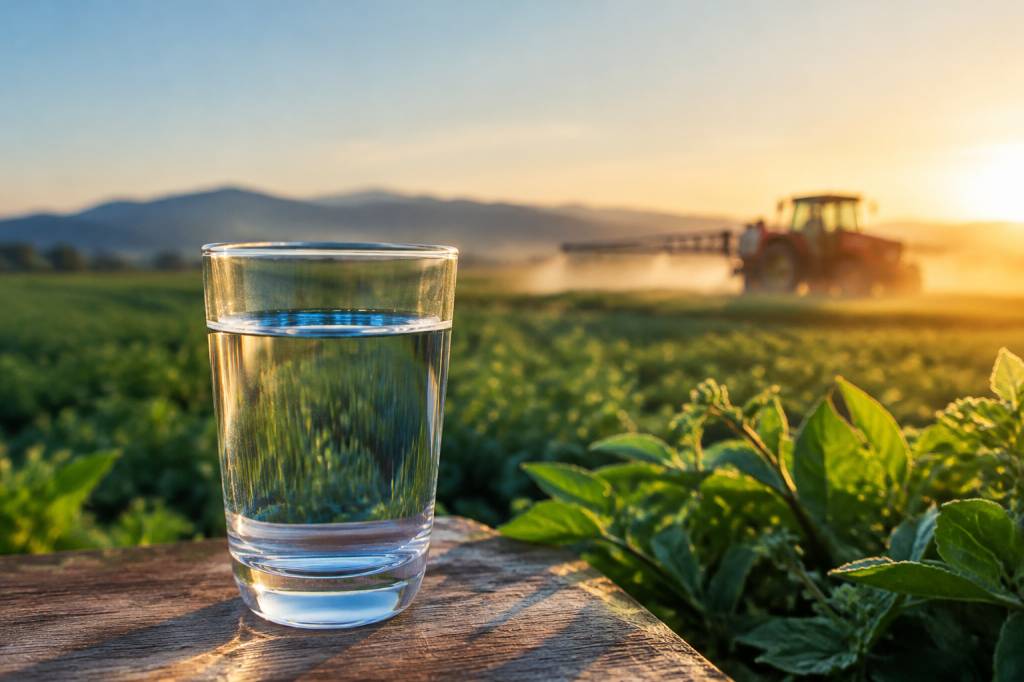
A glass of tap water can look and taste perfectly normal while containing traces of an agricultural chemical. That does not automatically mean it is dangerous: risk depends on which substance is present, its concentration and how long people are exposed. But herbicides and other pesticides in drinking water deserve careful attention, particularly for households using private wells or living near intensively farmed land.
Here is what the evidence says about potential health effects, how water supplies are monitored and which treatment methods can reduce contamination.
What are herbicides and pesticides?
Pesticides are substances used to prevent, control or destroy organisms considered harmful. The term covers several groups, including insecticides, fungicides and herbicides. Herbicides target unwanted plants and are used in agriculture, gardens, parks and along roads or railways.
These chemicals can reach water through spray drift, rainfall washing residues off fields, spills, or movement through soil into groundwater. Some break down relatively quickly; others persist for longer or form by-products that can also be relevant to water quality. A substance’s behaviour depends on its chemistry, how it is used, and local conditions such as soil type and rainfall.
Finding a pesticide in water does not, by itself, tell us whether the water poses a health risk. The name of the chemical, the measured level and the pattern of exposure all matter.
How do pesticides get into drinking water?
Rivers, reservoirs and groundwater can all be affected. Surface water may receive runoff after heavy rain, especially where treated land drains into streams. Groundwater contamination can take longer to appear, but once a chemical reaches an aquifer, it may be difficult to remove at the source.
Public water suppliers generally treat water from multiple sources and monitor it for a range of substances. Private supplies, such as wells and boreholes, may not receive the same routine testing or treatment. If a well is close to farmland, a pesticide store, a treated garden or a drainage channel, testing is a sensible precaution—not because contamination is certain, but because it can be invisible.
For example, after a period of intense rain, runoff from a recently treated field may carry residues into a nearby stream. A water company may be able to blend or treat that source, while a household relying on a shallow private well may have no such protection unless it has arranged testing and treatment.
What health risks are associated with exposure?
There is no single health effect shared by all pesticides. Each chemical has its own toxicology, and effects depend on dose, route and duration of exposure. Some pesticides can affect the nervous system at sufficiently high doses; others have been studied for possible effects on the liver, hormone systems, development or cancer risk. Evidence varies by substance, and a hazard identified in laboratory research does not automatically mean that the concentrations found in drinking water will cause harm.
Short-term exposure to a high concentration can cause acute poisoning, but that is different from the low-level exposure that water monitoring is designed to control. For most people, the key question is whether exposure over time is high enough to present a meaningful risk. Infants, pregnant people and individuals with particular health conditions may warrant extra care, but specific advice should be based on the contaminant identified and guidance from a qualified health professional or relevant public authority.
It is also important not to treat “pesticide” as if it were one chemical. A test showing a trace of one herbicide cannot be used to predict the effects of a different insecticide. Reliable interpretation requires the substance’s identity, concentration and applicable health-based guidance.
What do drinking water standards mean?
In England and Wales, drinking water rules set a parametric value of 0.1 micrograms per litre for an individual pesticide, with a general total-pesticide value of 0.5 micrograms per litre. Some substances have a lower individual value. These legal limits are used to manage water quality; they are not a simple boundary between “safe” and “poisonous”. A result above a standard calls for investigation and appropriate action, while a result below it does not mean that every possible health question has been settled.
Standards and monitoring requirements can differ between jurisdictions and may change. Scotland and Northern Ireland have their own regulatory arrangements, and limits for particular substances should be checked against current local rules. The Drinking Water Inspectorate (DWI) publishes information on the regulation of public supplies in England and Wales. The World Health Organization also provides chemical-specific guidance values for many pesticides.
If you receive water from a public supplier, check its water quality reports or contact the supplier if you have a concern. For a private supply, ask your local authority about testing requirements and use a laboratory accredited for drinking-water analysis. A general “water test” may not include the pesticide you need to investigate.
How to find out whether your water is affected
Start with the source. Public water suppliers usually publish quality information and can explain whether a particular substance has been detected in the supply. If you use a private well or borehole, arrange testing through your local authority or an appropriately accredited laboratory, especially if the supply is near agricultural activity or a known contamination source.
Before ordering a test, identify the chemicals of concern where possible. A laboratory can advise on the right analytical panel, sampling bottle and handling instructions. Follow these instructions closely: incorrect sampling or storage can affect results. Keep a copy of the report, including the detection limit, units and date, and ask the laboratory or local authority to explain any result you do not understand.
If a public supply has a confirmed problem, follow advice from the water supplier and relevant authorities. If a private supply result is above a relevant standard or guideline, seek advice before relying on a household filter alone. The response may involve repeat testing, an alternative source, treatment, or investigation of the contamination source.
Which treatment methods can remove pesticides?
The right treatment depends on the chemical. A system that reduces one pesticide may not work well for another, so claims such as “removes all chemicals” should be treated with caution. For a confirmed contamination issue, ask a water-treatment professional or public-health authority to match the treatment to the laboratory result.
- Granular activated carbon (GAC): Activated carbon can adsorb many organic compounds, including some pesticides. Performance depends on the chemical, carbon type, contact time and how much contaminant the filter has already collected. Filters need to be replaced or maintained as directed; exhausted carbon may no longer provide reliable treatment.
- Reverse osmosis (RO): RO systems can reduce a range of dissolved contaminants, including many pesticides, but performance varies by substance and system design. Check independent test data for the specific contaminant and maintain the unit according to its instructions. RO also produces a reject-water stream and may remove minerals as well as unwanted substances.
- Specialist treatment: Some water supplies use processes such as advanced oxidation or combinations of treatment methods. These are designed and operated for particular water conditions; they are not a one-size-fits-all household fix. Oxidation can transform a contaminant, so treatment design should account for any by-products.
For a household system, look for independent certification or test results that name the specific pesticide and show the reduction achieved under defined conditions. Certification for taste, chlorine or lead does not prove that a product removes herbicides. Installation, flow rate, cartridge life and servicing all affect real-world performance.
What will not reliably remove pesticide residues?
Boiling water is not a dependable way to remove pesticides. It can kill many disease-causing microorganisms, but it does not reliably remove dissolved chemicals; evaporation may even concentrate some non-volatile substances. Boil-water advice from authorities is intended for microbiological risks, not as a general chemical-treatment method.
Ordinary jug filters can improve taste or reduce certain substances, but their performance is product-specific. Do not assume that a jug filter removes a pesticide unless the manufacturer provides credible, independent evidence for that exact chemical. Likewise, settling water, using a standard sediment filter or adding household disinfectant will not generally remove dissolved pesticide residues.
Practical steps for households
- Find out whether your water comes from a public supply or a private source.
- Check supplier reports or arrange targeted testing if you use a private well or have a specific reason for concern.
- Use an accredited laboratory and follow its sampling instructions carefully.
- Choose treatment based on the identified chemical and verified performance, not broad marketing claims.
- Replace cartridges and maintain equipment on schedule, then retest if advised.
- Report suspected pollution to the relevant water supplier, local authority or environmental regulator.
Reducing pesticide pollution at source is as important as treating water after contamination occurs. Careful application, good storage, buffer zones near waterways and responsible management of runoff can all help limit the amount that reaches rivers and groundwater.
Reliable information matters
A detection is a reason to ask questions, not a reason to panic. The most useful next steps are to identify the chemical, confirm the concentration with a suitable test and compare the result with current, local guidance. Public water suppliers and regulators can explain what is being monitored; accredited laboratories can provide targeted analysis; and treatment should be selected for the contaminant actually found.
For further information, consult the Drinking Water Inspectorate, your local authority, the relevant environmental regulator and the World Health Organization’s chemical-specific drinking-water guidance. These sources help put a test result into context—and distinguish a measurable trace from a level that requires action.