


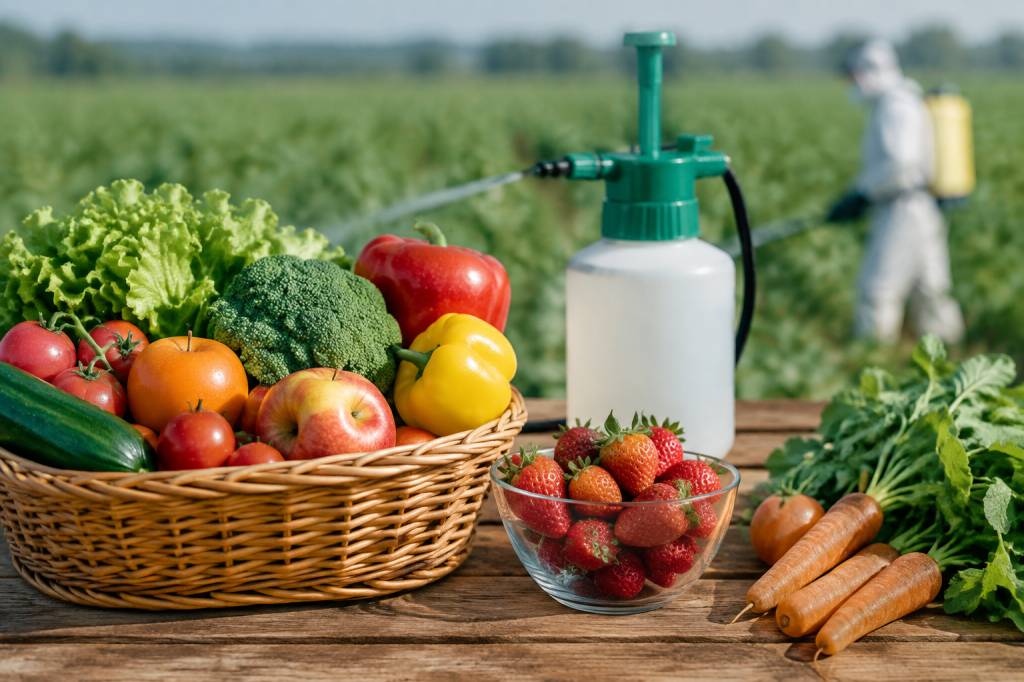
Fresh produce is often presented as an uncomplicated choice: colourful, nutritious and good for you. But some fruit and vegetables carry traces of pesticides used to protect crops from insects, weeds and disease. What do those residues mean for our health—and what happens when pesticides move beyond the field into soil, rivers and wildlife?
The answer is not simply that every detectable residue is dangerous, or that pesticide use is harmless whenever it follows the rules. Risk depends on the chemical, the amount, how often people are exposed and how sensitive they are. Understanding those distinctions helps put food monitoring results in perspective and points to practical ways of reducing exposure.
What counts as a pesticide residue?
Pesticides are substances used to control pests. The term includes insecticides, herbicides and fungicides, as well as products used to regulate plant growth or protect stored crops. After treatment, small amounts of a pesticide—or of substances formed as it breaks down—may remain on or in food. These are known as residues.
A residue can be present even when a farmer has followed approved instructions. Weather, crop type, application timing and how quickly a chemical degrades all affect what remains at harvest. Some pesticides are absorbed into plant tissue; others mostly remain on the surface. That difference matters when considering how much washing or peeling can achieve.
Residues are also distinct from contamination caused by an accidental spill or improper use. A monitoring programme finding traces in food does not, by itself, show that the food is unsafe. The important questions are what was detected, at what level, and how that compares with health-based guidance and legal limits.
How are residue limits set?
In the UK, pesticide residues in food are monitored through government programmes, including work reported by the Expert Committee on Pesticide Residues in Food. The Health and Safety Executive assesses pesticides for authorisation, while food safety authorities oversee standards and enforcement. The UK maximum residue level, or MRL, is the highest concentration legally permitted for a pesticide in a particular food.
An MRL is generally set using evidence about approved agricultural use and is checked against estimates of consumer exposure. It is not a line dividing “safe” from “poisonous”. A sample exceeding an MRL is a compliance issue that may prompt investigation or enforcement; it does not automatically mean that eating the food will cause harm. Conversely, staying below an MRL is not a guarantee that every conceivable exposure scenario has been tested.
Regulators also assess toxicological evidence, including the acceptable daily intake: an estimate of how much of a substance can be consumed daily over a lifetime without appreciable health risk. Acute reference doses are used to assess the risk from a short-term, high exposure. These assessments include safety factors to account for uncertainty, including differences between people.
For current UK findings, consult the government’s annual Pesticide Residues in Food report. The European Food Safety Authority (EFSA) also publishes annual monitoring results for European countries. Read the details, not just a headline about “pesticides found”: a detection may be below the legal limit, while a result above a limit requires a closer look at the substance and estimated exposure.
What could residues mean for human health?
At sufficiently high doses, some pesticides can affect the nervous system, hormones, liver or other body functions. The effects depend on the compound and dose; pesticides are not one uniform class of chemical. That is why it is misleading to treat a trace detection as proof of harm—or to assume that all substances called pesticides carry the same risk.
For most people, regulators assess the expected dietary exposure from approved pesticide uses and compare it with health-based guidance. Monitoring results and risk assessments are designed to identify when exposure may be of concern. However, uncertainty remains, particularly around long-term exposure to mixtures of chemicals and the effects of low doses over many years. Mixture assessment is an active area of research, and methods continue to develop.
Some groups deserve particular attention. Children may consume more food relative to their body weight than adults, and their bodies are still developing. Pregnant people and those with certain health conditions may also have different vulnerabilities. Regulatory assessments account for sensitive groups, but public health guidance generally recommends following food safety advice rather than avoiding nutritious foods because of fear about residues.
Evidence about pesticide exposure in agricultural workers can be more direct than evidence about residues in the general food supply. Workers may handle concentrated products or experience repeated exposure during mixing, spraying and re-entry to treated fields. Exposure controls, protective equipment, training and enforcement therefore matter alongside consumer monitoring.
Why a detection is not the whole story
Modern laboratory tests can detect extremely small concentrations—sometimes far below levels that would be expected to cause harm. “Detected” describes what an instrument measured; it is not a medical diagnosis. To interpret a result, you need the pesticide’s identity, the concentration, the food involved and the amount a person might realistically eat.
It is also useful to distinguish pesticide residues from PFAS. PFAS are a large group of highly persistent chemicals, and some have been used in pesticide-related applications or may occur as environmental contaminants. But not every pesticide is a PFAS, and not every residue has the same environmental behaviour. Where a particular PFAS is relevant, its persistence and potential for long-range movement need to be assessed specifically.
This distinction matters because persistent chemicals may remain in the environment much longer than pesticides that break down relatively quickly. Chemical names and technical classifications can be confusing, but grouping substances together simply because they are “chemicals” obscures the differences that risk assessment depends on.
How pesticides affect ecosystems
A pesticide applied to a crop does not necessarily stay on that crop. Wind can carry spray beyond the field; rain can wash residues into drains and streams; and chemicals can bind to soil, move through it or break down into other substances. The route and duration vary widely by product, soil type, weather and farming practice.
Non-target species may be affected. Insecticides can harm beneficial insects as well as crop pests, while herbicides can alter the plants that provide food and habitat for insects and birds. Aquatic organisms may be exposed when pesticides reach surface water. The consequences can range from short-term toxicity to wider changes in food webs and habitat quality.
For example, a treatment intended to control an insect pest may also affect pollinators if exposure occurs while they are foraging. The risk depends on the pesticide, dose, timing, application method and the pollinator species. This is one reason why restrictions, buffer zones, integrated pest management and careful timing can be important—not merely administrative hurdles.
Monitoring of water can reveal pressures that food testing alone cannot. A residue may be within food limits yet still raise environmental concerns if it repeatedly enters a stream or affects sensitive aquatic life. Conversely, detecting a pesticide in water does not automatically establish ecological damage: concentration, duration and toxicity all matter.
Does washing or peeling help?
Rinsing fruit and vegetables under clean running water can remove soil, some surface residues and microbes. Gently rubbing firm produce, such as apples or cucumbers, may help. The UK Food Standards Agency advises washing fruit and vegetables before eating or preparing them, unless the product is labelled as ready to eat.
Washing is useful, but it is not a chemical force field. It may do little to remove pesticides that have been absorbed into the plant, and the effect differs from one pesticide and food to another. Peeling can reduce some residues on the surface, but it may also remove fibre and nutrients. There is no need to use soap or household cleaning products on produce.
Cooking, blanching or processing can reduce some residues, leave others largely unchanged or occasionally concentrate them as water is removed. The outcome depends on the chemical and method. Good kitchen hygiene remains worthwhile, but it should not be presented as a way to eliminate every possible residue.
Practical ways to reduce exposure
For most households, the aim is sensible risk reduction without sacrificing fruit and vegetables. A varied diet also helps avoid relying heavily on one crop or one source of produce.
-
Wash fresh produce under running water and rub firm items gently. Remove damaged outer leaves where appropriate.
-
Vary the fruit, vegetables and suppliers you buy. Variety is a practical way to avoid repeatedly choosing the same foods.
-
Follow food safety advice and pay attention to official monitoring updates rather than making decisions from isolated social media claims.
-
Choose organic produce if it suits your budget and priorities. Organic standards restrict many synthetic pesticides, but they do not mean that food is guaranteed to contain no residues; approved substances and environmental contamination can still be relevant.
-
Support farming approaches that reduce reliance on routine chemical controls, including integrated pest management, crop rotation and habitat that supports natural pest predators.
There is no need to treat organic food as the only safe option. The health benefits of eating a range of fruit and vegetables are well established, and concern about residues should not become a reason to avoid produce altogether.
What should happen next?
Residue monitoring is most useful when it is transparent, regular and linked to action. Authorities need to publish which foods and chemicals were tested, how results compare with legal limits and what happens when a limit is exceeded. Farmers need clear guidance and workable tools to protect crops while reducing risks to workers, wildlife and water.
Researchers are also improving methods for assessing combined exposures and tracking pesticides and their breakdown products in the environment. For communities concerned about local pollution, water-quality monitoring can add an important piece of evidence—but results should be interpreted by qualified experts and compared with appropriate standards.
Food residues are a genuine subject for scrutiny, not a reason for panic. A measured approach recognises that pesticide rules and monitoring reduce risks, while also asking whether current practices adequately protect people and ecosystems. The most useful questions are specific: which substance, at what level, through what route, and with what evidence of harm?