


When a drinking water quality report lands in your inbox, it can feel a bit like reading a medical scan in a language you never studied. Numbers, thresholds, acronyms, trace levels, “non-detects,” and the occasional warning about contaminants you can’t pronounce. Among the most concerning of these are PFAS, a family of persistent chemicals now found in water supplies across many regions. If your report mentions PFAS, or if you simply want to know how safe your tap water really is, the key is to understand what the numbers mean and what actions actually reduce risk.
PFAS have earned the nickname “forever chemicals” for a reason. They break down extremely slowly in the environment and can accumulate in water, soil, wildlife, and the human body. That persistence is exactly why drinking water quality reports matter: they are one of the few practical tools households and communities have to identify exposure and decide what to do next.
What PFAS are and why they show up in drinking water
PFAS, or per- and polyfluoroalkyl substances, are a large class of synthetic chemicals used for decades in products that resist heat, water, oil, and stains. They have appeared in firefighting foam, food packaging, non-stick coatings, stain-resistant fabrics, industrial processes, and even some consumer goods.
The problem is not just how widely they have been used, but how easily they move. Once PFAS enter rivers, groundwater, or reservoirs, conventional water treatment is often not enough to remove them. They can travel from industrial sites, airports, military bases, landfills, wastewater discharges, and contaminated soils into drinking water sources.
This is why a water quality report can be more than a regulatory document. It can be an early warning system.
A few things make PFAS especially troubling:
- They do not readily degrade in the environment.
- Some PFAS can accumulate in the human body over time.
- They may be present at very low concentrations that still matter for long-term exposure.
- Different PFAS compounds can behave differently, making testing and regulation more complex.
How to read a drinking water quality report without getting lost
Drinking water reports vary by country, utility, and testing framework, but the basic structure is usually the same: source information, contaminant results, regulatory limits, and whether any exceedances were recorded. If PFAS are included, the report may list specific compounds such as PFOA, PFOS, PFHxS, PFNA, or a grouped metric such as “total PFAS” or “sum of PFAS.”
Start by identifying three things:
- Which PFAS were tested — a report may only test a handful of compounds, even though hundreds exist.
- What the result unit is — typically nanograms per litre (ng/L) or parts per trillion (ppt).
- What benchmark is being used — this could be a legal limit, a health advisory, or an internal utility target.
Here’s the catch: a result marked “below detection limit” does not always mean “zero.” It usually means the compound was not detected above the method’s measurable threshold. If that threshold is higher than a health-based target, there may still be a gap between what was found and what would be considered ideal.
It’s also important to notice whether the report lists only “regulated” contaminants. PFAS regulations are still evolving in many places, and some compounds may not yet be routinely monitored, even if they are present.
Why PFAS testing matters even when water looks clean
PFAS are invisible, tasteless, and odourless. That makes them particularly difficult for households to detect without a report or laboratory testing. Clear water is not the same as safe water. In fact, the contaminant you cannot see may be the one that deserves the most attention.
Testing matters for several reasons. First, it helps determine whether your drinking water source is affected. Second, it gives you a baseline for comparing changes over time. Third, it helps you choose the right treatment solution, because not all filters are equally effective against PFAS.
There is also a practical reality: PFAS exposure is often cumulative. A single glass of water is not the issue. The concern is long-term, repeated exposure from water, food, and other sources. That is why the quality report is useful not just as a snapshot, but as part of a wider exposure assessment.
For households relying on private wells, the stakes can be even higher. Unlike public water systems, private wells are often not subject to routine monitoring unless the owner arranges it. If your home uses a well and PFAS contamination is suspected nearby, testing should be treated as a priority rather than an optional extra.
What the science says about PFAS health risks
The health effects linked to PFAS depend on the specific compound, the level of exposure, and how long exposure has lasted. Research has associated certain PFAS with increased cholesterol, immune system effects, liver impacts, reproductive concerns, developmental effects, and changes in thyroid function.
That does not mean every person exposed to PFAS will become ill. It does mean the evidence is strong enough for health agencies and regulators to treat PFAS as a serious drinking water issue, particularly because exposure can start early in life and continue over years.
A few points are worth keeping in mind:
- Some PFAS remain in the human body for years.
- Children, pregnant people, and communities with higher water exposure may face greater concern.
- Health risk is influenced by total exposure, not drinking water alone.
- Even low concentrations can matter when exposure is continuous.
One reason PFAS reporting can feel frustrating is that scientific understanding continues to evolve. But uncertainty should not be mistaken for safety. When a contaminant is persistent, mobile, and linked to harmful outcomes, waiting for perfect information is rarely a good strategy.
Regulatory limits and why they can be confusing
If you compare drinking water quality reports from different regions, you may notice that PFAS limits do not always match. That is because regulation is still catching up with the science. Some jurisdictions set limits for a few individual PFAS, while others use a combined threshold or are still developing formal standards.
This creates a common problem for consumers: a water report may show compliance with current law, while health researchers or advocacy groups argue that the acceptable level should be lower.
In other words, “meets regulatory standards” and “best available protection” are not always the same thing. That distinction matters, especially for households trying to decide whether to install filtration.
When reading the report, check whether it includes:
- Individual PFAS limits
- A combined PFAS threshold
- Historical data showing trends over time
- Sampling dates and locations
- Notes about treatment changes or source water changes
A single test result is useful, but repeated sampling gives a much clearer picture. PFAS levels can change depending on source water conditions, seasonal variation, and treatment system performance.
When should you test your water for PFAS?
If your local report already lists PFAS results, that is a strong starting point. But there are situations where additional household testing makes sense. This is especially true if your area is near a known contamination source or if the public report is limited.
You should strongly consider testing if:
- You rely on a private well.
- There is an airport, military base, industrial site, landfill, or wastewater discharge nearby.
- Your utility report does not include PFAS data.
- You want to verify the performance of an existing filter.
- You have an infant, pregnant household member, or medically vulnerable person in the home.
Testing can be done through certified laboratories or through local environmental or public health programs, depending on your area. The key is to choose a method that is sensitive enough to detect PFAS at the relevant concentrations. For these chemicals, “good enough” can be surprisingly inadequate.
For homeowners, a lab report can also help with decisions beyond filtration. It may support discussions with local authorities, inform property assessments, or provide evidence if contamination becomes a broader community issue.
What filtration solutions actually work for PFAS
Not all water filters remove PFAS effectively. This is where marketing claims can become a real problem. A carbon pitcher that improves taste may not be the same thing as a treatment device capable of reducing PFAS to meaningful levels.
The most widely recommended options for PFAS reduction are activated carbon, reverse osmosis, and ion exchange systems, but effectiveness depends on design, maintenance, and the specific PFAS present.
Activated carbon can be effective for some PFAS, especially longer-chain compounds, though performance depends on contact time, filter quality, and timely replacement. It is often used in under-sink systems and whole-house setups, but the media eventually saturates.
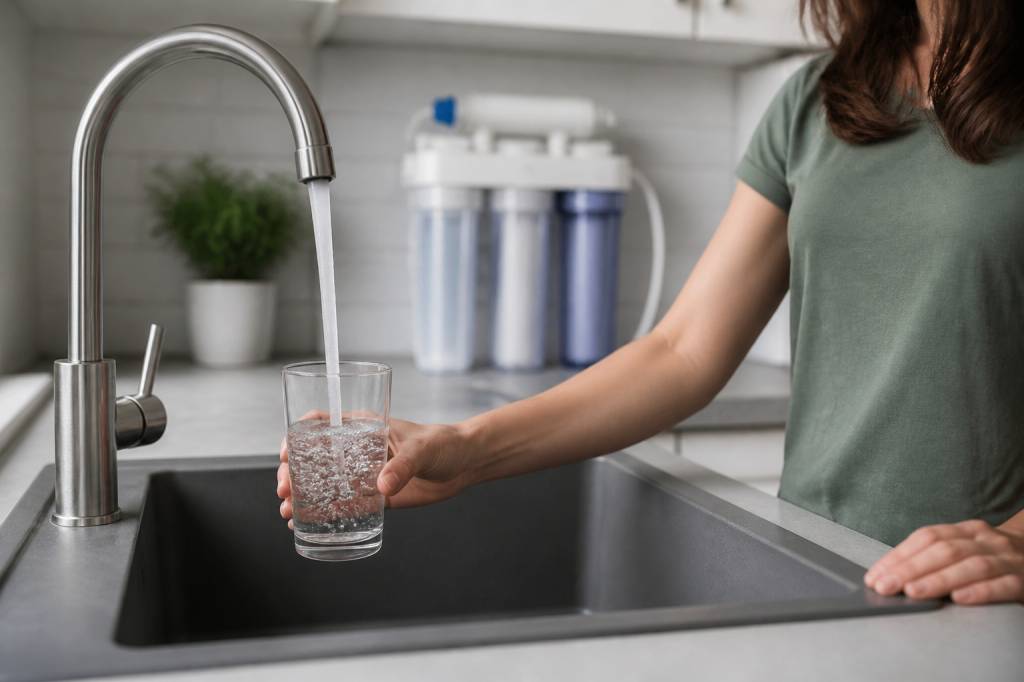
Reverse osmosis is generally one of the most effective point-of-use solutions for PFAS because it uses a semi-permeable membrane to remove a wide range of dissolved contaminants. It is commonly installed at the kitchen tap for drinking and cooking water. The trade-off is that it produces wastewater and requires regular maintenance.
Ion exchange systems can also target PFAS effectively, particularly in larger-scale or specialty applications. These are often used in utility treatment systems or advanced home systems, depending on configuration.
When evaluating a filter, ask these questions:
- Is the system independently certified for PFAS reduction?
- Which PFAS compounds were tested?
- What is the filter’s capacity before replacement?
- Does the system treat the whole house or only drinking water at one tap?
- How easy is it to maintain properly over time?
That last point matters more than people think. A high-performance filter that is never changed is just an expensive piece of plumbing with ambitions.
Choosing between whole-house and point-of-use treatment
For most households, the decision comes down to where PFAS reduction is most needed. If the concern is drinking and cooking water, a point-of-use system under the sink may be the most cost-effective option. If PFAS exposure through showering, bathing, or household use is also a concern, a whole-house system may be worth exploring, although it is generally more expensive and more complex to maintain.
Since PFAS are not easily absorbed through the skin in the same way as they are ingested, the main health concern remains drinking and eating. That said, a whole-house system can still be useful for reducing overall household contamination and for families wanting a broader protective measure.
A practical approach is to start with the tap water most likely to be consumed directly:
- Kitchen drinking water
- Water used for infant formula
- Water used in coffee, tea, and cooking
If budget allows, you can expand from there. But the most urgent risk reduction usually comes from the tap you use every day without thinking.
How to make sense of a “non-detect” or low PFAS result
Low results can be reassuring, but they should be interpreted carefully. A “non-detect” result means the chemical was not found above the test’s detection limit. That detection limit matters. If it is higher than the level at which health concern begins, the report may not be as reassuring as it first appears.
This is why the methods section of the report is important. It tells you what was measured, how it was measured, and how sensitive the analysis was. For PFAS, sensitivity is everything.
If the report seems hard to interpret, a good rule is to focus on three questions:
- Was PFAS actually tested, or only a limited subset?
- What are the results relative to local health-based guidelines?
- Does the water treatment system have proven PFAS removal capability?
If the answer to the last question is no, and there is any credible contamination concern, then filtration may still be a sensible preventive measure.
What households can do right now
PFAS can feel overwhelming because they sit at the intersection of chemistry, regulation, and public health. But there are concrete steps that reduce uncertainty and exposure.
Here is a practical approach:
- Review your local drinking water quality report carefully.
- Check whether PFAS were tested and which compounds were included.
- If you use a private well, arrange certified PFAS testing.
- Choose a filtration system with independent PFAS certification.
- Replace filters on schedule, not when taste changes.
- Monitor updated reports, since PFAS findings can change over time.
If you are supporting a household with higher vulnerability, such as a young child or a pregnant family member, prioritising tested, effective drinking water treatment becomes even more important. The good news is that PFAS exposure from water is one of the more controllable environmental risks, once you know what is in the water and what treatment actually works.
Drinking water quality reports are not always easy reading, but they are worth the effort. They can reveal hidden contamination, point to long-term trends, and guide smarter choices about filtration. And when it comes to PFAS, that knowledge is not just useful — it is one of the best tools we have for reducing exposure at home.