


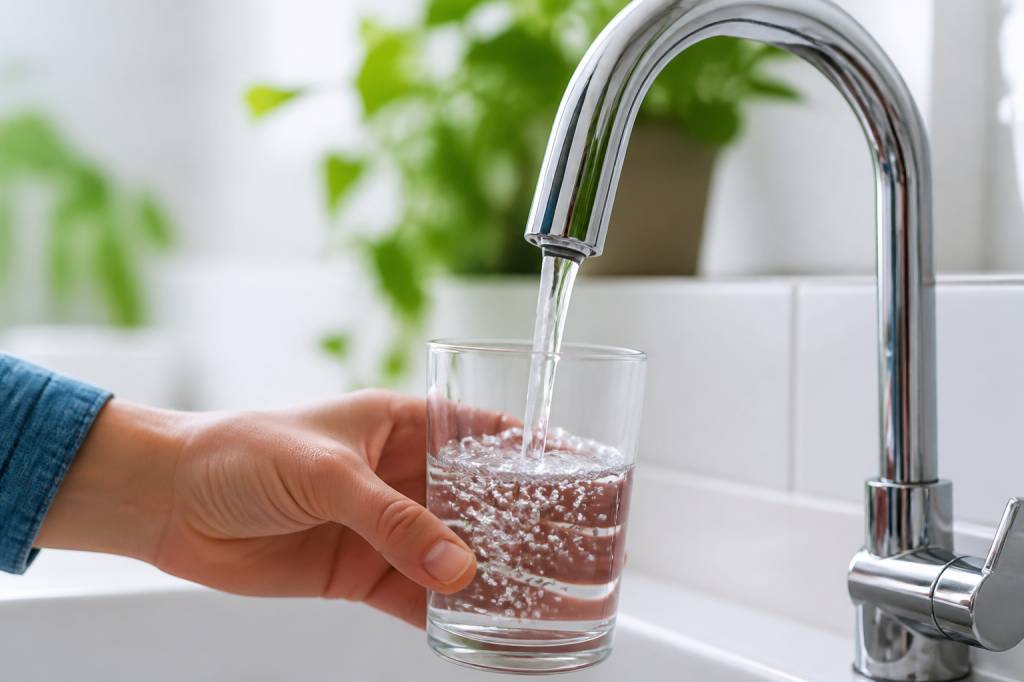
When people talk about drinking water quality, the conversation often jumps straight to contaminants like lead, nitrates, or PFAS. But there is another common feature of tap water that affects everyday life in a much more visible way: hardness. If your kettle fur is building up faster than your patience, or your soap refuses to lather properly, you are probably dealing with hard water.
Water hardness is not usually a health emergency, but it does matter. It influences taste, household plumbing, appliance lifespan, cleaning performance, and, in some cases, how well certain filtration systems work. For households already thinking about water safety and contaminant removal, understanding hardness is a useful first step. Why? Because not every water problem is solved by the same filter.
What water hardness actually means
Water hardness refers to the concentration of dissolved minerals, mainly calcium and magnesium. These minerals are naturally picked up as rainwater moves through soil, limestone, chalk, and other rock formations. The more calcium and magnesium in the water, the harder it is.
There are two main forms of hardness:
In practical terms, hardness is measured in milligrams per litre as calcium carbonate, often written as mg/L as CaCO3. Water is generally classified as soft, moderately hard, hard, or very hard depending on the mineral level.
For example, in the UK, some regions in the south and east are known for hard water because the geology is rich in chalk and limestone. By contrast, areas with granite or sandstone tend to have softer water. Nature, as usual, does the sorting before any utility company gets involved.
Hard water is not the same as unsafe water
This is an important distinction. Hard water is not inherently harmful. In fact, calcium and magnesium are essential minerals in the human diet. Drinking water can contribute a small amount to daily intake, though food remains the main source.
That said, hardness is still relevant to water quality because it affects the way water behaves in pipes, appliances, and treatment systems. A glass of hard water may be perfectly safe to drink, but over time it can leave behind mineral deposits that reduce efficiency and increase maintenance costs.
Soft water, on the other hand, may feel gentler on soap and laundry, but it is not automatically cleaner or safer. Water quality is about much more than hardness. A soft supply can still contain contaminants, and a hard supply can still be microbiologically safe and chemically well regulated.
How to tell if your water is hard
Some signs are obvious. Others are annoyingly subtle until your dishwasher starts complaining.
Common indicators of hard water include:
If you want a more accurate answer, water hardness can be checked through your local water supplier, a water quality report, or a home testing kit. Some suppliers publish hardness figures by postcode or supply zone. That is often the easiest place to start.
It is also worth remembering that hardness can vary geographically even within a country, and in some cases within a utility service area. So a neighbour’s experience may not match yours exactly.
Why hard water matters for household systems
The main problem with hard water is scale. When calcium and magnesium are heated, they can precipitate out of solution and form deposits on heating elements and internal surfaces. This buildup reduces efficiency and can shorten the lifespan of equipment.
Scale is more than a cosmetic issue. It can:
In the home, this adds up. A kettle with heavy limescale may take longer to boil. A dishwasher may leave cloudy marks on glassware. A boiler operating in a hard water area may need descaling or maintenance more frequently than one supplied with softer water.
For water treatment and filtration systems, hardness can also be a design consideration. Some technologies are sensitive to scaling, while others are more robust. Ignoring hardness can reduce the performance of filtration equipment and increase running costs.
Does water hardness affect drinking water taste?
Yes, and taste is one of the first things people notice. Hard water often has a mineral or slightly chalky taste. Some people find this refreshing; others find it unpleasant. Soft water can taste flatter or more neutral.
Taste is subjective, but it matters because people are less likely to drink enough water if they dislike the flavour. That is a practical public health issue, even if it is not as dramatic as a contamination alert.
Hardness can also interact with tea and coffee. In tea, hard water may affect colour and flavour extraction. In coffee, mineral content influences extraction and mouthfeel. This is one reason why cafés often pay close attention to water chemistry, not just filtration.
Hardness and filtration: what filters can and cannot do
This is where many homeowners get confused. Not all filters remove hardness, and not all filters are intended to. A basic jug filter may improve taste or reduce chlorine, but it usually will not remove significant amounts of calcium and magnesium.
Different treatment technologies work in different ways:
If your goal is to prevent limescale, you need a softening or anti-scale solution. If your goal is to improve taste, reduce chlorine, or target specific contaminants, a different system may be appropriate. If your goal is comprehensive treatment, a combination approach may be required.
What this means for PFAS treatment
Because this blog focuses heavily on PFAS, it is worth being very clear: water hardness does not remove PFAS. Calcium and magnesium are not the same as per- and polyfluoroalkyl substances, and a hard water supply can still contain PFAS if the source is contaminated.
Likewise, softening water does not automatically make it safer from a chemical contamination perspective. A water softener may reduce scale, but it is not a PFAS treatment solution.
For PFAS removal, the most commonly discussed household technologies include:
That matters because many households looking into filtration are trying to solve more than one issue at once. They may have hard water, taste concerns, chlorine, and a PFAS question all at the same time. The right system needs to match the problem being solved. A softener alone will not address PFAS, and a PFAS filter may not solve limescale.
How hardness affects different filter types
Hard water can influence filter performance and maintenance. If a system is not designed for mineral-rich water, scale can clog components, reduce flow, or shorten cartridge life.
Here is how hardness can interact with common systems:
In short, hard water can be a quiet sabotage agent. It does not usually announce itself with a crisis. It just slowly makes equipment less efficient until you start noticing the bills.
Should you soften all your drinking water?
Not necessarily. This is where personal needs, local water chemistry, and treatment goals come into play.
Some households prefer softened water throughout the home because it reduces scale and makes cleaning easier. Others choose to soften only part of the supply, or to keep cold kitchen drinking water unsoftened while protecting appliances elsewhere. That approach can make sense because some ion exchange softeners increase sodium slightly in the treated water.
If sodium intake is a concern, especially for people on medically advised low-sodium diets, this is worth discussing with a water treatment professional or clinician. In many cases, the amount added is small, but it should still be considered.
For households worried about both hardness and contaminants like PFAS, a more targeted setup is often best. For example, a softener may be used to protect the plumbing and appliances, while a dedicated point-of-use reverse osmosis system is installed at the kitchen sink for drinking and cooking water.
What to look for in a water treatment setup
If you are evaluating filtration or softening options, focus on the problem first, then the product. That sounds obvious, but many people start with a brand name instead of a water test.
Useful questions include:
Certification and third-party testing matter. A product claim is not the same thing as verified performance. That applies to both softening and contaminant removal.
A practical way to think about water hardness
Hardness is one of those water quality issues that sits between nuisance and necessity. It usually is not dangerous, but it can have real effects on daily life, household costs, and the performance of water treatment systems. It also matters because it can shape how you choose a filter or softener.
If your tap water leaves scale behind, that is telling you something about the mineral content of your supply. If your priority is contaminant removal, especially for concerns like PFAS, hardness should be treated as a separate issue, not a substitute for proper filtration.
The key takeaway is simple: know what is in your water, know what problem you are trying to solve, and choose treatment accordingly. Water chemistry is not glamorous, but it is remarkably good at proving one thing: what you cannot see can still cost you money, time, and efficiency.
Final thoughts for households comparing water quality solutions
Drinking water hardness is one of the most common, and most misunderstood, aspects of domestic water quality. It affects scale, taste, appliance performance, and filter maintenance, but it does not determine whether water is safe on its own. And importantly for readers concerned about PFAS, hardness control is not PFAS removal.
The best approach is evidence-based: test your water, identify your main concerns, and match the treatment technology to the issue. That way, you are not buying a filter that solves the wrong problem very efficiently.
In water treatment, as in environmental health more broadly, precision matters. The more clearly you understand your water, the better equipped you are to protect both your home and your health.