


A bag of spinach and a punnet of strawberries can look like a healthy, straightforward choice. But some shoppers see those foods on the Environmental Working Group’s “Dirty Dozen” list and wonder whether they should be worried about pesticide residues—or even about the water used to grow them.
The list is useful, but it is often misunderstood. It ranks certain fruits and vegetables by pesticide residues detected in US government testing. It does not measure the safety of drinking water, prove that a food is dangerous, or tell you how much pesticide a person has absorbed. Understanding what it does—and does not—show makes it easier to make informed choices without unnecessary alarm.
What is the Dirty Dozen?
The Dirty Dozen is an annual list published by the US-based Environmental Working Group (EWG). It identifies 12 types of conventionally grown produce with the highest pesticide-residue findings in the government samples analysed for that year. EWG uses data from the US Department of Agriculture’s Pesticide Data Program, which tests foods after they have been prepared in ways intended to reflect how people eat them, including washing or peeling where appropriate.
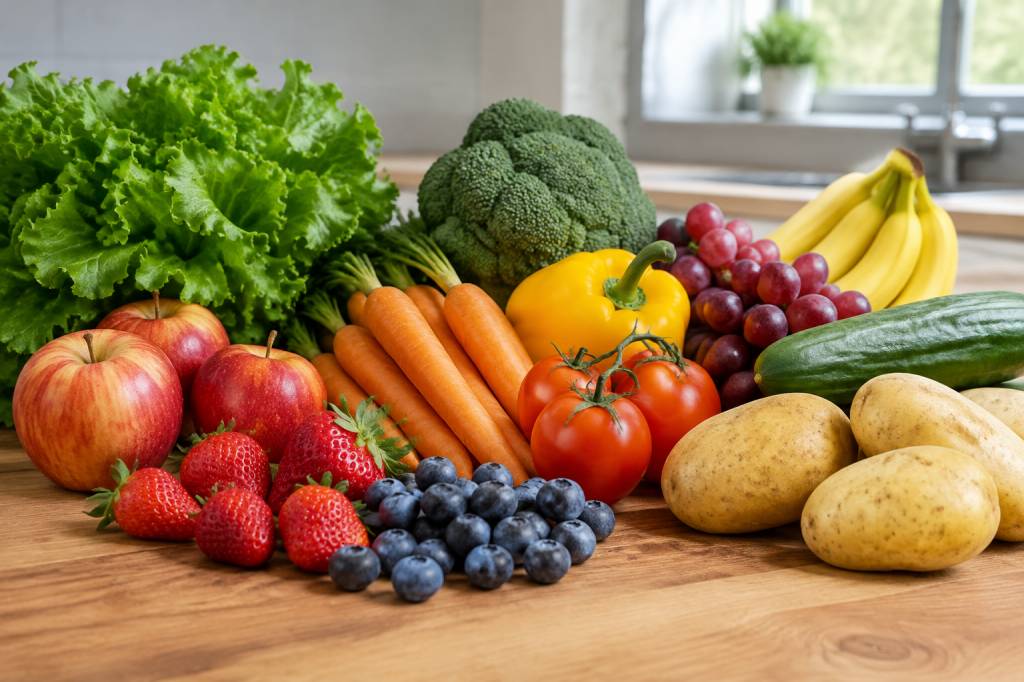
In EWG’s 2025 guide, the list included spinach, strawberries, kale, collard and mustard greens, grapes, peaches, cherries, nectarines, pears, apples, blackberries, blueberries and potatoes. Kale, collard and mustard greens are grouped together, which is why the list names more than 12 individual foods.
The ranking reflects residue findings in sampled produce—not a direct assessment of health risk. It is also not a list of foods that should be avoided. EWG’s own advice is to eat plenty of fruit and vegetables, whether or not they appear on the list.
What does a residue finding actually mean?
A pesticide residue is a small amount of a pesticide, or a substance left behind as it breaks down, detected on or in food. Finding a residue does not automatically mean that a person faces a health risk. That depends on factors such as the chemical, the amount present, how often someone is exposed, and how the chemical behaves in the body.
Regulators set maximum residue limits (MRLs)—also called tolerances in the United States—for specific pesticide-and-food combinations. These limits are designed to ensure that residues remain within permitted levels when pesticides are used according to approved conditions. A result below an MRL is not proof of zero exposure; equally, a detectable residue is not proof of harm. A sample exceeding a legal limit warrants attention, but it should not be treated as equivalent to every detection reported in a ranking.
EWG’s ranking is a consumer guide, not a regulatory risk assessment. Its methods and interpretation are debated, in part because a count of different residues does not tell us the dose or toxicity associated with each one. The list can prompt useful questions, but it cannot replace detailed exposure assessments by public-health authorities.
What the list does not tell us about water
The Dirty Dozen is based on tests of food samples. It is not a survey of irrigation water, rivers, groundwater or drinking water. A high ranking for grapes or spinach therefore does not mean the crop was irrigated with contaminated water—or that local tap water is unsafe.
There is, however, a genuine connection between pesticide use and water quality. Pesticides applied to fields can reach waterways through surface runoff, soil erosion, drainage or spray drift. Some chemicals can persist in the environment or move into groundwater; others break down relatively quickly. The pathway and the level of contamination depend on the substance, the soil, weather, farming practices and nearby water sources.
This is separate from PFAS contamination, the focus of this blog. PFAS are a large group of persistent chemicals used in a range of industrial and consumer applications. Some pesticides have been associated with PFAS chemistry, and fluorinated pesticides may be relevant to PFAS monitoring and research. But the term “pesticide residue” does not mean “PFAS,” and the Dirty Dozen does not identify PFAS in food or water.
That distinction matters. To understand whether water is affected, scientists need water samples and chemical-specific testing. A produce ranking cannot stand in for that evidence.
Why some produce appears repeatedly
Residues can vary with the crop, growing conditions and pesticide application practices. The surface of a fruit or vegetable, its skin, its growing season and the way it is sampled can all influence what testing detects. Some produce may also have residues from more than one pesticide. A sample containing several detectable substances can therefore feature prominently in a ranking, even though the ranking alone does not show the amount or combined health effect.
It is tempting to read a list as a simple scale from “safe” to “unsafe.” It is not. Rankings can also change from year to year as new samples are tested, methods evolve and the dataset changes. A food’s position is not a permanent verdict on that crop or on every farm that grows it.
How relevant is a US list to UK shoppers?
The EWG guide is built from US testing and should be read in that context. It does not directly describe pesticide residues on produce sold in the UK. Foods in UK shops may come from different countries, be subject to different controls and be tested under different monitoring programmes.
In the UK, the Health and Safety Executive (HSE) sets and reviews pesticide maximum residue levels, while government monitoring checks for residues in food. The Food Standards Agency publishes information about monitoring and food safety. These systems do not mean that every product is residue-free; they provide a framework for checking compliance and investigating results.
If you are shopping in the UK, look to UK authorities for local monitoring information rather than assuming that a US ranking describes your supermarket basket. The EWG list can still raise broader questions about pesticide use, but it is not a substitute for local data.
Practical ways to reduce exposure
You do not need to give up the foods on the list. Fruit and vegetables provide fibre, vitamins and other nutrients, and the established benefits of eating them are important. A practical approach is to handle produce well and choose the options that fit your budget and circumstances.
-
Wash fresh produce under clean running water before eating or preparing it. Rub firm items such as apples and potatoes with your hands or a clean produce brush.
-
Remove damaged outer leaves and trim areas that are bruised or spoiled. Washing can reduce dirt and some surface residues, but it cannot remove every chemical, especially those that have penetrated the food.
-
Do not use soap, bleach or household cleaning products on fruit and vegetables. These products are not intended for food and may leave harmful residues of their own.
-
Peeling can reduce some residues on certain foods, but it can also remove fibre and nutrients. It is one option, not a universal solution.
-
Buy organic produce if you want to reduce exposure to some synthetic pesticides and can afford it. Organic does not mean pesticide-free: approved pesticides may be used, and residues can still occur.
-
Vary the fruit and vegetables you eat. Variety is good nutritional practice and avoids relying heavily on a single crop or source.
-
Keep eating produce. If organic choices are too expensive or unavailable, conventional fruit and vegetables remain an important part of a healthy diet.
What consumers can ask about water quality
If your concern is the water used to grow food, look for evidence specific to the source and chemical in question. Agricultural runoff is a water-management issue, but a residue result on a food sample cannot identify whether contamination came from irrigation water, soil, post-harvest handling or another route.
Useful questions include: Which pesticide was detected? Was it found in food, surface water or drinking water? At what concentration? What standard applies? Was the result confirmed through repeat testing? Those details help distinguish a measurable finding from a meaningful exposure concern.
For drinking water in England and Wales, water suppliers publish information about water quality, and the Drinking Water Inspectorate oversees compliance. Scotland and Northern Ireland have their own relevant regulators. For suspected local pollution, environmental regulators and public-health agencies can provide more appropriate information than a produce ranking.
Read the list as a prompt, not a verdict
The Dirty Dozen can draw attention to pesticide residues and encourage people to ask how food is grown and monitored. Its limits are just as important: it ranks residue findings in US produce samples, does not directly quantify personal risk, and says nothing about whether a particular water supply is contaminated.
For most people, the useful response is not to avoid strawberries or spinach. Wash produce, eat a varied diet, consult local food-monitoring information and keep pesticide concerns distinct from PFAS testing. Good environmental decisions depend on the right evidence—and on asking the right question of it.