


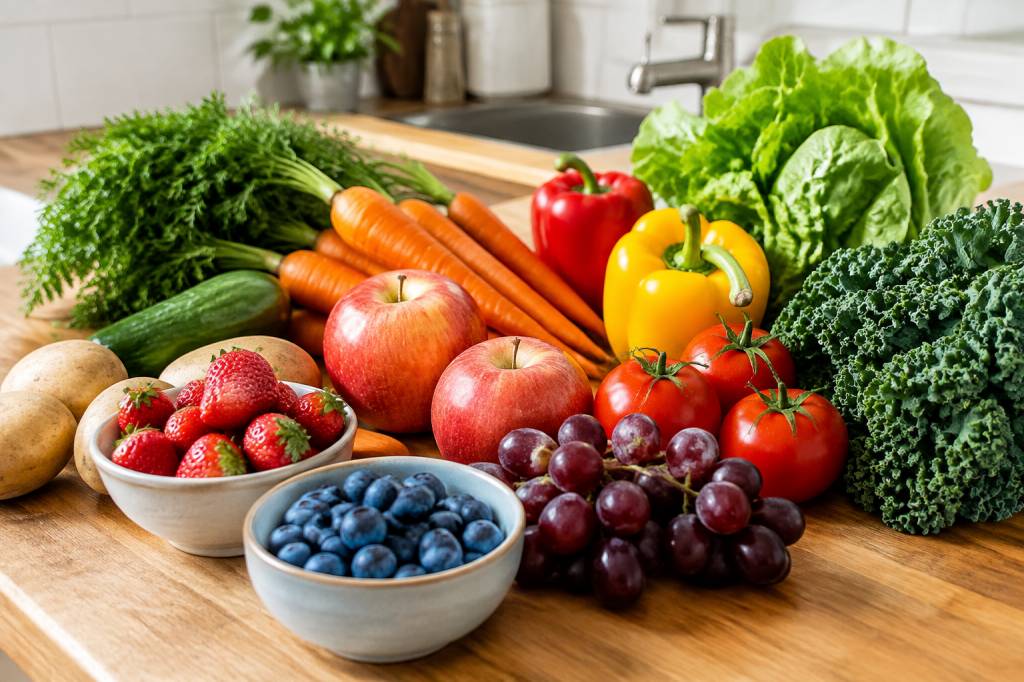
“Dirty Dozen” is the name given to an annual list of fruits and vegetables that, in tests, are more likely than others to carry detectable pesticide residues. It can be a useful shopping prompt—but it is not a list of foods proven to cause illness, nor a reason to avoid fresh produce. Understanding what the list does and does not tell us makes it easier to reduce exposure without losing the health benefits of fruit and vegetables.
For readers following contaminants such as PFAS, there is another important distinction: pesticide residues and PFAS are different groups of chemicals, with different sources, behaviour and health evidence. Both raise questions about how pollutants reach food and water, but the Dirty Dozen measures pesticide residues on produce. It does not measure PFAS.
What the Dirty Dozen actually measures
The Environmental Working Group (EWG), a US advocacy organisation, publishes the Dirty Dozen each year using pesticide-residue results from the US Department of Agriculture’s Pesticide Data Program (PDP). USDA staff wash and prepare samples in ways intended to reflect how food is typically handled, then test for a wide range of pesticide residues. The EWG uses those results to rank produce according to factors including how many pesticide types are detected and how often samples contain residues.
A residue being “detected” means a laboratory found it above its analytical detection limit. It does not, by itself, mean that the amount is dangerous. In the United States, the Environmental Protection Agency sets legal limits—called tolerances—for pesticide residues on food. Risk depends on the particular chemical, the amount, frequency and duration of exposure, and a person’s characteristics, among other factors.
That distinction matters. The list is a comparative screening tool, not a clinical risk assessment. It does not tell an individual how much pesticide they consumed, predict their health outcome or show that every item in a category has the same residue profile. Rankings can also change from year to year as testing results and methods change.
Which foods appear on the list?
The exact order varies by annual edition. Recent Dirty Dozen lists have featured the following foods:
- Strawberries
- Spinach
- Kale, collard and mustard greens
- Grapes
- Peaches
- Pears
- Nectarines
- Apples
- Bell and hot peppers
- Cherries
- Blueberries
- Green beans
Use this as a reminder that some commonly eaten produce can carry a variety of residues—not as a reason to take these foods off the menu. A bowl of berries or a serving of greens still provides fibre, vitamins and other nutrients. Public-health guidance consistently encourages people to eat a varied diet rich in fruit and vegetables.
Does a residue mean a health risk?
Not necessarily. The presence of a residue and the risk posed by that residue are related questions, but they are not interchangeable. Regulators assess pesticides individually and establish limits intended to protect consumers, including groups considered more vulnerable. Scientists continue to study the effects of pesticide exposure, particularly during pregnancy and childhood, and research may examine exposures that occur repeatedly through food, work or the environment.
There are also limits to what a shopping list can tell us. It does not account for the exact quantity someone eats, residues in other foods, exposure from home or work, or differences between pesticides. Nor does a ranking prove that a food is unsafe. For a fuller assessment, look to the underlying government monitoring data and the methods used to interpret it—not just a headline or a social-media graphic.
The practical message is proportionate: it is reasonable to reduce avoidable exposure where convenient, while keeping the benefits of produce in view. Skipping fruit and vegetables altogether would trade a possible reduction in one exposure for the loss of foods that support a healthy diet.
Simple ways to reduce pesticide residues
You do not need specialist equipment or a complicated routine. A few sensible steps can help remove dirt and some residues from the surface of produce:
- Rinse under clean, running water. Rub firm produce gently with your hands. For items such as apples or cucumbers, a clean produce brush can help.
- Wash before cutting or peeling. Otherwise, a knife may transfer material from the surface into the edible portion.
- Remove outer leaves. Discarding the outer leaves of lettuce or cabbage can reduce surface residues, as well as grit.
- Peel when it suits the food and your preferences. Peeling may reduce some residues, but it also removes fibre and nutrients concentrated in or near the skin.
- Wash your hands and clean preparation surfaces. This is good food-safety practice and helps prevent contamination between foods.
Do not use washing-up liquid, bleach, disinfectant or household cleaning products on food. Produce can absorb some substances, and these products are not intended to be eaten. The US Food and Drug Administration advises washing produce under running water; washing can reduce surface dirt and some bacteria, but it will not remove every pesticide residue.
Cooking, blanching or peeling may reduce certain residues in some foods, but the effect varies by chemical and preparation method. There is no universal kitchen technique that eliminates every pesticide. Washing is worthwhile, but it should not be presented as a guarantee.
Is organic produce a better choice?
Organic farming restricts the use of many synthetic pesticides, but “organic” does not mean pesticide-free. Organic standards permit certain pesticides, including some naturally derived substances, and residues can also reach food through environmental drift or handling. Conversely, a conventional item may have no detectable residue in a particular test.
Research has found that choosing organic produce can reduce exposure to some synthetic pesticide residues. Whether that is worth the extra cost depends on your priorities and budget. If buying organic for every item is not realistic, you can choose it selectively, vary the produce you buy, and keep eating plenty of conventional fruit and vegetables. Frozen produce is another practical option: it can be affordable, nutritious and available year-round.
There is no need to treat the Dirty Dozen as a mandatory organic shopping list. The companion “Clean Fifteen” ranks produce with fewer detected residues in the same general monitoring framework, but it too is a comparative guide—not a declaration that foods in one group are safe and those in another are unsafe.
Why variety is a useful strategy
Eating different kinds of produce is a straightforward way to avoid relying heavily on a single food. Rotate the fruit in a lunchbox, alternate leafy greens, and buy what is in season or affordable. Variety supports a broader nutrient intake and makes your diet less dependent on any one crop, supplier or growing practice.
Take a family that buys strawberries every week because they are a favourite. The useful response to a high ranking is not necessarily to ban them. It might be to rinse them well, serve other fruits at different meals and choose organic strawberries when the price and availability make sense. Small, sustainable changes tend to work better than rules that make healthy eating feel stressful.
For people who grow their own food, follow the label instructions for any pesticide used and keep chemicals away from children, pets and waterways. “Natural” does not automatically mean harmless: risk depends on the substance and how it is handled. Integrated pest management—using monitoring, crop rotation, physical barriers and targeted treatment where needed—can reduce reliance on pesticides in gardens and farms.
Food, water and environmental exposure
Pesticides can move beyond the field where they are applied. Depending on the chemical and local conditions, they may reach soil, surface water or groundwater through runoff, spray drift or leaching. That makes pesticide management relevant not only to food residues, but also to ecosystems and drinking-water protection.
Still, pesticide residue testing on produce cannot tell you whether your tap water contains pesticides, and it says nothing about PFAS contamination. PFAS are a large group of persistent chemicals used in some industrial processes and consumer products; they can enter the environment through sources such as manufacturing, firefighting foams and waste. Testing and treatment need to target the contaminant of concern. If you have a specific concern about local drinking water, consult your water supplier’s quality report and advice from the relevant public-health or environmental authority.
This distinction prevents a common kind of confusion: one “chemical” headline does not describe all chemical exposures. A pesticide residue on a food sample, PFAS in a water source and a naturally occurring plant compound are different findings, requiring different evidence and responses.
A balanced approach at the grocery store
The Dirty Dozen can help start a conversation about food production and pesticide monitoring. It is most useful when read alongside its limits: it compares residue findings, not overall food safety; it does not calculate an individual’s health risk; and it is not a reason to eat fewer fruits and vegetables.
Buy the produce you enjoy and can afford. Rinse it under running water, prepare it safely, vary what you eat and consider organic options if reducing exposure to certain synthetic pesticides is a priority for you. For questions about a particular product or local contamination, seek information from the agency responsible for testing and regulation rather than relying on rankings alone.
The goal is not a perfectly residue-free diet—an unrealistic standard for most people. It is an informed one: fewer avoidable exposures where practical, clear thinking about what the evidence shows, and plenty of nourishing produce on the plate.