

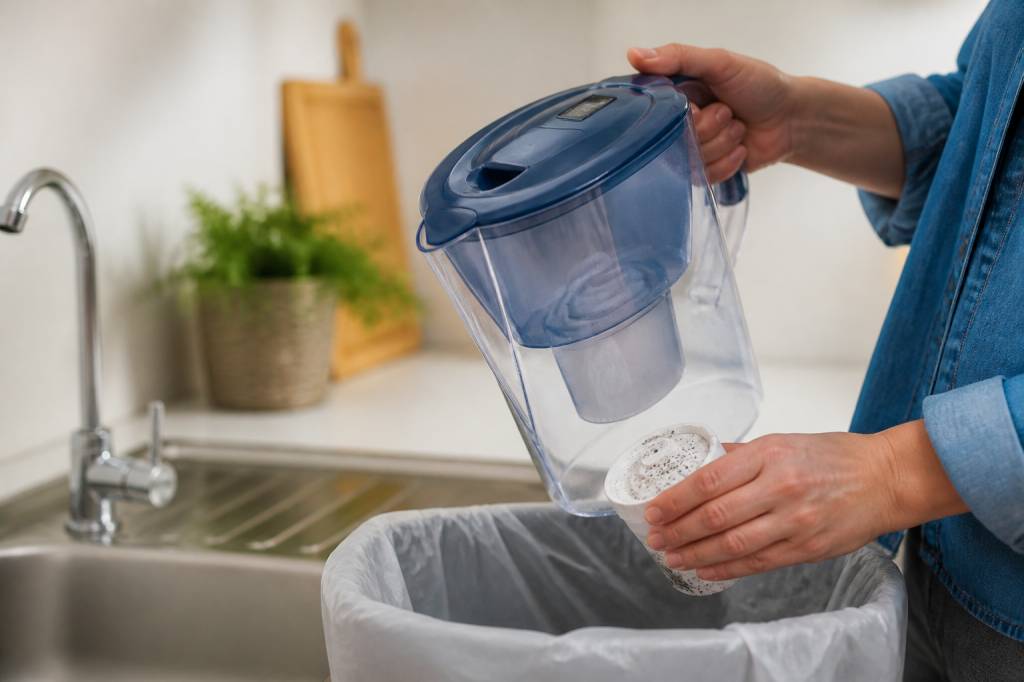
Replacing a Brita filter feels like a tiny household win: fresher-tasting water, a shorter trip to the shop, and one less plastic bottle used. But then the old cartridge lands in your hand, damp, oddly heavy, and not exactly obvious to throw away. Can it go in the recycling bin? Should it be rinsed? Does it need to be taken apart first? If you’ve ever paused over that question, you’re not alone.
Brita filters are designed to improve tap water by reducing substances such as chlorine and, depending on the model, certain metals and impurities. The trade-off is that a used filter has done its job by trapping contaminants, which means disposal deserves a little more thought than simply tossing it in the nearest bin. The good news: safe disposal is usually straightforward once you know what the cartridge is made of, what your local authority accepts, and whether the manufacturer offers a take-back scheme.
In this guide, we’ll break down how to dispose of used Brita filters safely, what not to do, and how to reduce waste if you use filtered water regularly.
Why used Brita filters should not be treated like ordinary waste
A Brita filter is not hazardous waste in the way that batteries or chemicals are, but it is also not just “clean plastic.” Inside the cartridge is a filtration medium, often activated carbon and ion-exchange material, which has captured particles and dissolved substances from water. Once saturated, the filter no longer performs effectively and should be replaced according to the manufacturer’s schedule.
Because the filter has absorbed impurities, many people assume it should be handled with caution. That instinct is sensible. While normal domestic exposure from a used water filter is low, reusing an old cartridge far beyond its recommended lifespan can mean poorer filtration performance and a higher chance of bacterial build-up inside the unit.
So the disposal question is not only about environmental responsibility. It is also about hygiene and making sure your water-filtration system continues to work as intended.
Check the exact Brita product you’re using
Not all Brita products are built the same. The disposal route can differ depending on whether you use a pitcher filter, a faucet-mounted filter, a bottle filter, or a cartridge for a larger system. The housing materials may also vary by model and region.
Before you throw anything away, take a moment to identify the product name and check the packaging or the manufacturer’s website. Look for disposal guidance specific to your filter type. Some Brita cartridges are designed with recycling programs in mind, while others may have limited recycling options depending on where you live.
If the label is gone and the product name is no longer visible, check the shape of the cartridge, the connector type, or the model number on the jug or dispenser. A quick identification step can save you from placing it in the wrong waste stream.
Can Brita filters go in household recycling?
Sometimes yes, but not automatically. This is where local rules matter more than assumptions.
Many Brita filters are made from a mix of plastic and filtration media, which means they are not always accepted in standard curbside recycling. Some local recycling systems only accept rigid plastic items with specific resin codes, while composite cartridges often need special processing.
That said, some manufacturers and retailers run dedicated recycling schemes for used water filters. These programs can collect cartridges separately and break them down into reusable material streams. If a take-back or mail-back option exists in your area, it is usually the best route for the filter housing and internal materials.
Before placing a used filter in the recycling bin, ask:
- Does my local council accept composite water filter cartridges?
- Does Brita offer a return or recycling program in my country or region?
- Are there retailer collection points nearby?
If the answer to all three is no, the filter may need to go into general waste. That is not ideal, but it is better than contaminating a recycling load with an item the facility cannot process.
How to dispose of a used Brita filter safely
Safe disposal is less about complex handling and more about following a practical sequence. Think of it as a small routine: use, remove, drain, store, then dispose in the right stream.
Here is a simple approach:
- Remove the filter from the pitcher or device once it reaches the recommended replacement time.
- Let excess water drain out for a short period.
- Do not try to open, puncture, or dismantle the cartridge unless the recycling scheme explicitly asks for that.
- Check for a manufacturer take-back programme or local recycling instructions.
- If no recycling option is available, place it in the general waste bin according to local rules.
A useful habit is to keep the old cartridge in a small container or bag until you’ve checked your disposal option. Wet filters can drip, and no one wants mystery puddles in the kitchen bin. Household convenience is important, but so is avoiding a mini water feature on the way to the curb.
Should you rinse a used filter before disposal?
In most cases, a brief external rinse is fine if the filter has visible residue, but there is no need for aggressive cleaning. You should not scrub it, soak it, or use detergents to “sanitize” the cartridge before disposal unless the manufacturer specifically recommends it.
The main concern is not to wash trapped contaminants deeper into the drain or expose yourself to unnecessary contact with the media inside the cartridge. A quick surface rinse can reduce mess, but the objective is not to restore the filter. It has already reached the end of its working life.
If you are using a mail-back recycling scheme, follow the preparation instructions exactly. Some programs want filters dried or bagged in a specific way. Others prefer they be returned as-is. The correct method depends on how the recycling partner sorts and processes the materials.
What not to do with used Brita filters
A few disposal mistakes are common, and they are easy to avoid once you know them.
- Do not reuse an expired filter beyond the recommended lifespan. Filtration performance drops over time.
- Do not break open the cartridge just to see what is inside. It can create unnecessary mess and may expose you to trapped debris.
- Do not assume all plastic parts are recyclable in your curbside bin.
- Do not place the filter in food waste or compost unless the manufacturer and local authority explicitly allow it. Most cartridges are not compostable.
- Do not pour filter media into the sink or toilet. That can clog plumbing and is not an environmentally sound disposal route.
In short: if the filter has a clear manufacturer-supported recycling route, use it. If not, treat it as residual household waste rather than forcing it into the wrong system.
How to find the right recycling route
If you want to keep your waste handling as low-impact as possible, start with three places: the product packaging, the manufacturer’s website, and your local council’s waste guidance.
Many people begin and end with the recycling bin, but that is not always the best answer. Better to spend two minutes checking than to send a non-recyclable cartridge into a stream that cannot process it. Recycling facilities rely on clean, correctly sorted material. A misplaced composite item can create extra work or spoil a batch.
Here’s a practical checklist:
- Search the Brita website for your exact filter model and disposal guidance.
- Check whether the manufacturer offers a return programme, collection point, or mail-in option.
- Look up your local authority’s rules for mixed-material plastics or water filter cartridges.
- If you buy filters from a retailer, ask whether they participate in a take-back scheme.
If you live in a building with shared waste facilities, it may also be worth asking the property manager whether a recycling collection point is available. Some programmes are run through offices, universities, supermarkets, or larger retail chains rather than through curbside collection.
How often should Brita filters be replaced?
Disposal starts with replacement. A filter that stays in service too long is not just a waste issue; it can become a performance issue. Brita typically recommends replacement intervals based on water volume and model type, often measured in weeks or litres filtered.
Why does timing matter? Because the filter media gradually becomes saturated. Once that happens, it cannot remove contaminants as effectively, and in some cases flow rate may slow noticeably. If your water tastes different, pours more slowly, or the indicator on your device signals replacement, those are strong hints that the cartridge has done its job.
Using a filter longer than recommended can undermine the reason you installed it in the first place. That is a frustrating way to save a few pounds.
Ways to reduce waste if you use Brita regularly
For households that filter water every day, the waste stream can build up quickly. The aim is not to stop filtering water, but to use the system in a smarter way.
Consider these practical habits:
- Choose the right size filter system for your household to avoid unnecessary replacements.
- Track replacement dates so you are not swapping filters too early or too late.
- Store spare filters in a dry place to preserve performance before use.
- Use the manufacturer’s app or reminder system if available.
- Check whether a local recycling scheme exists before you buy more cartridges.
If you are trying to cut down on single-use plastics, a reusable pitcher plus a well-managed cartridge system can still be a sensible middle ground. It is not a perfect zero-waste solution, but it can reduce bottled water consumption and lower the environmental burden associated with transport and packaging.
What if your filter is damaged or leaking?
If a used filter is cracked, leaking, or has an unusual smell, do not ignore it. Remove it from the system promptly and place it in a sealed bag before disposal if needed. A damaged filter is less about recycling complexity and more about preventing a mess in your home.
If the filter was in use far beyond its service life and you noticed slimy residue or odour inside the housing, clean the pitcher or dispenser according to the manufacturer’s instructions before installing a new cartridge. Disposal and maintenance go hand in hand. A clean reservoir supports better water quality and reduces the chance that the new filter starts its life in a contaminated environment.
When in doubt, follow the waste hierarchy
The most sensible disposal option is usually the highest one available in your area: reuse where possible, return through a manufacturer programme, recycle if accepted, and use general waste only when there is no better route.
For a Brita filter, “reuse” does not mean extending its filtration life beyond recommendation. It means using the product fully during its intended lifespan, then directing it to the proper disposal pathway instead of defaulting to the bin. That small distinction matters.
It is easy to think of one filter as a negligible item. But millions of households use filtration cartridges every year. Multiply one cartridge by one household by one replacement cycle, and the waste picture becomes significant. That is exactly why correct disposal, local recycling systems, and manufacturer responsibility all matter.
A simple rule of thumb for used Brita filters
If you want the shortest possible answer, here it is: drain the used filter, check for a Brita or local recycling scheme, and if none exists, place it in general waste rather than the curbside recycling bin. Do not dismantle it unless instructed, and do not keep using it past the recommended replacement date.
That approach is practical, safe, and aligned with how mixed-material filtration cartridges are usually handled. It also avoids the common trap of “recycling optimism,” where an item is put in the blue bin simply because it is made of plastic. Not all plastics are created equal, and composite cartridges are a perfect example.
By taking a minute to dispose of a used Brita filter properly, you help reduce contamination in recycling systems, protect the performance of your water filtration setup, and make a small but real contribution to better waste management. For something that starts as a kitchen convenience item, that is a surprisingly meaningful outcome.