


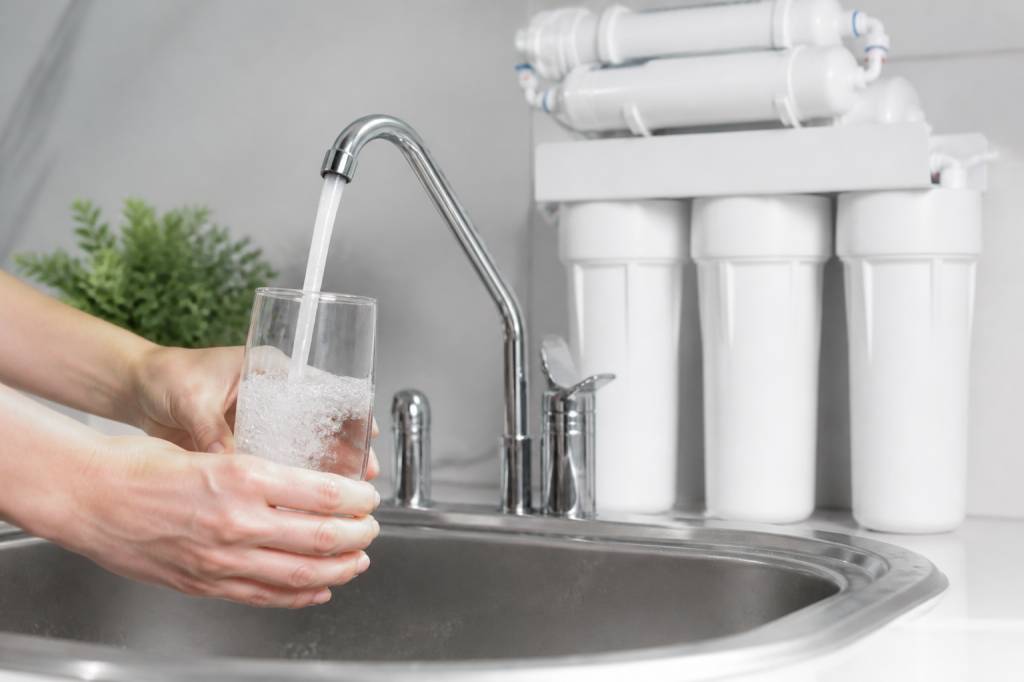
Why does tap water sometimes look white?
Turn on a tap and you may occasionally see water that appears milky, cloudy or almost white. In most cases, this is not bleach and does not indicate that the water has been chemically whitened. The appearance is usually caused by tiny air bubbles suspended in the water.
A simple test can help. Fill a clear glass and leave it undisturbed for a few minutes. If the water clears from the bottom upwards, trapped air is the most likely explanation. As pressure changes when water travels through pipes, dissolved air can come out of solution and form microscopic bubbles. This is particularly common after maintenance work, changes in supply pressure or periods of low water use.
But cloudy water is not always harmless. A white or hazy appearance can also be linked to calcium carbonate, plumbing disturbance, sediment or, less commonly, a water-quality problem. The key is to look at the pattern: does the cloudiness disappear quickly, affect only hot water, occur throughout the home or come with an unusual smell or taste?
Understanding the cause matters because appearance alone cannot reveal whether water contains contaminants such as lead, nitrates or PFAS. Clear water is not necessarily safe water, and cloudy water is not necessarily dangerous water. Both assumptions can be misleading.
Air bubbles: the most common cause of white water
Water can hold dissolved gases, including oxygen and nitrogen. When water is under pressure inside a pipe, it may retain more dissolved air. Once it reaches an open tap, the pressure drops. The dissolved air then forms tiny bubbles, producing a pale or milky appearance.
This effect is similar to opening a bottle of sparkling water, although the bubbles in tap water are much smaller and do not usually create visible fizzing. The water typically becomes clear within seconds or a few minutes.
Air-related cloudiness is more likely after:
- Work has been carried out on local water mains or household plumbing.
- A tap has not been used for several hours or days.
- Water pressure has changed suddenly.
- A new faucet, filter or water heater has been installed.
- Cold water has warmed or hot water has been released from a pressurised system.
If only one tap is affected, the issue may be local to that faucet or its aerator. Aerators contain small screens designed to produce a smooth flow. They can trap debris or air and should be removed and cleaned periodically.
Minerals, sediment and plumbing-related cloudiness
Not all white water is caused by air. Hard water contains naturally occurring minerals, mainly calcium and magnesium. When water is heated or its chemical balance changes, calcium carbonate can precipitate. This may create a hazy appearance, white flakes or scale on kettles, showerheads and taps.
Mineral particles usually settle over time, although some remain suspended. A water softener may reduce hardness, but it is not a universal water purifier. Softening removes or exchanges calcium and magnesium; it does not reliably remove PFAS, bacteria, viruses or every other contaminant.
Brown, yellow, orange or grey discolouration often points to sediment or corrosion. Iron deposits can enter water after mains work or changes in flow. Older properties may also have internal plumbing made from materials that release metals into standing water. Lead is especially important because it has no reliable taste, smell or visible colour.
Run the cold kitchen tap for several minutes if water has been standing overnight, particularly in an older property. Use the flushed water for plants or cleaning rather than wasting it. However, flushing is not a substitute for testing where lead plumbing is suspected.
Is white or “bleaching” water dangerous?
When the water clears quickly from the bottom upwards, health risks are generally low because the cause is physical rather than chemical. The bubbles themselves are simply air. Nevertheless, persistent changes should not be ignored.
Contact your water supplier or local authority if:
- The water remains cloudy after several minutes.
- It has a strong chemical, fuel-like, metallic or sewage odour.
- The taste has changed significantly.
- Particles or sediment are visible.
- Multiple taps are affected for an extended period.
- People in the household develop gastrointestinal symptoms after a suspected supply incident.
- The issue follows flooding, a burst pipe or plumbing repairs.
Do not assume that boiling will solve every water-quality problem. Boiling can inactivate many disease-causing microorganisms, but it does not remove PFAS, metals, nitrate or dissolved chemicals. In some cases, evaporation can even concentrate non-volatile substances. If a local “do not drink” or “boil water” notice has been issued, follow the instructions provided by the relevant authority.
Could chlorine be responsible?
Chlorine is widely used to disinfect public drinking-water supplies. It helps control bacteria and viruses as water moves through distribution networks. Some people notice a swimming-pool-like smell or taste, especially when chlorine levels change or when water has been sitting in pipes.
Chlorine may also react with naturally occurring organic matter and form disinfection by-products. Water suppliers monitor these substances, and regulated drinking-water systems are designed to keep concentrations within safety limits. The presence of a chlorine smell does not mean that water is “bleaching” your plumbing or skin.
Activated carbon filters can reduce chlorine taste and odour. However, a filter selected for chlorine alone should not be presented as a PFAS treatment. Different contaminants require different technologies, and filter claims should be checked carefully.
Where PFAS fit into the picture
PFAS, or per- and polyfluoroalkyl substances, are a large group of persistent chemicals used in applications such as firefighting foams, stain-resistant materials, non-stick products and industrial processes. They are often described as “forever chemicals” because many break down very slowly in the environment.
PFAS are dissolved contaminants. They are generally invisible in drinking water and do not produce a distinctive smell or taste. This means that white, cloudy water is not a typical sign of PFAS contamination. Water can look perfectly clear and still contain measurable PFAS, while cloudy water caused by air may contain none.
Exposure is a concern because certain PFAS can remain in the body for long periods. Research and regulatory assessments have associated some PFAS with effects including changes in immune response, cholesterol levels, liver function and developmental outcomes. The level of risk depends on the specific compound, concentration, duration of exposure and individual circumstances.
The only dependable way to establish whether PFAS are present is through properly conducted laboratory testing or reliable information from the water supplier and regulators. Home appearance checks cannot detect them.
Effective filtration options for cloudy water
The right treatment depends on the cause. Installing the most expensive filter available is not automatically the best solution. Start by identifying the problem and checking the manufacturer’s performance data.
For air bubbles
Air bubbles usually require no treatment. Allow the glass to stand, clean the faucet aerator and check whether the issue occurs only at one outlet. If air continues to enter the plumbing, a qualified plumber or water supplier may need to inspect pressure, valves and pipework.
For sediment and particles
A sediment filter can capture sand, rust flakes and suspended particles. Cartridge filters are available in different micron ratings. A finer rating can remove smaller particles, but it may clog more quickly and reduce water flow.
Sediment filtration does not remove dissolved PFAS, chlorine, nitrate or many metals. It is often used as a pre-treatment stage to protect other filters rather than as a complete solution.
For chlorine taste and odour
Granular activated carbon and carbon block filters can reduce chlorine, unpleasant tastes and some organic chemicals. Carbon performance depends on contact time, water chemistry, cartridge condition and flow rate. A filter that is not replaced on schedule can become less effective and may support microbial growth.
For PFAS
Activated carbon can reduce many PFAS when the filter has sufficient capacity and is correctly maintained. Performance varies considerably between products and between different PFAS compounds. Short-chain PFAS can be more difficult to remove than some long-chain compounds.
Reverse osmosis is another established option. It uses a semi-permeable membrane to reduce a broad range of dissolved substances, including many PFAS. Reverse osmosis systems generally produce a concentrated wastewater stream and require filter and membrane replacement. They may also remove minerals that contribute to taste, which is not necessarily a health problem but can affect user preference.
Ion exchange systems can also be designed for PFAS reduction. Their effectiveness depends on the resin, competing substances in the water and system maintenance. As with carbon and reverse osmosis, certification or independent test data is more useful than general marketing language.
How to choose a PFAS water filter
Look for clear, compound-specific performance information. A product that claims to remove “chemicals” or “toxins” without naming PFAS should be treated cautiously.
- Check whether the product has been tested or certified for PFAS reduction by an independent body.
- Review which PFAS compounds were tested and at what concentrations.
- Confirm the rated capacity and expected cartridge life.
- Check the maximum flow rate and contact time requirements.
- Find out whether replacement filters are readily available.
- Verify that the system is suitable for the pressure and plumbing configuration in your home.
- Follow installation, sanitation and replacement instructions precisely.
In the United States, standards such as NSF/ANSI 53 and NSF/ANSI 58 are commonly referenced for certain PFAS reduction claims, depending on the type of product. In the United Kingdom, consumers should also examine manufacturer test reports, independent laboratory evidence and guidance from recognised water and public-health authorities. Certification schemes and regulatory requirements can differ, so the exact claim matters.
Point-of-use or whole-house filtration?
A point-of-use system treats water at one outlet, usually the kitchen tap. It is often the most practical choice when the main concern is drinking and cooking water. Under-sink carbon or reverse osmosis systems can provide targeted treatment without filtering water used for bathing, laundry or toilets.
A whole-house system treats water as it enters the property. This may be appropriate when testing identifies a confirmed contamination problem or when all household outlets need treatment. However, it is more expensive and demands careful design, maintenance and monitoring. A system installed without adequate pretreatment can fail prematurely.
Shower filters are frequently marketed for general “chemical removal”. Many reduce chlorine, but consumers should not assume that a standard shower filter removes PFAS. PFAS exposure from drinking water is a different question from exposure through bathing, and credible product evidence is essential.
Practical steps when your water turns white
First, fill a transparent glass and observe it for several minutes. Note whether the cloudiness clears from the bottom upwards. Compare cold and hot water, and check whether other taps are affected.
Next, clean the faucet aerator and run the cold kitchen tap briefly. Avoid using hot tap water for drinking or cooking, since hot water can dissolve metals from plumbing more readily than cold water.
If the appearance persists, contact your water supplier. Ask whether maintenance, pressure changes or a local incident has been reported. For private wells, arrange testing through an accredited laboratory, particularly after flooding or changes in taste and appearance.
Finally, remember that filtration should respond to evidence. White water caused by air does not need a PFAS filter, while clear water with confirmed PFAS contamination does. The most effective approach combines observation, reliable testing, verified treatment technology and disciplined maintenance. Water may not always tell you what it contains—but good information can.