


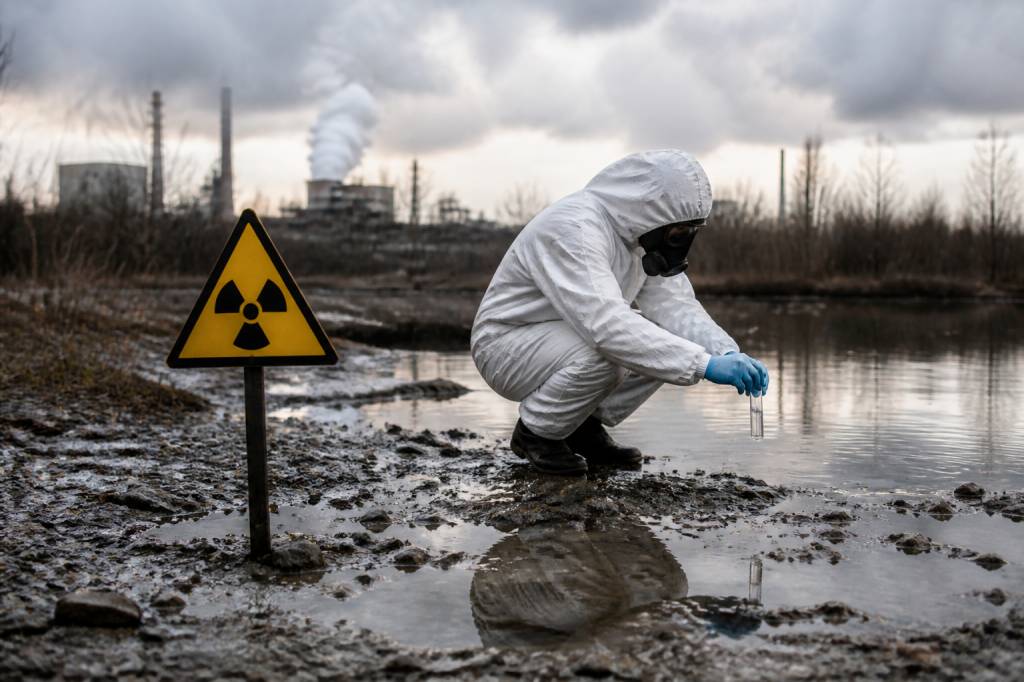
Alpha radiation is often described as the least penetrating form of ionising radiation. That statement is technically correct—but it can create a dangerous misunderstanding. Alpha particles cannot travel through skin or even a sheet of paper, yet they can cause serious biological damage when radioactive material is inhaled, swallowed or enters the body through a wound.
For communities concerned about contaminated soil, industrial pollution or drinking water quality, the key question is not simply whether alpha radiation can reach the body. It is whether an alpha-emitting substance can get inside it. Once that happens, the same particle that is easy to stop outside the body can deliver concentrated energy directly to sensitive cells.
This article explains how alpha radiation works, where exposure can occur, what health and environmental risks are involved, and which protection measures are genuinely effective.
What is alpha radiation?
Alpha radiation is made up of alpha particles. Each particle contains two protons and two neutrons—the same combination found in the nucleus of a helium-4 atom. Because alpha particles are relatively large and carry a positive electrical charge, they interact strongly with matter as they move through it.
That strong interaction gives alpha radiation two apparently contradictory characteristics:
Alpha radiation is produced by certain unstable elements as they undergo radioactive decay. Naturally occurring examples include uranium, thorium, radium, radon and polonium. Some man-made radionuclides, such as americium-241, also emit alpha particles.
The important distinction is between external and internal exposure. An intact layer of skin is generally enough to protect against external alpha radiation. Internal exposure is much more concerning because there is no protective skin barrier between the radioactive material and nearby organs.
Why alpha radiation can be dangerous inside the body
Ionising radiation has enough energy to remove electrons from atoms and molecules. This process can alter important biological structures, including DNA. A single alpha particle travels a short distance, but it can produce dense clusters of ionisation along its path.
This concentrated energy may cause:
The risk depends on several factors: the radionuclide involved, the amount taken into the body, the route of exposure, how long it remains in the body and which organs it targets. A radioactive substance that is rapidly excreted may present a different risk from one that binds to bone or remains in lung tissue for years.
Radiation protection specialists generally refer to the energy deposited in tissue as the absorbed dose. For assessing biological harm, the type of radiation also matters. Alpha particles have a higher radiation weighting factor than beta particles or gamma rays because their energy is deposited more densely. This is why a small internal quantity of an alpha-emitting radionuclide can be biologically significant.
Common sources of alpha radiation exposure
Alpha radiation is not automatically a sign of industrial contamination. Many alpha-emitting materials occur naturally in rocks and soils. The risk arises when radioactive elements become concentrated, mobilised or inhaled and ingested.
Radon in buildings
Radon is a radioactive, odourless and colourless gas formed during the decay of uranium in soil and rock. It can enter buildings through cracks in floors, gaps around pipes, construction joints and other openings. When radon decays, it produces solid radioactive particles that can attach to dust and aerosols.
Breathing in these decay products exposes lung tissue to alpha radiation. Radon is recognised as a major cause of lung cancer after smoking, and the risk is higher for people who smoke because the two hazards can act together. The only reliable way to know whether a building has elevated radon levels is to test it.
Contaminated soil and dust
Mining, milling, industrial processing and historical waste disposal can leave uranium, thorium, radium or other radionuclides in soil. Dry, contaminated dust may be inhaled, while particles on hands or food can be swallowed accidentally.
Children may face additional exposure pathways because they spend more time close to the ground and are more likely to put dirty hands or objects in their mouths. This does not mean every site with naturally occurring uranium is unsafe, but it does make careful sampling and land-use assessment essential.
Drinking water and food
Groundwater can dissolve radioactive elements from surrounding rock. Radium, uranium and polonium may enter water supplies, particularly in areas with naturally mineralised geology or a history of uranium-related activity. Some radionuclides can also accumulate in crops, fish or livestock when soil and water are contaminated.
Routine water testing is therefore important where geological surveys, industrial records or previous monitoring indicate a potential problem. A standard test for bacteria or PFAS, for example, does not automatically measure radionuclides. Different contaminants require different analytical methods.
Workplace exposure
Workers in uranium mining, mineral processing, oil and gas production, phosphate processing, nuclear facilities and certain research environments may encounter alpha-emitting materials. Industrial processes can concentrate naturally occurring radioactive materials—often referred to as NORM, or naturally occurring radioactive material—and create exposure risks that are not obvious from the original raw material.
Health risks associated with alpha radiation
The main long-term health concern is cancer. Internal alpha exposure has been associated with cancers of the lung, bone and blood-forming tissues, depending on the radionuclide and its distribution in the body. Radon exposure is particularly associated with lung cancer, while radium can behave chemically like calcium and accumulate in bones.
Health effects are not usually immediate after a low-level exposure. That can make alpha radiation difficult to understand: the absence of an instant symptom does not prove that no biological damage occurred. Cancer risk is probabilistic, meaning that exposure may increase the likelihood of disease without making illness inevitable.
Very high internal exposures can cause more immediate tissue damage, although such scenarios are uncommon outside serious accidents, uncontrolled sources or major contamination events. The practical focus for households and communities is usually prevention, monitoring and reducing chronic exposure.
Radiation risk should also be considered alongside other hazards. For example, a person living in a poorly ventilated building with elevated radon may face a greater health risk if they smoke. Similarly, contaminated dust may carry both radioactive substances and toxic metals. Environmental assessment works best when it considers the full mixture of hazards rather than examining each contaminant in isolation.
Environmental impacts of alpha-emitting contaminants
Alpha particles themselves do not travel far through air, water or soil. The environmental concern is the movement and persistence of the radioactive substances that emit them.
Radionuclides can be transported by groundwater, surface runoff, wind-blown dust and industrial waste. Their behaviour depends on factors such as pH, mineral composition, organic matter and the presence of competing ions. Some remain tightly bound to soil, while others dissolve and move through aquifers.
Once present in an ecosystem, radioactive elements may enter food chains. Plants can absorb radionuclides from soil or irrigation water, and animals may ingest them through vegetation or sediment. Bioaccumulation is not identical for every radionuclide, but substances that resemble essential nutrients can be particularly problematic. Radium, for example, may be incorporated into bone tissue.
Contamination can also restrict land use. Areas affected by uranium mine waste, industrial tailings or historical releases may require long-term monitoring, soil management and controls on groundwater use. Remediation may involve removing contaminated soil, stabilising waste, preventing dust generation or treating water before discharge.
The environmental persistence of a radionuclide is linked to its half-life—the time required for half of a radioactive substance to decay. A long half-life does not necessarily mean immediate high danger, and a short half-life does not make a substance harmless. Risk depends on both radioactivity and how people and ecosystems interact with the material.
How alpha radiation is detected
Because alpha particles have limited range, they can be difficult to measure unless the detector is close to the source. A conventional survey meter designed mainly for gamma radiation may fail to identify alpha contamination, even when radioactive material is present.
Specialist instruments may include:
Laboratories may analyse water, soil, air filters, food or biological samples using alpha spectrometry or radiochemical methods. These tests can identify particular radionuclides and measure their activity, usually reported in becquerels. A becquerel represents one radioactive decay per second.
Home radon test kits can provide useful information, but they must be placed correctly and used for the recommended duration. Short-term tests may capture unusual conditions, while longer measurements often provide a better estimate of average exposure. If results are elevated, advice from a qualified radon professional or the relevant public health authority is appropriate.
Practical ways to reduce exposure
Protection follows a simple principle: prevent radioactive material from entering the body. For alpha radiation, shielding the source with thick material is usually less important than controlling contamination.
Ordinary household water filters should not be assumed to remove radioactive contaminants. Some treatment technologies can reduce specific radionuclides, but performance depends on water chemistry, the contaminant and the design of the system. Reverse osmosis, ion exchange and specialised adsorbents may be suitable in certain situations, while activated carbon is not a universal solution.
Alpha radiation, PFAS and the wider contamination picture
Alpha radiation and PFAS are different hazards. Alpha radiation comes from radioactive atoms and involves ionising energy. PFAS are a large group of synthetic chemicals that do not emit radiation simply because they are persistent or difficult to break down.
However, the two issues share important environmental lessons. Both require reliable sampling, contaminant-specific laboratory analysis, transparent communication and treatment systems matched to the chemistry of the pollutant. A filter marketed for “chemical removal” may not control radionuclides, just as a device designed for radioactive ions may not remove PFAS.
When contamination is suspected, testing should identify the actual hazard rather than relying on broad claims such as “pure,” “natural” or “radiation-free.” Evidence matters more than reassuring language—particularly when the contaminant cannot be seen, smelled or tasted.
What to remember about alpha radiation
Alpha radiation is easy to stop outside the body but potentially damaging when alpha-emitting material is inhaled, swallowed or introduced through broken skin. Radon in buildings, contaminated soil, polluted groundwater and occupational materials are among the most important exposure pathways.
Effective protection is practical: test where risk is plausible, control dust and soil contact, ventilate buildings, follow workplace procedures and use treatment technologies that have been independently verified for the specific radionuclide involved. If a test result is abnormal, professional assessment is far safer than guessing—or relying on a generic filter and hoping for the best.
Reliable information is available from the UK Health Security Agency, the Environment Agency, the International Atomic Energy Agency and the World Health Organization. These organisations provide guidance on radon, radioactive substances, monitoring and public protection.