


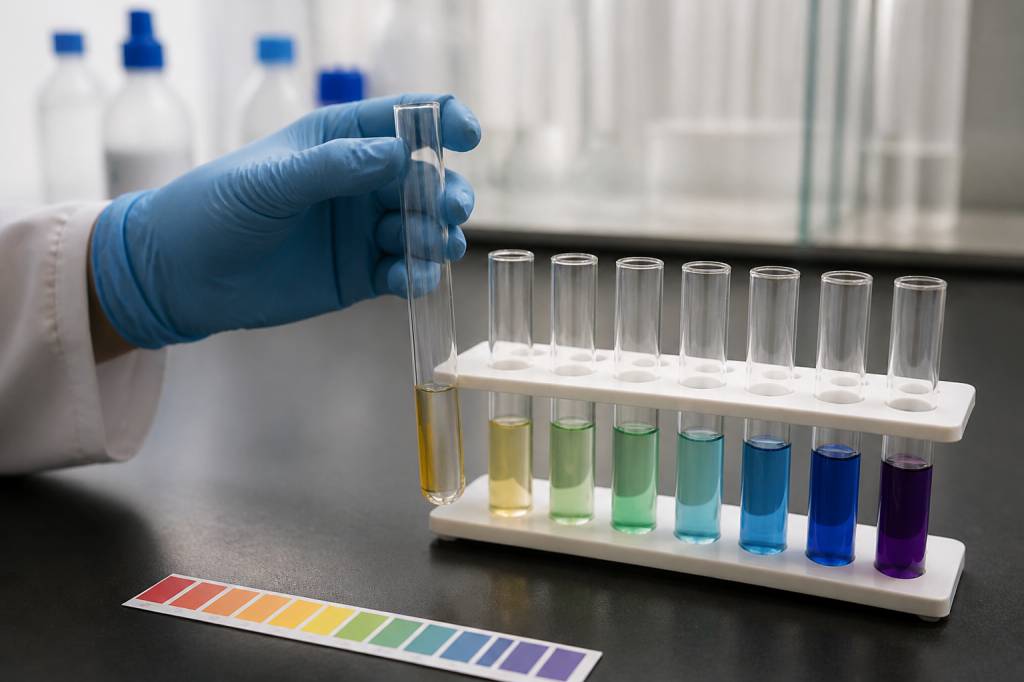
When people talk about water quality, pH is usually one of the first numbers that comes up. But what does that scale actually tell you? And why does it matter so much when you are testing for PFAS, those persistent “forever chemicals” that have become a major concern in drinking water, groundwater, and industrial wastewater?
The short answer is that the acidity-alkalinity scale is more than a chemistry lesson for school textbooks. It influences how water behaves, how contaminants move, how treatment systems perform, and even how reliable your PFAS sampling results may be. If you are working in environmental monitoring, compliance, or water treatment, understanding pH is not optional. It is one of the simplest measurements, and yet one of the most useful.
What the acidity-alkalinity scale actually measures
The acidity-alkalinity scale, better known as the pH scale, measures how acidic or alkaline a water sample is. It runs from 0 to 14.
A pH of 7 is considered neutral. Values below 7 are acidic, and values above 7 are alkaline, or basic. The lower the number, the more acidic the water. The higher the number, the more alkaline it is.
This scale is logarithmic, which means each whole number change represents a tenfold difference in acidity or alkalinity. So water with a pH of 6 is ten times more acidic than water at pH 7, and water at pH 5 is one hundred times more acidic than neutral water. That is a big difference hiding behind a tiny number.
Here is a simple way to think about it:
- pH 0–3: strongly acidic
- pH 4–6: weakly acidic
- pH 7: neutral
- pH 8–10: weakly alkaline
- pH 11–14: strongly alkaline
In natural waters, pH usually falls somewhere between 6 and 9, although industrial discharges, mine drainage, treatment chemicals, and polluted runoff can push it outside that range.
Why pH matters for water quality
pH affects nearly every aspect of water chemistry. It influences corrosion, scaling, disinfection efficiency, metal mobility, biological activity, and treatment performance. In other words, it is a small measurement with a very large footprint.
In drinking water systems, low pH can make water more corrosive. That matters because corrosive water can leach metals like lead, copper, and zinc from pipes and fittings. High pH, on the other hand, can encourage scale formation, which can reduce pipe efficiency and foul membranes or other treatment equipment.
For aquatic ecosystems, pH also matters. Fish, insects, and plants are sensitive to changes in acidity. A river that becomes too acidic may reduce biodiversity and alter nutrient cycling. A pond that becomes too alkaline may also stress certain species. Water chemistry is rarely dramatic in the way a pollution spill looks on the news, but the biological effects can be just as serious.
There is also a practical side: many treatment processes work best within a narrow pH range. Coagulation, precipitation, chlorination, and activated carbon performance can all be influenced by pH. If you are managing a water treatment system, ignoring pH is a bit like trying to bake bread without checking the oven temperature. You might still get something edible, but the odds are not in your favour.
How pH connects to PFAS testing
pH does not directly measure PFAS. You cannot simply dip a probe into water and discover the concentration of PFOA, PFOS, or any other PFAS compound. PFAS testing requires laboratory analysis, typically using methods such as LC-MS/MS after careful sampling and extraction.
So why does pH matter? Because it can affect how PFAS behave in water and how samples are handled, preserved, and interpreted.
PFAS are a large class of synthetic chemicals with strong carbon-fluorine bonds, which makes them highly resistant to degradation. They are also chemically diverse. Some PFAS are anionic at environmental pH levels, meaning they carry a negative charge, while others are neutral or can exist in different forms depending on conditions. This matters because pH can influence sorption, mobility, and partitioning between water, sediments, soils, and treatment media.
In simple terms, pH can help determine whether PFAS stay dissolved in water or are more likely to associate with solids and surfaces. That does not make them disappear, of course. PFAS have an annoying habit of sticking around wherever they are not wanted. But pH is part of the puzzle that explains where they go.
For example, in more acidic conditions, some functional groups in the environment may interact differently with PFAS molecules, potentially changing their adsorption to soil particles or activated carbon. In alkaline water, other interactions can shift as well. These changes are often subtle, but when you are dealing with contamination at trace levels, subtle is exactly what matters.
pH is also important during sample collection and preservation. If a sample is not stabilized properly, the chemistry of the matrix can change before analysis. While PFAS are generally quite stable compared with many other contaminants, the surrounding water matrix still affects the reliability of the result. That is why field parameters such as pH, conductivity, temperature, and dissolved oxygen are often recorded alongside PFAS sampling data.
pH, PFAS mobility, and the environment
One of the key reasons scientists pay attention to pH is that it influences how contaminants move through the environment. PFAS are notorious for migrating from source areas into groundwater and surface water, but the extent of that movement depends on several variables, including the chemistry of the water and soil.
In soils and sediments, pH can alter surface charge on mineral particles and organic matter. When the pH changes, the way PFAS bind to these surfaces can also change. This affects leaching, runoff, and long-term persistence in contaminated sites.
This is particularly relevant near airports, firefighting training grounds, landfills, metal plating facilities, and industrial sites where PFAS contamination has often been identified. If the local water chemistry supports mobility, PFAS can travel farther than expected. If it favours retention, contamination may remain concentrated in sediments or soils, creating a different management challenge.
Groundwater chemistry adds another layer. A groundwater plume with a low pH may behave differently from one that is alkaline, even if both contain the same PFAS source term. That is one reason risk assessment cannot rely on concentration data alone. Understanding the chemistry of the site is essential.
What pH tells you during PFAS monitoring
In a PFAS monitoring program, pH is not the headline result, but it is an important supporting measurement. It helps professionals understand the conditions under which PFAS were detected and whether the sample matrix may have affected extraction or analysis.
Here are a few reasons pH is routinely measured alongside PFAS testing:
- It provides context for contaminant mobility in water, soil, and sediments.
- It helps explain differences between sites or sampling points.
- It supports treatment design and process optimization.
- It can indicate whether corrosion or scaling risks are present in drinking water systems.
- It helps laboratories and field teams interpret whether matrix effects could influence results.
Imagine two wells with the same PFAS source nearby. One well is slightly acidic, the other slightly alkaline. The concentrations may not be identical, even if the contamination source is similar, because the chemistry around each well affects how PFAS move and partition. Without pH data, you are missing part of the story.
How pH affects water treatment for PFAS
pH can influence the effectiveness of PFAS treatment technologies, especially those that rely on adsorption or chemical separation.
Activated carbon, ion exchange resins, and membrane processes are common tools in PFAS removal. Their performance can be affected by pH because pH changes the charge characteristics of both the contaminants and the treatment media.
For example, adsorption efficiency may shift depending on whether competing ions are present and how the water chemistry affects surface interactions. In some cases, a treatment system that performs well at one pH may lose efficiency if the water chemistry changes upstream. That is one reason operators often track pH as part of routine process control.
pH also matters for pre-treatment and post-treatment steps. If water is too acidic or too alkaline, operators may need to adjust it to improve treatment performance, protect equipment, or comply with discharge limits. In a full-scale system, chemistry is rarely static. Seasonal changes, rainfall, industrial inputs, and source water fluctuations can all change pH over time.
This is especially important in compliance settings. A treatment plant may meet PFAS targets under one set of conditions and fall short under another if pH drifts outside the optimal range. The chemistry does not care about schedules or budgets. It only cares about equilibrium.
Common mistakes when interpreting pH and PFAS data
One of the most common mistakes is assuming that a “good” pH means PFAS are under control. That is not how it works. A water sample can have a perfectly acceptable pH and still contain concerning PFAS concentrations.
Another mistake is treating pH as a standalone indicator of contamination. It is not. pH is a context parameter. It helps explain conditions, but it does not replace direct chemical analysis.
It is also easy to overinterpret small pH differences. A change from 7.2 to 7.4 may be important in a sensitive process or specific site, but it does not automatically signal a major contamination shift. The broader hydrogeological and chemical context matters.
Finally, field measurement quality matters. pH meters need calibration, proper storage, and regular maintenance. A poorly calibrated probe can mislead a whole monitoring campaign. That is not just inconvenient; it can distort risk assessment and treatment decisions.
Best practices for pH measurement in PFAS-related water testing
If pH is being measured as part of PFAS monitoring, good sampling practice is essential. The goal is to get data that are both accurate and useful.
- Calibrate pH meters before use with appropriate buffer solutions.
- Record temperature, since pH readings can vary with temperature.
- Measure pH as close to the sampling point as possible when field conditions matter.
- Use clean equipment to avoid cross-contamination, especially in PFAS-sensitive work.
- Follow the correct sampling protocol for PFAS, including approved containers and handling procedures.
- Document site conditions, because unusual weather, discharge events, or treatment changes can affect interpretation.
For PFAS projects, it is also wise to separate the idea of “general water chemistry” from “PFAS analytical chemistry.” They are related, but they are not interchangeable. pH gives you environmental context. Laboratory PFAS results give you contaminant concentrations. You need both to make decisions with confidence.
Reading the acidity-alkalinity scale with real-world examples
Let us make the scale a little more concrete.
Rainwater is often slightly acidic, typically around pH 5.5 because of dissolved carbon dioxide and atmospheric pollutants. That does not automatically mean it is dangerous, but it shows how naturally water chemistry can shift.
Tap water in many systems is kept close to neutral or slightly alkaline to reduce corrosion in pipes. A utility may target a pH range that helps protect infrastructure and maintain stable water quality.
Industrial wastewater can vary widely. Some streams may be acidic from cleaning processes or metal finishing, while others may be alkaline due to detergents or treatment chemicals. If PFAS are present in those streams, the pH can influence how they behave during discharge, treatment, and monitoring.
Groundwater impacted by landfill leachate or firefighting foam residues may also show pH variation depending on geology and site-specific conditions. In these cases, the acidity-alkalinity scale helps environmental teams understand why contamination patterns look the way they do.
Why this scale deserves more attention
It is easy to overlook pH because it looks simple. One number. One probe. One quick reading. But in water quality work, simplicity can be deceptive.
pH is one of the first parameters you should look at because it influences so many others. It affects how contaminants move, how treatment systems perform, and how confidently you can interpret PFAS data. That makes it a cornerstone measurement, not a background detail.
If PFAS testing is the investigation, pH is part of the evidence. It does not identify the suspect, but it helps explain the scene. And in environmental monitoring, that context often makes the difference between a weak dataset and a reliable one.
So the next time you see a pH reading on a water report, do not dismiss it as a routine box to tick. Ask what it is telling you about the site, the sample, and the behavior of contaminants. In PFAS work, that little number may be carrying more weight than it first appears.