

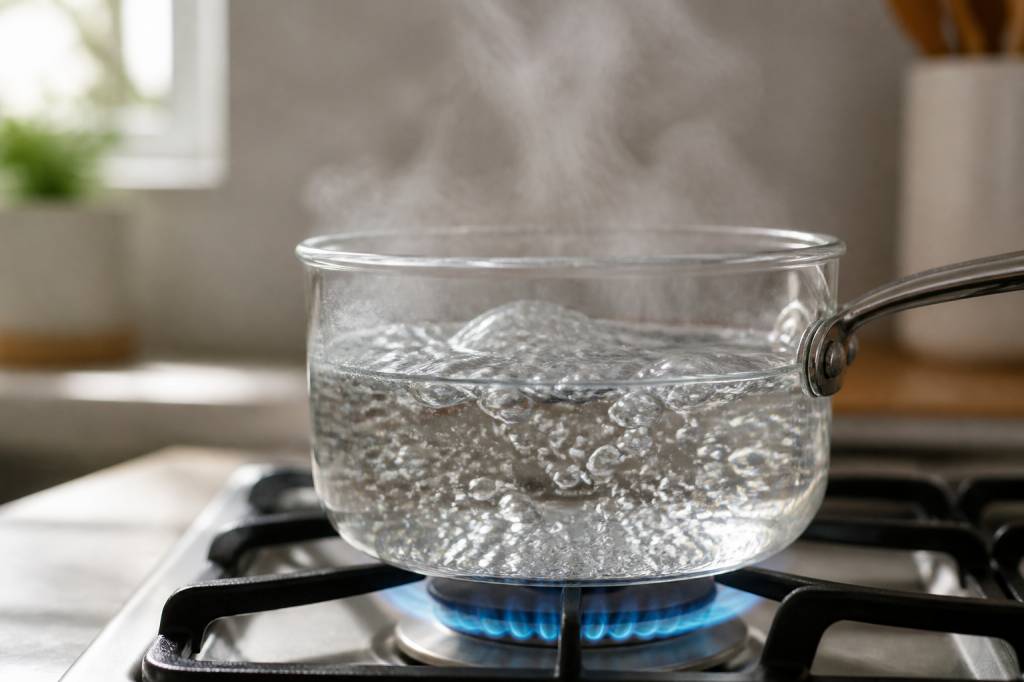
When people hear that their tap water may contain PFAS, one of the first questions is often the most practical one: can you just boil it away? It sounds reasonable. Boiling kills bacteria, so why not chemical contaminants too?
Unfortunately, PFAS do not behave like microbes. These compounds are famously persistent, chemically stable, and resistant to heat in the range of normal household use. In plain terms: boiling water is not an effective way to remove PFAS. In some cases, it can even make the problem worse by reducing the water volume and leaving the PFAS behind in a more concentrated form.
That distinction matters. If you are trying to protect your household, especially in areas where PFAS contamination has been detected, understanding what boiling can and cannot do is essential. Let’s break it down clearly.
What happens to water when you boil it?
Boiling water is useful because it inactivates many disease-causing organisms. Bacteria, viruses, and parasites are vulnerable to heat. That is why boiling is a trusted emergency method in situations where microbiological safety is the main concern.
PFAS are different. They are a family of synthetic chemicals used in products such as non-stick coatings, stain-resistant treatments, firefighting foams, and some industrial processes. Their carbon-fluorine bonds are among the strongest in chemistry, which is one reason these substances are so persistent in the environment and in the human body.
Normal boiling temperatures, around 100°C at sea level, are not enough to break those bonds. So while the water gets hotter, the PFAS remain.
There is another issue too: evaporation removes water, not PFAS. If you boil a pot of contaminated water for a long time, some of the water turns into steam, but the PFAS do not simply disappear with it. The result may be a slightly smaller volume of water with the same amount of PFAS still present, meaning the concentration can increase.
Why boiling does not remove PFAS
The short answer is chemistry. PFAS are not volatile in the way that some other contaminants are. They do not readily evaporate under typical kitchen conditions, and they are not broken down by boiling.
Some people assume “heat equals destruction,” but that is only true for certain types of contaminants. For PFAS, the temperatures needed for significant breakdown are far beyond anything achievable with a domestic kettle or saucepan. Think incineration or specialised industrial treatment, not a rolling boil on the hob.
Here is the key takeaway:
- Boiling can reduce germs.
- Boiling does not effectively remove PFAS.
- Boiling may slightly increase PFAS concentration if enough water evaporates.
That last point is especially important if someone is trying to make contaminated water “safer” by boiling it for tea, coffee, baby formula, or cooking. The heating process does not solve the PFAS problem, and in some cases may make exposure a little worse per sip.
What about cooking with boiled water?
This is where things get less obvious. If you use contaminated water to cook pasta, rice, soups, or vegetables, the PFAS do not vanish just because the pot is simmering. They can remain in the cooking water and may be absorbed by the food.
For foods that absorb a lot of water, such as rice or pasta, the water quality matters. If the water contains PFAS, the contamination can end up in your meal. Boiling, steaming, or simmering will not neutralise the chemical.
That does not mean every home needs to panic about every pot of pasta. But if you live in a known PFAS-affected area, it is worth paying attention to how you use tap water:
- Use treated water for drinking and cooking if possible.
- Do not assume boiling makes tap water PFAS-free.
- Pay special attention to baby formula and infant feeding water.
Infants are more vulnerable because they consume more water relative to body weight and are still developing. For that reason, households with babies should be especially cautious about using untreated tap water where PFAS contamination is a concern.
Can boiling remove any chemicals at all?
It is worth separating PFAS from other contaminants, because this is where confusion often starts. Boiling can help with biological contamination, but it is not a general-purpose purification method.
Some chemicals may be reduced through boiling if they are volatile, but PFAS are not in that category. They are designed to resist breakdown, water, heat, oil, and many forms of chemical degradation. That resilience is one of the reasons they are so useful industrially, and one of the reasons they are such a long-term environmental headache.
So if the goal is specifically to reduce PFAS exposure, boiling is not the answer. It may still be appropriate for emergency disinfection in a microbiological event, but that is a very different issue from chemical contamination.
What methods do work for PFAS in drinking water?
If boiling is not the solution, what is? The most effective household approaches are filtration technologies that physically remove or capture PFAS rather than trying to destroy them.
The three methods most commonly discussed are activated carbon, reverse osmosis, and ion exchange. Each has strengths and limitations.
- Activated carbon: Can reduce some PFAS, especially longer-chain compounds, depending on the filter design and contact time.
- Reverse osmosis: Generally one of the most effective home treatment methods for PFAS removal, because it uses a membrane that blocks many contaminants.
- Ion exchange: Often used in larger systems and can be effective for certain PFAS, though performance depends on system design and water chemistry.
Not all filters are equal. A jug filter from the supermarket may improve taste and reduce chlorine, but that does not automatically mean it is certified for PFAS removal. Always check whether a product has been tested for the contaminants you are trying to reduce.
For households that want reliable reduction, look for systems that have independent certification or test data specifically for PFAS, not just general “water quality” claims. Marketing language can be very optimistic; chemistry is less forgiving.
How to know if your water may contain PFAS
One challenge with PFAS is that you cannot smell them, taste them, or see them. Water that looks crystal clear may still contain measurable levels. That invisibility is part of what makes PFAS such a difficult public health issue.
Possible signs that your area may be affected include:
- Local news reports about PFAS detections in municipal water.
- Nearby industrial sites, airports, military bases, or landfills.
- Public water quality reports mentioning PFAS testing.
- Historical use of firefighting foam in the area.
If you are unsure, check your local water supplier’s consumer confidence report or equivalent water quality publication. In some regions, PFAS monitoring is now routine. In others, testing may be less comprehensive, so local reports and environmental updates matter.
Private well owners should be especially proactive. Unlike municipal systems, wells are the homeowner’s responsibility, and contamination can go unnoticed for a long time. If your well is near a known source of PFAS, testing is a wise move rather than an optional one.
Common myths about boiling water and PFAS
PFAS misinformation spreads easily because people want a simple fix. Let’s clear up a few common assumptions.
Myth: “If I boil water long enough, PFAS will burn off.”
No. Typical boiling temperatures are far below the level needed to break down PFAS.
Myth: “Steam carries PFAS away, so boiling cleans the water.”
Not reliably. The PFAS remain in the water or become more concentrated as the water volume drops.
Myth: “Boiled water is always safe.”
Safe from many pathogens, yes. Safe from PFAS, no.
Myth: “A little PFAS is fine if the water is boiled first.”
Boiling does not reduce PFAS exposure, so it does not make contaminated water safer in that respect.
It is easy to see why these myths persist. Boiling is one of the oldest and most familiar water safety practices. But PFAS require a different response, based on filtration, source control, and regular testing.
What households can do right now
If PFAS are a concern in your area, the most practical steps are straightforward:
- Check whether your local water supply has been tested for PFAS.
- Test private wells if you rely on one.
- Use a PFAS-rated filtration system for drinking and cooking water.
- Do not rely on boiling as a treatment method for PFAS.
- Use filtered water for baby formula and infant food preparation where contamination is suspected.
If you are shopping for a filter, do not just look for “improved taste” or “basic water purification.” Read the technical specifications. The best choice depends on your water source, your budget, and the PFAS profile in your area. In many cases, reverse osmosis provides strong protection at the point of use, while activated carbon can be a useful supplementary option when properly certified and maintained.
Maintenance matters as much as the technology itself. A filter that has reached capacity is not a filter; it is a very expensive placeholder. Replace cartridges on schedule, and follow the manufacturer’s instructions carefully.
Why this issue matters beyond the kitchen
The boiling question is really part of a bigger public health issue. PFAS contamination is not just about one glass of water. It is about cumulative exposure over time from drinking water, food, dust, packaging, and consumer products. Drinking water is one of the most direct and controllable sources, which is why it gets so much attention.
Regulators in many countries are tightening standards, and more communities are testing water supplies than ever before. That is a positive step, but it also means more households are learning that their water is affected. When that happens, people want immediate, practical guidance. “Just boil it” sounds convenient, but it is not scientifically sound for PFAS.
The good news is that there are effective treatment options. The less good news is that they require the right technology, correct installation, and ongoing upkeep. In other words, PFAS are not the sort of contamination you can outsmart with a kettle and optimism.
What to remember if you are worried about PFAS in water
Boiling water is useful for killing microbes, but it does not remove PFAS. In fact, evaporation can leave you with a smaller amount of water containing the same amount of contamination, which may increase concentration.
If PFAS are a concern where you live, focus on verified treatment methods such as reverse osmosis, activated carbon, or ion exchange systems that are specifically designed and certified for PFAS reduction. Check local testing data, especially if you use a private well, and be careful with water used for drinking, cooking, and preparing infant formula.
The most important lesson is simple: not all water problems are solved the same way. Boiling has its place, but PFAS demand a different tool.