

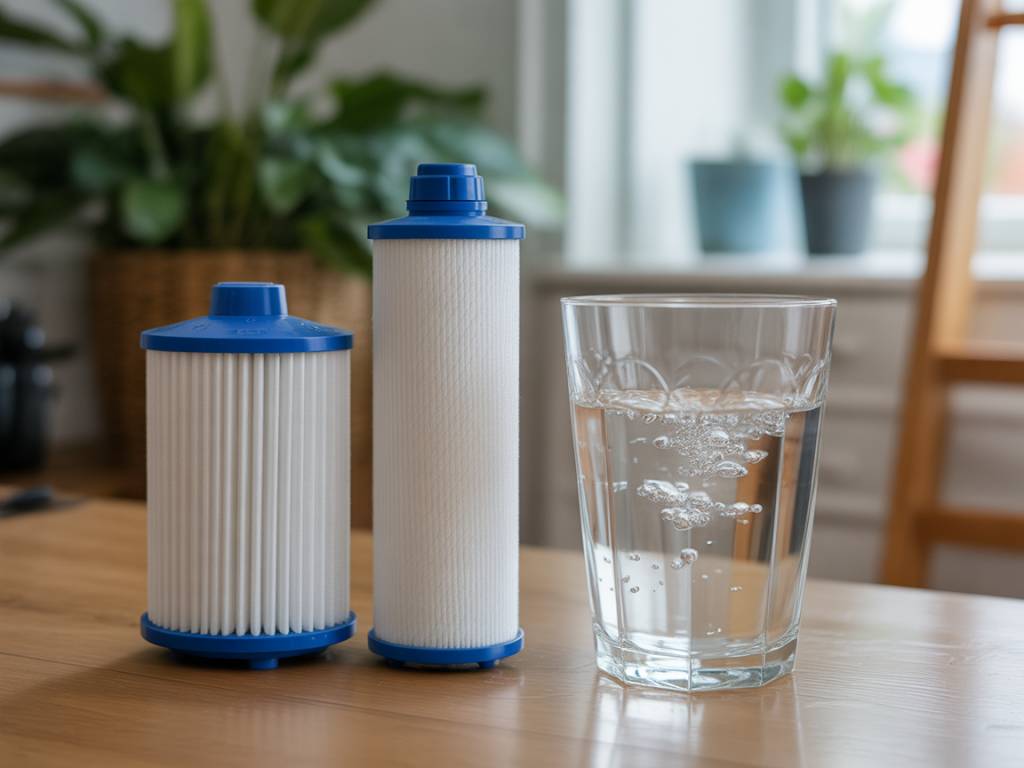
Turn on the tap, fill a glass, take a sip. Most of us repeat this ritual every day without thinking too much about what’s inside that water – or what our filter cartridges are actually doing.
If you’re using a water filter jug, an under-sink system or a whole-house unit, the cartridge inside is doing the heavy lifting. But cartridges aren’t all created equal. Some will improve taste and odour but barely touch PFAS. Others can significantly reduce a broad range of contaminants – if they’re installed correctly and replaced on time.
This guide unpacks the main types of water filter cartridges, how long they really last, and how to choose the right one for your home, especially if you’re concerned about “forever chemicals” like PFAS.
What a water filter cartridge actually does
A filter cartridge is a replaceable component that sits inside a housing and forces water through one or more treatment media. Its job is to remove, reduce or retain specific contaminants – from sediment and rust to chlorine, pesticides, PFAS and heavy metals.
Most cartridges target one or more of these goals:
- Protect equipment (removing grit, sand, scale that damage appliances and plumbing)
- Improve aesthetics (better taste, less chlorine smell, clearer water)
- Reduce health risks (cutting down on chemicals, metals, microbes, PFAS and other emerging contaminants)
The key is understanding which of these your current cartridge is designed for – and whether that matches your actual needs.
Main types of water filter cartridges
Cartridges are often combined in multi-stage systems, but each type has its own job, strengths and limits. Here are the main categories you’ll encounter.
Sediment cartridges
Sediment filters are the “pre-filter workhorses” of many systems. They physically strain out particles like sand, rust, silt and organic debris.
Common types include:
- Spun or melt-blown polypropylene: Layers of fibres that capture particles of different sizes as water passes through.
- Pleated filters: Folded material (often polyester) with a high surface area, good for higher flow rates and longer life.
- String-wound filters: Thread wrapped around a core, often used for well water with visible sediment.
They’re rated in microns (µm) – a measure of particle size. For example:
- 20–50 µm: Coarse filtration (visible grit, sand)
- 5–10 µm: Finer sediment, rust, some turbidity
- 1 µm or less: Very fine particles, sometimes used prior to sensitive filters like reverse osmosis
What they remove: Only physical particles. They do not remove PFAS, chlorine, dissolved metals or most chemicals.
Where they fit: As a first stage in under-sink, whole-house and well-water systems, protecting more specialised cartridges downstream.
Activated carbon cartridges
Activated carbon is one of the most common filter media in domestic systems. It’s made from materials like coconut shell, coal or wood, processed to create a huge internal surface area packed with microscopic pores.
Contaminants are removed primarily by adsorption (they stick to the carbon surface), and sometimes by catalytic reactions.
You’ll see two main designs:
- Granular activated carbon (GAC): Loose granules packed into a cartridge. Good contact but more risk of “channeling” (water finding paths of least resistance).
- Carbon block: Carbon powder compressed into a solid block, often with a fine pore size. Better control of flow paths and more consistent performance.
What they can reduce (depending on design and certification):
- Chlorine, chloramine and associated by-products
- Certain pesticides and herbicides
- Volatile organic compounds (VOCs)
- Some PFAS, especially long-chain compounds (with properly engineered carbon blocks)
- Taste and odour issues
What they generally don’t remove well on their own:
- Hardness (limescale)
- Most dissolved inorganic contaminants (e.g., nitrates, fluoride)
- Some short-chain PFAS, unless specifically designed and tested
For PFAS, the details matter: pore size, carbon type, contact time, and whether the cartridge has independent performance data. Many simple jug filters use small amounts of granular carbon more for taste than for robust contaminant removal.
Ion exchange cartridges
Ion exchange resins are tiny beads that swap ions in the water (like calcium, magnesium, lead) with more benign ions (often sodium or hydrogen).
Common domestic uses include:
- Water softening (swapping hardness minerals for sodium)
- Heavy metal reduction (targeting lead, copper, etc.)
- Specialised PFAS-selective resins in advanced systems
Standard ion exchange cartridges in jugs and under-sink filters often combine resin with carbon to tackle both hardness and taste.
For PFAS, generic softening resins aren’t enough. However, some advanced systems use PFAS-targeted ion exchange resins that have shown strong removal performance in studies and real-world applications, including for shorter-chain PFAS that can slip past some carbon filters.
Always look for:
- Clear identification of which PFAS compounds are targeted
- Independent lab testing or certification where available
- Stated capacity and change-out schedule under realistic conditions
Reverse osmosis (RO) cartridges and membranes
Reverse osmosis is a pressure-driven process that pushes water through a semi-permeable membrane, rejecting many dissolved substances. RO systems are typically multi-stage units that include sediment and carbon pre-filters, an RO membrane, and often a post-filter.
Technically, the core membrane is not a “cartridge” in the same sense as a simple carbon filter, but in home systems it is packaged and replaced in a similar way.
RO can significantly reduce:
- Salts and dissolved solids
- Many heavy metals
- Nitrates, fluoride, arsenic (depending on system design)
- Many PFAS compounds – studies indicate high rejection rates for several common PFAS, especially with well-maintained membranes
However:
- RO systems require sufficient pressure
- They produce a waste stream (reject water)
- They usually treat only one tap (point-of-use), not the whole house
For households in PFAS-affected areas, RO combined with good carbon pre-filtration is one of the more robust options currently available at domestic scale.
Specialised media cartridges
Beyond the common categories, some cartridges use specialised media to target specific issues:
- KDF (copper-zinc alloy) for reducing chlorine, some metals and controlling microbial growth
- Media for iron and manganese where these cause staining or taste problems
- Certified lead reduction media in areas with legacy lead plumbing
- Dedicated PFAS media (often advanced ion exchange or engineered carbon) in high-contamination scenarios
These are typically used as part of a multi-stage system, not as standalone fixes for complex contamination profiles.
How long do water filter cartridges really last?
Manufacturers often print an attractive lifespan on the box – “6 months”, “1 year”, “2,000 litres”. The reality is more nuanced.
Cartridge life depends on:
- Water quality: High sediment, high organic load, or high contaminant levels will exhaust media faster.
- Water volume: Larger households and heavy usage reduce lifespan.
- Flow rate: Pushing water through too quickly can reduce effectiveness even if the cartridge isn’t “full” yet.
- Media type: Carbon that targets organic chemicals can saturate long before it clogs; sediment filters usually fail by clogging.
Some practical benchmarks (very general, always check the specific product):
- Pitcher/jug cartridges: Often 1–2 months or 100–200 litres.
- Under-sink carbon blocks: Typically 6–12 months, depending on capacity and usage.
- Sediment pre-filters: Anywhere from 1–3 months in challenging water to 6–12 months in cleaner supplies.
- RO membranes: Often 2–5 years if pre-filters are maintained and feed water is within design parameters.
For health-related contaminants like PFAS, relying purely on taste or flow changes is risky. A carbon filter can still deliver water that tastes fine long after its capacity for PFAS has been exceeded.
Signs it’s time to replace (or at least investigate):
- Noticeable drop in flow rate or pressure
- Return of chlorine taste/odour (for carbon filters)
- Visible discolouration of sediment filters
- Manufacturer’s recommended time or volume reached – especially important for chemical and PFAS reduction
Can old cartridges make water worse?
They can – in specific ways:
- Breakthrough: Once media is saturated (for example with PFAS or pesticides), contaminants simply pass straight through at original or increasing levels.
- Desorption: Under some conditions, previously adsorbed contaminants can be released back into the water. This is complex and media-specific but another reason not to overrun cartridges.
- Microbial growth: Stagnant water in or around old carbon cartridges can allow biofilms to develop, which may affect taste, odour and hygiene.
In other words: “It’s still flowing so it must still be working” is a poor rule. For chemical contaminants, time and capacity matter more than flow.
How to choose the right cartridge for your needs
Before buying a replacement cartridge – or a whole new filter system – it helps to step back and ask a few key questions.
1. What’s actually in your water?
Everything rests on this. Without data, you’re guessing.
- Check your water provider’s report if you’re on mains supply. In some regions, PFAS data is now included in public water quality reports.
- Consider independent testing for private wells or if you suspect specific contaminants (PFAS, lead, nitrates, etc.). Look for accredited labs and request a panel relevant to your area.
- Look for regional PFAS information from environmental agencies, universities or NGOs, which may highlight hotspots or typical compounds found locally.
Taste and odour alone are poor indicators. Many PFAS compounds have no smell, no taste, and are present at very low (but still concerning) concentrations.
2. What are your priorities?
Different households have different goals. Common priorities include:
- Health protection: Reducing PFAS, lead, nitrates, pathogens or other harmful contaminants.
- Aesthetic improvement: Better taste, no chlorine smell, clearer water.
- Plumbing and appliance protection: Reducing scale, sediment and corrosion.
- Practicality: Ease of maintenance, cartridge cost, environmental footprint.
Being clear about your top two or three priorities helps avoid overbuying in some areas and under-protecting in others.
3. Do you need point-of-use or whole-house treatment?
Point-of-use (POU) systems filter water at a specific tap (usually kitchen sink) or device (like a jug or countertop unit).
- Best for drinking and cooking water.
- More cost-effective for advanced treatment like RO or PFAS-targeting filters.
- Doesn’t address contaminants in shower water, laundry or other taps.
Point-of-entry (POE) / whole-house systems treat water as it enters the building.
- Protects plumbing, appliances and all taps.
- Useful for sediment, hardness, iron, manganese, general organics.
- PFAS-specific whole-house options exist but require careful design and professional installation; maintenance costs can be higher.
For many households, a realistic compromise is:
- A basic whole-house system for sediment and perhaps chlorine; and
- A high-performance POU system (carbon block, PFAS-selective media, or RO) for drinking and cooking water.
4. What performance claims are backed by evidence?
Filter packaging can be enthusiastic. Look for:
- Specific contaminant lists (e.g., “reduces PFOA and PFOS by at least X% at Y litres”), not vague phrases like “filters out harmful chemicals”.
- Independent certifications where applicable (for example, NSF/ANSI standards). For PFAS, some standards and protocols are emerging, but not all products will have formal certification yet.
- Test reports from accredited labs if no formal certification is available. Be wary of internal, non-transparent data.
For PFAS specifically, note which compounds have been tested. PFAS is a large family; good performance on one (e.g. PFOA) doesn’t automatically mean the same for all others, especially shorter-chain variants.
5. Are replacement cartridges affordable and available?
A high-spec system is only as good as the user’s ability to maintain it.
- Check cartridge cost before committing to a system – especially the main contaminant-removal stages.
- Confirm availability from multiple suppliers if possible, so you’re not locked into a single source.
- Be realistic about replacement intervals. If you know you’re unlikely to change a cartridge every 6 months, choose one with longer life or a clear reminder system.
Why PFAS need special attention
PFAS (per- and polyfluoroalkyl substances) are persistent, mobile and biologically active at very low concentrations. Many have been associated in studies with effects on the immune system, thyroid function, cholesterol levels and certain cancers.
From a filtration perspective, PFAS are challenging because:
- The family is large and chemically diverse.
- Some are more easily captured by carbon or RO membranes than others.
- They are often present at ng/L (parts-per-trillion) levels, requiring high performance and good monitoring.
When evaluating cartridges or systems for PFAS:
- Look for explicit PFAS performance data, ideally listing specific compounds and reduction percentages.
- Understand capacity: How many litres can be treated before significant breakthrough is expected?
- Maintain conservative replacement schedules. For PFAS, it’s better to replace early than late.
- Consider combination technologies, such as carbon plus RO, or carbon plus PFAS-selective ion exchange.
For households in or near known contamination areas, speaking with a qualified water treatment professional and reviewing local guidance can help ensure the system and cartridges selected are appropriate for the actual PFAS profile.
Practical steps you can take this week
To turn information into action, a few simple steps can make your filtration more effective:
- Check the label on your current cartridge. What type is it? What contaminants does it claim to address? Does PFAS appear anywhere in the documentation?
- Find out when you last replaced it. If you can’t remember, it’s probably time.
- Look up your local water quality report. Note any mention of PFAS, nitrates, lead, or other contaminants of concern.
- Plan a replacement schedule (even just in your phone calendar) for key cartridges, especially those targeting health-related contaminants.
li>Make a short list of priorities: for example, “PFAS reduction + better taste + realistic yearly budget”. Use this to guide future purchases.
Cartridges may be small components, but they sit at a critical intersection between environmental contamination and everyday health. Understanding how they work, when they fail, and what they can (and cannot) remove is one of the most practical steps you can take to protect your household from PFAS and other unwanted substances in drinking water.