


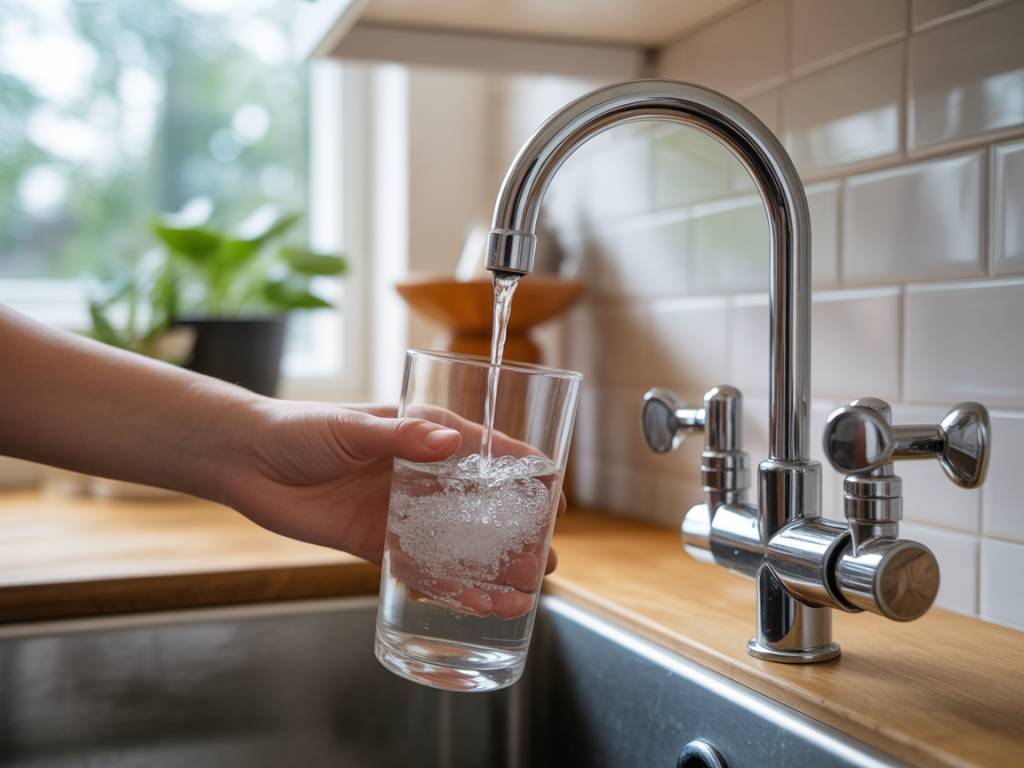
Reverse osmosis (RO) has quietly moved from industrial plants and laboratories into domestic kitchens. If you’re worried about PFAS, nitrates, or simply the long list of “emerging contaminants” in UK tap water, a 5-stage RO system is one of the most effective point-of-use options currently available to households.
But what does “5-stage” actually mean? Does it really make your drinking water safer, or is it just another layer of marketing jargon? And where does PFAS fit into the picture?
This article unpacks how a 5-stage reverse osmosis system works, what it can and can’t remove (including PFAS), and how to decide if it’s the right choice for your home.
What is a 5-stage reverse osmosis system?
Reverse osmosis is a filtration process that forces water through a semi-permeable membrane at high pressure. The membrane’s pores are so small (typically around 0.0001 microns) that many dissolved contaminants are rejected and flushed to waste, while relatively pure water passes through.
In a domestic 5-stage system, the RO membrane is supported by a series of pre- and post-filters. “5-stage” usually means water passes through:
- one or two sediment filters,
- one or two activated carbon filters,
- the RO membrane itself,
- and often a final polishing or taste-improving filter.
The exact order can vary by brand, but the principle is the same: each stage deals with specific contaminants so the membrane can focus on what it does best—removing dissolved solids and many chemical pollutants.
Typical configuration of a 5-stage RO system
To understand how this helps with safety, especially regarding PFAS, it’s useful to walk through a common 5-stage layout from tap to glass.
Stage 1 – Sediment pre-filter
This is usually a polypropylene filter that removes larger particles:
- sand
- rust
- pipe scale
- other suspended solids
Why it matters: sediment doesn’t just look unappealing; it can clog the finer filters and the RO membrane, shortening their lifespan. Removing these particles also reduces the risk of biofilm development inside the system.
Stage 2 – Granular activated carbon (GAC) filter
Here, water encounters a bed of activated carbon granules. This stage typically targets:
- chlorine and chloramines (commonly used for disinfection),
- some volatile organic compounds (VOCs),
- certain pesticides and industrial chemicals,
- odours and off-tastes.
Why it matters: chlorine can damage RO membranes. Removing it protects the system and improves taste. Some PFAS species can weakly adsorb to activated carbon, but contact time and carbon quality are critical, and GAC alone is not a reliable PFAS solution.
Stage 3 – Carbon block filter
This is another carbon stage, but in a more compact “block” form. The denser structure provides longer contact time and better contaminant removal for:
- remaining chlorine/chloramine,
- more stubborn organic chemicals,
- micro-pollutants at low concentrations.
Why it matters: this stage refines what Stage 2 started. It also helps reduce the load on the RO membrane by taking out more organic molecules that could otherwise foul it.
Stage 4 – Reverse osmosis membrane
This is the core of the system. Under pressure, water is forced across a semi-permeable membrane. Many contaminants are rejected, including:
- dissolved salts (reducing total dissolved solids, or TDS),
- heavy metals (e.g. lead, arsenic, chromium),
- fluoride, nitrate, and sulphate,
- many pharmaceuticals and industrial chemicals,
- a substantial fraction of PFAS compounds.
Why it matters: most of the safety benefit of RO comes from this stage. However, performance depends on membrane quality, system design, and maintenance. Laboratory studies consistently show that well-functioning RO membranes can remove a high percentage of long-chain PFAS (like PFOA and PFOS) and a significant proportion of many short-chain PFAS, although removal is rarely 100%.
Stage 5 – Post-carbon “polishing” filter
The final stage is often a small inline carbon filter. Its role is less about safety and more about fine-tuning:
- improves taste and odour of the stored RO water,
- removes any residual volatile compounds picked up in the storage tank or lines.
Why it matters: people are more likely to use a system consistently if the water tastes good. From a risk-reduction perspective, habitual use is just as important as the technical performance on paper.
How effective is a 5-stage RO system against PFAS?
PFAS (per- and polyfluoroalkyl substances) present a particular challenge: many are water-soluble, persistent, and present at very low concentrations. No domestic system can promise complete elimination, so the key questions are: how much reduction is realistic, and what factors influence it?
Based on available research, a well-designed and properly maintained RO system can often achieve PFAS reductions in the range of 90–99% for many common compounds. For example, studies on PFOA and PFOS regularly report removal rates above 95% with intact, non-fouled membranes.
Several factors can affect this performance:
- PFAS chain length: long-chain PFAS (like PFOS, PFOA) tend to be removed more effectively than short-chain alternatives (such as PFBA, PFBS). Short-chain PFAS are smaller and more mobile, making them harder to reject.
- Membrane condition: aging, fouling or physical damage can create pathways for contaminants to pass. Regular maintenance and timely replacement are non-negotiable if you care about PFAS.
- Water pressure: insufficient pressure can reduce rejection efficiency. Most under-sink systems need at least 3–4 bar (around 45–60 psi) to perform well; some use booster pumps to maintain this.
- Temperature: higher water temperatures can slightly decrease rejection for certain compounds, although in UK domestic settings this is rarely the dominant factor.
Crucially, RO systems are typically validated using data like TDS reduction, not PFAS specifically. If PFAS are your primary concern, look for systems that provide independent test results (ideally from accredited laboratories) showing performance on key PFAS compounds at realistic concentrations.
What else does a 5-stage RO system remove?
Even if PFAS is your main motivation, RO systems offer broader protection by significantly reducing:
- Heavy metals: lead, mercury, cadmium, arsenic.
- Inorganic contaminants: nitrate, nitrite, fluoride, bromide, sulphate.
- Disinfection by-products (DBPs): such as trihalomethanes (THMs) formed when chlorine reacts with natural organic matter.
- Micro-pollutants: traces of pharmaceuticals, hormones, and industrial chemicals.
- Salinity and hardness: lowering TDS and limescale-forming minerals.
However, some limitations are worth noting:
- Microplastics and particulates are largely removed by the sediment and carbon stages (and by the RO membrane), but effectiveness depends on particle size.
- Microorganisms (bacteria, viruses) can be significantly reduced by RO, but most domestic systems are not certified as microbiological purifiers. If your source water is microbiologically unsafe, additional disinfection (e.g. UV) is necessary.
- Very volatile compounds (certain solvents) may pass through if they do not interact strongly with carbon and are small enough for the membrane. This is one reason carbon stages before and after the membrane are important.
Trade-offs: minerals, taste and waste water
RO is powerful, but it comes with trade-offs that are worth considering before installing a 5-stage system.
Mineral removal
RO does not “know” which dissolved ions are “good” and which are “bad.” Calcium, magnesium, and other beneficial minerals are reduced along with contaminants. This leads to:
- very low TDS water, sometimes described as “flat” or “bland” in taste,
- lower alkalinity and buffering capacity.
From a health perspective, most people in the UK obtain the majority of their minerals from food, not water, and the evidence that mineral-rich water is essential is mixed. However, if you prefer the taste or buffering of mineralised water, you can:
- choose an RO system with a remineralisation cartridge (often adding calcium and magnesium), or
- mix a small proportion of untreated tap water back in for cooking (while keeping pure RO water for direct drinking or baby formula).
Waste water (“reject water”)
RO systems create a waste stream carrying the concentrated contaminants. Domestic units typically discharge 1–4 litres of waste water for every litre of treated water produced, depending on design and conditions.
For environmentally conscious households, this can feel counterintuitive. However, consider two points:
- The absolute volume is usually modest because RO is used at a single tap, not for all household water.
- Waste water can often be repurposed for toilet flushing, cleaning floors, or certain outdoor uses (avoiding sensitive plants, due to the higher salt content).
Higher-efficiency systems and permeate-pump designs can further reduce the waste ratio, though usually at higher upfront cost.
Installation options: under-sink vs countertop
Most 5-stage RO systems come in two forms:
Under-sink systems
These are plumbed into the cold-water supply under the kitchen sink and typically include:
- a separate dedicated drinking-water tap,
- a storage tank (commonly 6–12 litres),
- fixed cartridges for each stage.
Pros:
- clean look—most components hidden in the cupboard,
- higher production rate and storage, suitable for families,
- potential for add-ons like remineralisation or UV.
Cons:
- requires plumbing modifications,
- takes up under-sink space,
- installation may need a professional, especially in rented homes with restrictions.
Countertop systems
These sit on the worktop and connect to the tap via an adapter or have their own reservoir.
Pros:
- no permanent plumbing changes,
- portable—can be moved or taken to a new home,
- good option for tenants or for testing RO before committing.
Cons:
- bulkier presence on the counter,
- usually lower flow rate and smaller internal tanks,
- may involve more user interaction (filling or connecting).
Functionally, both can host a 5-stage setup. The choice is mostly about lifestyle, kitchen layout, and whether you’re comfortable modifying existing plumbing.
Maintenance: the non-negotiable factor for safety
Neglecting maintenance is the fastest way to degrade the performance of any RO system, especially for PFAS and other persistent contaminants that require high membrane integrity.
Typical schedules (always check manufacturer guidance) are:
- Sediment filter: every 6–12 months.
- Carbon pre-filters (GAC and block): every 6–12 months.
- RO membrane: every 2–5 years, depending on water quality, usage, and pre-filter care.
- Post-carbon polishing filter: every 12 months.
Warning signs that maintenance is overdue include:
- noticeably slower flow from the RO tap,
- change in taste or odour,
- visible discoloration in sediment filters,
- rising TDS in the treated water (a cheap TDS meter is useful here).
While TDS is not a direct measure of PFAS, a sudden drop in overall rejection (seen as rising TDS in the product water relative to feed water) can indicate membrane damage or bypass—both of which would likely reduce PFAS removal as well.
How to choose a 5-stage RO system if you’re PFAS-conscious
With many products on the market, selection can feel like guesswork. A few targeted questions help cut through the noise:
- Is there third-party testing? Look for independent lab data specifically on PFAS (e.g. PFOA, PFOS, PFHxS, PFBS, GenX) rather than generic claims about “forever chemicals.”
- What certifications are held? In Europe, equivalent or recognised standards to NSF/ANSI (such as 42, 53, 58) can provide some reassurance about contaminant reduction claims and material safety, even if PFAS is not yet fully integrated into those standards.
- Can you access replacement filters easily in the UK? A high-performance system is only as good as your ability to keep it maintained with genuine parts.
- What is the waste water ratio? Check the stated recovery rate (how much treated water vs waste) and decide if it aligns with your environmental priorities.
- Does it include remineralisation? If taste is important and you dislike very low TDS water, a built-in remineralisation cartridge can improve long-term user acceptance.
It’s also worth aligning the system to your local water issues. If you’re on a private well with elevated nitrate, or in an area with known legacy PFAS contamination, the additional protection of RO may carry more weight than for households on relatively low-contaminant municipal supplies.
Is a 5-stage RO system the right choice for every home?
Not necessarily. For some households, a high-quality activated carbon system, possibly combined with specialised PFAS media, may provide adequate risk reduction with less complexity and water waste. Others may prefer whole-house filtration combined with a simpler point-of-use system at the kitchen tap.
However, if your priorities include:
- maximum contaminant reduction at the tap,
- significant PFAS reduction based on current technology,
- protection against a wide range of known and emerging pollutants,
then a 5-stage reverse osmosis system is one of the most robust tools currently available at the household scale.
RO will not fix upstream pollution, outdated regulations, or the slow pace of PFAS phase-outs. But in the meantime, it gives you a tangible, measurable way to reduce your family’s exposure at home—one glass of water at a time.